Lifestyle
What Is Retrieval-Augmented Generation (RAG)? Answers with Verifiable Evidence
Retrieval-augmented generation retrieves relevant external content for a language model to compose an answer. Using Q&A on event registration rules, this article explains indexing, retrieval, generation and source checking, compares it with search and fine-tuning, and shows why cited answers can still be wrong. Learn to distinguish outdated data, missing documents and overinterpreted evidence, and when to retain “I don't know.”
About 8 min read
Contents
Retrieval-Augmented Generation, usually abbreviated as RAG, connects external information retrieval to text generation. A model could not have read the event rules you revised yesterday during its training. But if the system first finds those rules, the model can answer based on the retrieved text. Here, external information provides the basis for the current answer; it does not first have to become model parametersWhat Are Model Parameters?Model parameters are values adjusted during training to map inputs to outputs, such as weights and biases. Simple equations show how they affect predictions and distinguish them from training hyperparameters, prompts and generation settings. Learn why parameter count, numerical precision and active parameters are different metrics, how to read model specs, why more parameters do not mean more individual facts, and why each chat does not mean retraining the model.Read the full article. This allows information updates and model training to be handled separately, while also giving readers a way to trace an answer's sources.
To judge whether a RAG system is useful, you cannot simply look at how fluently it answers or how many citations it lists. The real questions are whether the necessary provisions entered the context the model could see, and whether important qualifications in the answer can be traced back to the source. This article demonstrates the process using fictional community course registration rules. Both the rules and the expected results are teaching examples, not the policies of any real organization. Readers can use the same approach to check Q&A systems for company knowledge bases, product manuals or personal notes.
A Way to Combine Components, Not a Database
Lewis et al.'s original paper combined the parametric memory of a pretrainedPretraining: Where a Model's Foundational Abilities Come FromPretraining lets models learn reusable representations and patterns from large datasets before task-specific adaptation. Examples of next-token prediction and masked-content recovery explain data, objectives and parameter updates. We distinguish pretraining, fine-tuning and context supplied at use, and why learning text does not mean recalling sources or ensuring factual accuracy. Learn the origins of base-model abilities and the effects of training data quality and evaluation contamination.Read the full article language model with the nonparametric memory of an external document index, and studied trainable retrieval and generation architectures. Today's developer documentation uses RAG more broadly, often referring to an application workflow that retrieves content and then places it in a prompt. These systems do not necessarily reproduce the original paper's joint training. Even when the name is the same, you still need to check where the information comes from and whether the retriever changes through training.
Search tools usually deliver document lists or excerpts, while RAG adds a step that composes an answer from those excerpts. Vector databases are just one possible component for storage and similarity queries; full-text indexes and structured queries can also handle retrieval. Questions containing exact course codes may not be well served by semantic similarity alone. Vector search without answer generation is still search. Using vectors alone does not make a system a complete RAG system.
How Information Reaches the Answer
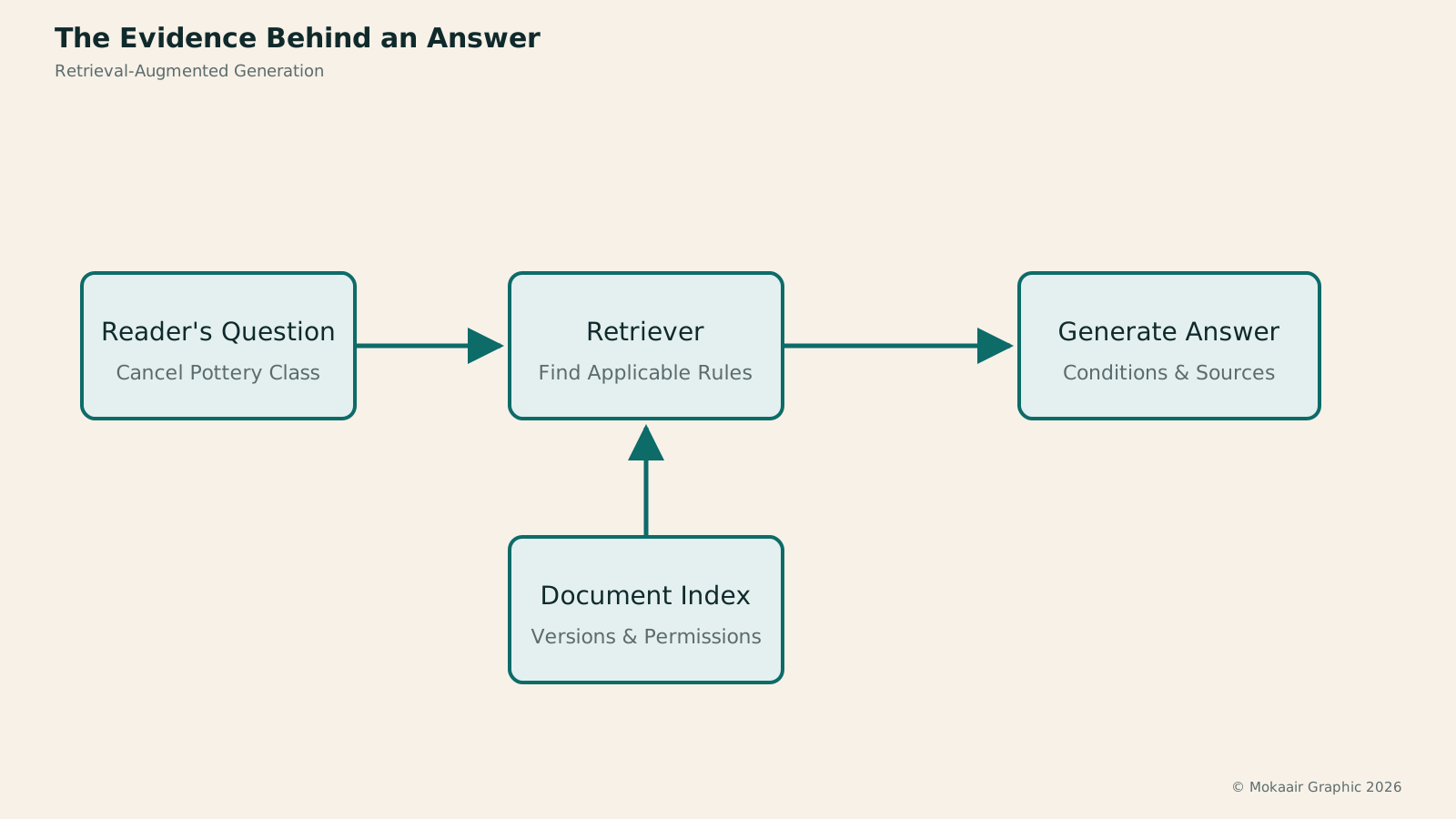
During data preparation, the system parses source files, splits them into retrievable passages, preserves document identifiers, sections, versions and permissions, and then builds an index. When a question arrives, the retriever converts it into a query, retrieves candidate passages, and reranks them or fetches additional context if necessary. The model receives the question together with the selected evidence, then produces a natural-language answer. Whether one service performs all these steps does not change their conceptual division of responsibilities.
Refund provisions should enter the index together with the applicable courses and effective dates. If the system stores only “refunds are available” but loses the deadline conditions in the next paragraph, apparently successful retrieval can still lead to a wrong answer. Citation links should ideally point to the actual passage. If they lead only to the document's opening page, readers must still search through lengthy content for the evidence. Version updates must also remove old passages from the applicable scope, rather than merely adding the new version and letting old and new rules compete in search rankings.
Read the full description
A question enters the retriever; a document index supplies applicable passages, which the model uses to produce an answer with conditions and sources.
Example: A Refund Question with Conditions
Suppose the input is: “I enrolled in the weekend pottery class. Can I get a full refund if I cancel before it starts?” The data contains general refund rules, exceptions for material fees and announced revisions. The process first identifies the pottery class's category, checks how the general rules handle cancellations before the course starts, then retrieves additional information on whether fees are deducted when materials have already been purchased. The output should distinguish what is certain, the exceptions and the missing information. For example, it might explain that the course fee may be refundable, but the material fee still depends on checking the purchase status, and cite the corresponding provisions.
A good answer does not necessarily give an immediate “yes” or “no.” If the index contains only the general rules, the system should state that it lacks sufficient information, rather than treating failure to find exceptions as proof that none exist. You can first give the model the correct provisions directly: if it then answers correctly, the original problem was probably in retrieval. If it still overlooks the material fee, check the instructions, context ordering or answer validation. This layered approach makes it easier to identify the cause than repeatedly switching models.
Now design a variation: the reader asks about an old course that has been discontinued. The system should identify the course version and look up the rules that applied at the time. If the index retains only the current version, it should explain that the available information cannot answer the historical case. It must not use the latest documents to answer questions about every year, or overlook the applicable period simply because the wording is highly similar. This test can expose problems that text similarity alone struggles to reveal.
Answers Can Be Wrong Even with Sources
RAG improves the chances of obtaining evidence; it does not turn a generator into an infallible citation machine. Documents may be outdated, contradictory or simply wrong. Similarity queries may also rank another course with a similar name ahead of the relevant one. A model may cite genuine text yet draw conclusions the source does not support. You therefore need to assess separately whether all relevant information was retrieved and whether the answer is faithful to that information. Neither measure can substitute for the other.
Permissions are also part of retrieval quality. If ordinary participants may only view public rules, the system must not first retrieve internal case records and then expect the model to withhold them on its own. A more reliable design restricts the query scope according to the reader's identity and treats retrieved text as content to analyze. A sentence in a document that asks the system to ignore rules does not have the authority to redefine the task. Source reliability, the user's permission to view the content and the text's relevance are separate checks.
When RAG Is Worth Using and How to Evaluate It
RAG is often a suitable starting point when information is continually updated, answers need sources, or the same model must serve multiple data collections. If the requirement is to follow a format consistently or learn a distinctive tone, fine-tuning may address the problem more directly; the two approaches can also be combined. If the information occupies only one short page, providing the whole page as context may be enough, without a full indexing service. Engineering complexity should be considered alongside data scale, update requirements and access permissions.
When importing the data, first prepare a set of common questions whose answers can be verified against the source text. Also include cases requiring information across sections, interference from old versions and questions the data does not cover. Check which passages each question retrieves, which sentences in the answer have supporting evidence, and whether the system openly stops when information is missing. Then record response times and how soon document updates become searchable. Evaluation records should retain the questions, document versions and citation locations so that the same comparisons can be repeated after future model or index updates.
| Method | Main Focus | What to Watch For |
|---|---|---|
| Direct search | Deliver documents or excerpts | Readers assemble the answer themselves |
| RAG | Retrieve evidence, then generate an answer | Retrieval and citations still require verification |
| Fine-tuning | Train behavior or capabilities | Does not equate to real-time data updates |
Document Chunking: How Long Should Chunks Be to Keep Answers Intact?
Reranking: From Finding Results to Putting Good Answers FirstReranking: From Finding Results to Putting Good Answers FirstReranking reassesses first-pass search candidates for relevance and is often used to improve search lists and RAG context quality. Using library loan rules, this article shows how retrievers and cross-encoders share the work and explains missing candidates, input truncation, and relevance scores versus truth checks. Learn when to broaden retrieval, fix chunks, or add reranking, and use suitable tests to avoid needless waiting for better rankings.Read the full article
Fine-tuning: Making an Existing Model Better Suited to Your TaskFine-tuning: Adapting an Existing Model to Your TaskFine-tuning continues training an existing model to fit a task or domain. Using support email classification, this article covers data preparation, parameter updates, held-out test sets and version deployment; distinguishes full fine-tuning, LoRA, supervised fine-tuning and RAG; and explains why training gains can mask real-world decline. Learn to judge whether fine-tuning is worthwhile and check format consistency, unknown types, data leakage and loss of prior abilities.Read the full article
AI Terms Index: From Loop Engineering to Generative AI
Found this guide helpful? Share it with someone who needs it
Lifestyle
Agentic Retrieval-Augmented Generation (Agentic RAG): When to Search Again
Agentic RAG lets models make retrieval decisions, choosing sources, rewriting queries or searching further based on the question and available evidence. Using a concrete LangGraph workflow and a comparison of venue-use conditions, this article contrasts it with fixed RAG and explains stopping criteria, permissions, query logs and cost control. Learn to judge whether a task needs dynamic exploration or a predictable fixed workflow is enough.
Lifestyle
Graph Retrieval-Augmented Generation (GraphRAG): Understanding a Document Collection Through Relationships
GraphRAG uses entities and relationships in retrieval to answer questions about cross-document connections and overall themes. Drawing on Microsoft's original paper and official docs, this article explains entity extraction, community summaries, and local and global search, using local event records to show why different questions need different paths. It also shows how missing links, mistaken name merges, and distorted summaries affect answers: a pretty graph is not verified fact.
Lifestyle
Knowledge Graphs: Making Entities and Relationships Clear
Knowledge graphs organize entities and relationships to trace who took part in what, where and when through links. Using community events, this article covers entity identity, relationship direction, sources and time; compares Resource Description Framework (RDF) and property graphs; and explains why graphs are not equivalent to visualizations or reliable facts. Learn when to build one and how it works with tables, vector search and graph retrieval-augmented generation (GraphRAG).
Lifestyle
Hybrid Search: Balancing Exact Terms and Meaning
Hybrid search merges full-text, vector and other retrieval results to cover exact codes and natural-language needs. An equipment-manual query explains candidate retrieval, deduplication, rank fusion and reranking, including how Reciprocal Rank Fusion (RRF) merges results by rank. Hybrid search is not always more accurate. Learn to test quality with code, paraphrase and no-answer queries and spot biases from permissions, filters and duplicate content.
Articles that cite this one
- Agentic Retrieval-Augmented Generation (Agentic RAG): When to Search Again
- Graph Retrieval-Augmented Generation (GraphRAG): Understanding a Document Collection Through Relationships
- Knowledge Graphs: Making Entities and Relationships Clear
- Reranking: From Finding Results to Putting Good Answers First
- Semantic Search: Finding Relevant Content Through Different Wording
- What Is Zero-shot Prompting? Start by Defining the Task Clearly
- Fine-tuning: Adapting an Existing Model to Your Task
Sources
- Lewis et al.: Retrieval-Augmented GenerationChecked:
- LangChain: RetrievalChecked:
Compiled from the references and verification dates listed above; fares, schedules, product features, and terms can change, so please confirm the latest details on the relevant official website before travelling, booking, or purchasing.