Lifestyle
What Are Model Parameters?
Model parameters are values adjusted during training to map inputs to outputs, such as weights and biases. Simple equations show how they affect predictions and distinguish them from training hyperparameters, prompts and generation settings. Learn why parameter count, numerical precision and active parameters are different metrics, how to read model specs, why more parameters do not mean more individual facts, and why each chat does not mean retraining the model.
About 7 min read
Contents
Model parameters are numerical values used in a model's internal computations. Many are adjusted during training, such as neural network weights and biases. Together, they determine how the model transforms inputs into outputs. A model's parameter count mainly describes one aspect of its scale. It does not count the individual things it knows or directly measure intelligence.
In software documentation, “parameter” can also broadly refer to request settings, which can cause confusion. Adjusting generation temperature, editing prompts and training weights are different actions. We will first build intuition with a simple, original equation, then explain how to read parameter information for large models. Information verified as of 2026-9-14.
Understanding Weights and Biases Through a Simple Model
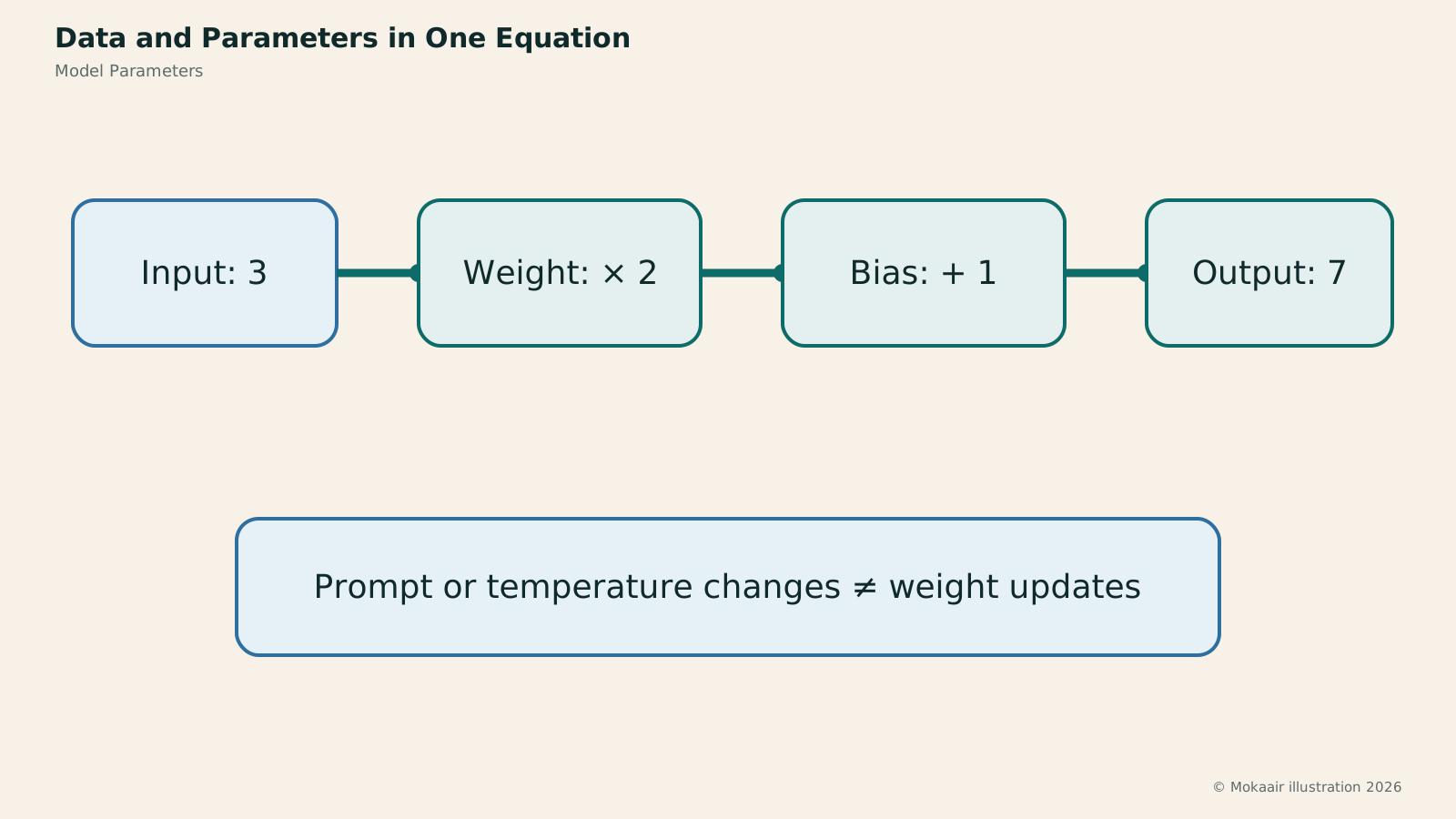
Google's linear regression materials and PyTorch tutorials both explain model computations using weights, biases and parameter updates. Consider an equation used purely for teaching: output equals weight multiplied by input, plus bias. Set the weight to 2 and the bias to 1, and an input of 3 gives 7. These numbers are an original example and do not represent actual product prices, grades or model measurements.
In this small model, the input 3 is data for the current request; the weight 2 and bias 1 are the model parameters. The parameters can remain unchanged when a different input is supplied. Changing the weight, however, may change the result for the same input. This distinction helps explain why seeing new content during each use does not mean the model changes its learned internal values every time.
The parameters in large neural networks are far more complex than this equation. They may be distributed across components such as embeddings, attention and feed-forward networks, stored as matrices or other tensors. Each parameter cannot be labeled as a particular word or fact. Knowledge and capabilities are usually supported jointly by many values and computations; a single parameter rarely has an encyclopedic meaning that can be read directly.
How Training Changes These Values
During training, the model first makes predictions, then a loss function measures the gap between those predictions and the desired results. Backpropagation can calculate the gradients of the loss with respect to the parameters, and an optimization method uses them to update the parameters. This does not directly write the correct answer into a particular slot. Instead, many examples gradually adjust the overall numerical relationships so that errors tend to decrease for the specified objective.
Continuing with the equation example, if the data shows that the original predictions are too low, the training program may adjust the weight or bias. How it adjusts them depends on all the examples, the loss and the optimization settings. A mismatch on one example does not justify arbitrarily changing the model until it gets that example right. If memorizing a single input harms performance on other data, the model loses its ability to generalize to new situations.
Some adaptation methods update only certain parameters while keeping other weights fixed; others add a small number of trainable components. This differs from fully retraining the model. When reading about fine-tuningFine-tuning: Adapting an Existing Model to Your TaskFine-tuning continues training an existing model to fit a task or domain. Using support email classification, this article covers data preparation, parameter updates, held-out test sets and version deployment; distinguishes full fine-tuning, LoRA, supervised fine-tuning and RAG; and explains why training gains can mask real-world decline. Learn to judge whether fine-tuning is worthwhile and check format consistency, unknown types, data leakage and loss of prior abilities.Read the full article methods, check which parameters change, which remain fixed and which cases are used to evaluate the update. Whether a parameter is trainable is part of the configuration and method; not every value necessarily updates at the same time.
Distinguishing Hyperparameters, Prompts and Generation Settings
Training hyperparameters control the learning process, including the learning rate, batch arrangements and certain architectural choices. They are distinct from the set of weights learned directly through those parameter updates, although they can be selected separately through search or other methods. Lowering the learning rate changes how learning happens; updating weights changes the model's own numerical relationships. The two affect different levels.
Prompts and files are inputs for the current request. If you place a set of rules in the context, the model can answer based on them, but this usually does not update its weights. Generation settings affect the output process; for example, some models offer controls for sampling temperature or output length. Google's prompt design documentation also lists these as request settings. Support and recommendations vary by model and should not be treated as universal, fixed rules.
Lowering temperature does not rewrite incorrect facts into correct weights, and increasing output length does not increase model capacity. If the model lacks current information, provide relevant sources. If the output format is inconsistent, check the prompt and structural validation. First identify which level you are changing so that you do not try to solve a problem with an unrelated knob.
Read the full description
Original example: input 3 is multiplied by weight 2, then bias 1 is added, yielding output 7. Below, current input, learned parameters and request settings are distinguished.
Parameter Count and Storage Size Are Different Measures
Parameter count describes the number of numerical values. Storage requirements also depend on each value's precision and format. With the same number of parameters, different numerical representations can produce different file sizes. Quantization changes representation precision without necessarily changing parameter count. A smaller download therefore does not directly imply that the model's architecture has shrunk by the same proportion.
At runtime, caches, intermediate tensors, programs and other resources also require memory. Estimating actual requirements solely from model file size may overlook the effects of long contexts and concurrent requests. For local deployment, review the official model and execution engine requirements, then test with your intended inputs instead of checking only whether the downloaded weights will fit.
Mixture-of-experts models also require distinguishing total parameters from those active for a particular request. All the experts contained in the model and the portion that actually participates in a computation answer different questions. Activating fewer parameters does not make the remaining weights disappear or guarantee faster overall execution. Shared layers, routing and data movement can all affect actual resource use.
Interpreting Scale Through Task Evaluations
More parameters can offer different representational capacity, but quality also depends on data, training, architecture and the task. Two models with similar parameter counts may perform differently in language, format compliance or specific knowledge. Ranking models only by size is like judging a tool's usefulness solely by its number of parts while ignoring what it was designed to do.
When choosing a model to organize notes, test it on the same notes to see whether it preserves negations, dates and unresolved matters, then compare waiting times and device resource use. If a small model already meets your needs reliably, a larger model's extra capacity may not justify the additional cost. If complex situations repeatedly cause failures, making the prompt longer cannot fill every capability gap either.
Model parameters are an important starting point for understanding technical specifications, but a useful reading considers parameter count, precision, activation methods, data and evaluations together. Once you can distinguish “changing the input,” “changing generation settings” and “changing weights,” you can describe problems more accurately and choose suitable improvements more easily, without calling every adjustment training AIWhat Is Artificial Intelligence?AI covers many technologies and uses; it is not synonymous with chatbots and need not generate text. Starting with the OECD system definition, this article uses photo classification and community resource recommendations to link inputs, inference, outputs and human goals, and explains AI's relationship to machine learning, deep learning and generative AI. Learn to ask concrete questions about what an AI feature does and distinguish capability, autonomy and trustworthiness.Read the full article.
| Item | What Changes | Examples |
|---|---|---|
| Model parameters | The model's internal numerical relationships | Weights and biases |
| Training hyperparameters | How the learning procedure is configured | Learning rate |
| Prompts and generation settings | Materials for the current request or output controls | Files, temperature and output length |
What Is Machine Learning?What Is Machine Learning?Machine learning uses data to adjust models to make predictions for unseen inputs or generate content. Breakfast shop prep forecasts show how features, labels, training and testing work together, distinguish supervised, unsupervised and reinforcement learning, and explain the effects of data leakage, overfitting and environmental change. Learn why models need held-out test data and which concrete questions help assess whether a seemingly accurate prediction is trustworthy.Read the full article
What Is a Mixture-of-Experts Model?
Quantization: The Trade-offs of Running Models with Fewer Bits
AI Terms Index: From Loop Engineering to Generative AI
Found this guide helpful? Share it with someone who needs it
Lifestyle
Agentic Retrieval-Augmented Generation (Agentic RAG): When to Search Again
Agentic RAG lets models make retrieval decisions, choosing sources, rewriting queries or searching further based on the question and available evidence. Using a concrete LangGraph workflow and a comparison of venue-use conditions, this article contrasts it with fixed RAG and explains stopping criteria, permissions, query logs and cost control. Learn to judge whether a task needs dynamic exploration or a predictable fixed workflow is enough.
Lifestyle
Graph Retrieval-Augmented Generation (GraphRAG): Understanding a Document Collection Through Relationships
GraphRAG uses entities and relationships in retrieval to answer questions about cross-document connections and overall themes. Drawing on Microsoft's original paper and official docs, this article explains entity extraction, community summaries, and local and global search, using local event records to show why different questions need different paths. It also shows how missing links, mistaken name merges, and distorted summaries affect answers: a pretty graph is not verified fact.
Lifestyle
Knowledge Graphs: Making Entities and Relationships Clear
Knowledge graphs organize entities and relationships to trace who took part in what, where and when through links. Using community events, this article covers entity identity, relationship direction, sources and time; compares Resource Description Framework (RDF) and property graphs; and explains why graphs are not equivalent to visualizations or reliable facts. Learn when to build one and how it works with tables, vector search and graph retrieval-augmented generation (GraphRAG).
Lifestyle
Hybrid Search: Balancing Exact Terms and Meaning
Hybrid search merges full-text, vector and other retrieval results to cover exact codes and natural-language needs. An equipment-manual query explains candidate retrieval, deduplication, rank fusion and reranking, including how Reciprocal Rank Fusion (RRF) merges results by rank. Hybrid search is not always more accurate. Learn to test quality with code, paraphrase and no-answer queries and spot biases from permissions, filters and duplicate content.
Articles that cite this one
- What Is Retrieval-Augmented Generation (RAG)? Answers with Verifiable Evidence
- What Is Few-shot Prompting? Clarifying Formats with Examples
- Fine-tuning: Adapting an Existing Model to Your Task
- What Is a Foundation Model?
- Supervised Fine-Tuning (SFT): Teaching Models Tasks with Good Examples
- Pretraining: Where a Model's Foundational Abilities Come From
- What Is the Transformer Architecture (Transformer)?
- What Is a Neural Network? A Function Built from Layers and Weights That Learns from Data
Sources
- PyTorch: Deep Learning with PyTorchChecked:
- Google: Linear regressionChecked:
- Google: Prompt design strategiesChecked:
- Fedus et al.: Switch TransformersChecked:
Compiled from the references and verification dates listed above; fares, schedules, product features, and terms can change, so please confirm the latest details on the relevant official website before travelling, booking, or purchasing.