Lifestyle
What Is Machine Learning?
Machine learning uses data to adjust models to make predictions for unseen inputs or generate content. Breakfast shop prep forecasts show how features, labels, training and testing work together, distinguish supervised, unsupervised and reinforcement learning, and explain the effects of data leakage, overfitting and environmental change. Learn why models need held-out test data and which concrete questions help assess whether a seemingly accurate prediction is trustworthy.
About 8 min read
Contents
Machine learning uses data to train models to learn relationships useful for making predictions or generating content. Instead of hard-coding every decision rule, developers select the data, model structure and learning objective, then let a training program adjust the model. The real test is whether it can provide useful results in new situations, rather than simply remembering data it has already seen.
A breakfast shop estimating how many portions to prepare for the next day offers an intuitive example. The shop has historical sales, day-of-week, opening-hour and weather data, but tomorrow's actual demand is still unknown. This original scenario illustrates the difference between training and use; it does not provide actual sales forecasts or guarantees. Information fact-checked as of 2026/9/14.
Features and Answers Play Different Roles in Data
Google's introduction to machine learning explains the concept as training models on data to make predictions or generate content. In supervised learning, features are the inputs a model uses to make judgments, while labels are the answers supplied during training. For the breakfast shop, the day of the week and weather can be features, while the actual number of portions sold that day is the label. These roles depend on the task being addressed.
The same data column can play a different role in a different task. When predicting sales, weather is reference information; when predicting rainfall, whether it rains may become the answer. You must define the problem before deciding what to collect. Feeding every spreadsheet column into a model does not automatically tell it which columns are usable or which information does not yet exist at prediction time.
Demand and sales must also be distinguished. If the shop prepares only a small quantity of food and sells out early, recorded sales do not equal the quantity customers actually wanted to buy. A model trained only on those records may mistake a stockout for low demand. This issue with the meaning of data in our original example is a reminder: if a label's business definition is unclear, even a sophisticated algorithm may learn the wrong target.
Training Adjusts the Model; Inference Uses It
During training, a model first makes predictions using its current parameters, then uses a loss function to compare predictions with labels and updates its parameters to reduce a particular kind of error. After training, new day-of-week and available weather information are entered, and the model produces an estimate. This usage stage is called inference. Making a prediction does not necessarily retrain the model; the two processes should be understood separately.
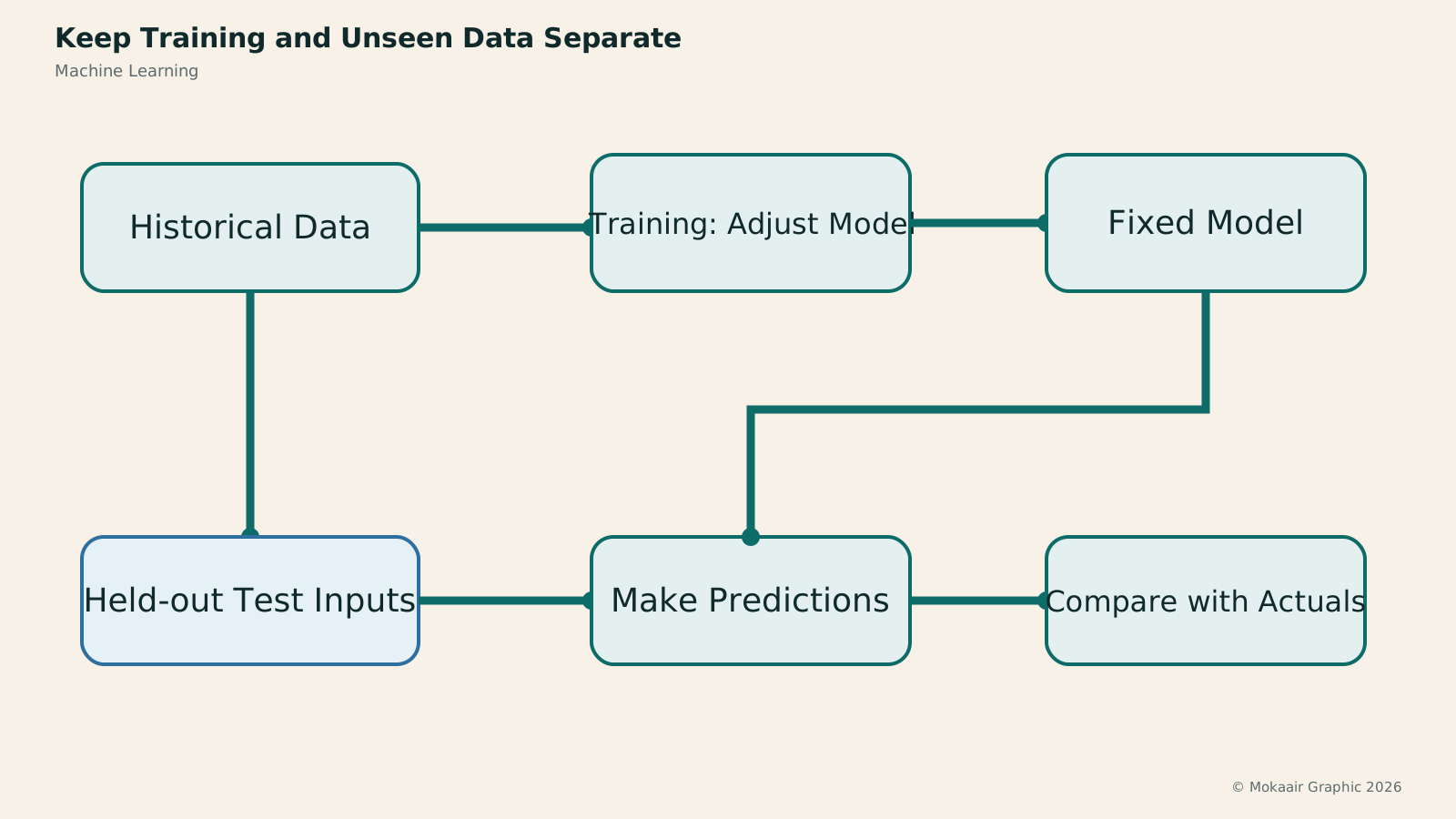
In this example, the model can be trained on earlier data, then tested on later days excluded from training. The expected output is a comparison of each day's estimate with the actual outcome, recording overestimates, underestimates and their consequences. Preparing too little causes stockouts, while preparing too much causes waste. These errors may carry different costs, so the average size of the error may not cover everything the shop cares about.
Simple baselines matter too, such as directly using recent sales from the same day of the week. If a new model does not clearly outperform an understandable baseline but requires substantial maintenance, it may not be worth using. Comparisons should use the same test period and the same available data. Do not let one method see the answers in advance while another must rely only on information available at the time.
Data Leakage Can Make Good Scores Meaningless
The official scikit-learn documentation lists data leakage as a common pitfall: improper handling allows test information to enter training, making evaluations overly optimistic. For the breakfast shop, using a day's checkout total as an input to predict that day's sales may make the model appear highly accurate. Yet that field is unavailable when preparation decisions are made the previous evening. Such results cannot support the intended use.
Preprocessing must also respect data boundaries. For example, when transformation parameters must be calculated from data, they should be obtained using only the training data, then the same transformation should be applied to the test data. Processing all the data before splitting it into training and test sets may inadvertently let future information influence model construction. A tool's pipeline can help keep code consistent, but people must still design the split correctly.
Test data should also resemble real usage conditions. When predicting future demand, randomly mixing nearby dates may make the task easier than genuinely forecasting across time. Consider chronological order, differences between shops and duplicate data, rather than looking only at the size of the test set. An evaluation's credibility comes from sound design, not the number of decimal places in a report.
Read the full description
Historical data is split into training and held-out test data. Training adjusts parameters; once fixed, the model makes predictions from test inputs, which are then compared with actual outcomes.
There Is More Than One Way to Learn
Supervised learning uses paired inputs and answers for tasks such as sales forecasting or spam classification. Unsupervised learning finds patterns in data without specified answer labels, such as grouping transactions with similar purchasing behavior. Forming groups does not automatically give them a fixed business meaning; people still need to interpret them. The two approaches address different problems and cannot be compared solely on which is more advanced.
Reinforcement learning focuses on the feedback a system receives after taking actions in an environment, learning more beneficial action strategies. It does not mean immediately updating a model whenever someone clicks Like, nor does it simply mean any form of repeated practice. For ordinary preparation forecasts, supervised methods may already suffice. There is no need to adopt a more complex form of learning simply because the term is popular.
Generative AIWhat Is Generative AI?Generative AI learns patterns from data to create text, images, sound and more based on inputs. Using publicity for a community secondhand market, this article contrasts generation with classification and search, introduces language models, diffusion and adversarial generation, and explains why plausible content may be untrue. Learn to separate creative needs, facts to retain and human review, and identify outputs that are still drafts awaiting confirmation.Read the full article is also built on machine learning, but generating descriptions and predicting portion counts require different validation methods. Plausible text suggestions do not mean the numbers within them were calculated by a reliable demand model. If a system uses both numerical forecasts and language explanations, readers should be able to distinguish model estimates from subsequent explanations.
Keep Checking for Data Changes After Deployment
A model may overfit, becoming too sensitive to details in the training data and performing worse on new data. It may also have been reasonable during training, only for relationships in the data to change when a nearby school goes on holiday, the shop changes its offerings or a new competitor appears. In these situations, saying that the model used to be accurate is insufficient. Recent estimates must be compared with actual outcomes again.
Predictions should help people make decisions, rather than conceal uncertainty. Manual adjustments and their reasons can be recorded. For example, the shop may know about an event nearby tomorrow that is not yet reflected in the data. These records help assess the respective contributions of the model and human judgment, and identify new information worth incorporating into subsequent data workflows.
Practical questions for understanding machine learning include: How is the answer defined? Were the inputs available at the time? Is test data truly isolated? What consequences will errors have? Clarifying these questions often helps you judge whether a prediction system suits your work more effectively than simply knowing the model's name.
| Concept | Preparation Example | What to Watch For |
|---|---|---|
| Features | Day of the week and information available at prediction time | Checkout results cannot be used in advance |
| Label | Actual sales or a separately defined demand measure | Sales when stock sells out may underestimate demand |
| Testing | Later dates excluded from training | Should follow the actual forecasting sequence |
What Is Artificial Intelligence?What Is Artificial Intelligence?AI covers many technologies and uses; it is not synonymous with chatbots and need not generate text. Starting with the OECD system definition, this article uses photo classification and community resource recommendations to link inputs, inference, outputs and human goals, and explains AI's relationship to machine learning, deep learning and generative AI. Learn to ask concrete questions about what an AI feature does and distinguish capability, autonomy and trustworthiness.Read the full article
What Is Deep Learning?What Is Deep Learning?Deep learning uses multilayer neural networks to learn representations at different levels, often for image, speech and text tasks. Classifying recyclables in photos illustrates hidden layers, nonlinearity, training and inference, why models may memorize backgrounds rather than objects, and trade-offs in data, compute and interpretability. Learn its relation to machine learning and use new shooting conditions to check whether a model has learned useful patterns.Read the full article
What Are Model Parameters?What Are Model Parameters?Model parameters are values adjusted during training to map inputs to outputs, such as weights and biases. Simple equations show how they affect predictions and distinguish them from training hyperparameters, prompts and generation settings. Learn why parameter count, numerical precision and active parameters are different metrics, how to read model specs, why more parameters do not mean more individual facts, and why each chat does not mean retraining the model.Read the full article
AI Terminology Index: From Loop Engineering to Generative AI
Found this guide helpful? Share it with someone who needs it
Lifestyle
Agentic Retrieval-Augmented Generation (Agentic RAG): When to Search Again
Agentic RAG lets models make retrieval decisions, choosing sources, rewriting queries or searching further based on the question and available evidence. Using a concrete LangGraph workflow and a comparison of venue-use conditions, this article contrasts it with fixed RAG and explains stopping criteria, permissions, query logs and cost control. Learn to judge whether a task needs dynamic exploration or a predictable fixed workflow is enough.
Lifestyle
Graph Retrieval-Augmented Generation (GraphRAG): Understanding a Document Collection Through Relationships
GraphRAG uses entities and relationships in retrieval to answer questions about cross-document connections and overall themes. Drawing on Microsoft's original paper and official docs, this article explains entity extraction, community summaries, and local and global search, using local event records to show why different questions need different paths. It also shows how missing links, mistaken name merges, and distorted summaries affect answers: a pretty graph is not verified fact.
Lifestyle
Knowledge Graphs: Making Entities and Relationships Clear
Knowledge graphs organize entities and relationships to trace who took part in what, where and when through links. Using community events, this article covers entity identity, relationship direction, sources and time; compares Resource Description Framework (RDF) and property graphs; and explains why graphs are not equivalent to visualizations or reliable facts. Learn when to build one and how it works with tables, vector search and graph retrieval-augmented generation (GraphRAG).
Lifestyle
Hybrid Search: Balancing Exact Terms and Meaning
Hybrid search merges full-text, vector and other retrieval results to cover exact codes and natural-language needs. An equipment-manual query explains candidate retrieval, deduplication, rank fusion and reranking, including how Reciprocal Rank Fusion (RRF) merges results by rank. Hybrid search is not always more accurate. Learn to test quality with code, paraphrase and no-answer queries and spot biases from permissions, filters and duplicate content.
Articles that cite this one
Sources
- Google: What is Machine Learning?Checked:
- scikit-learn: Common pitfalls and recommended practicesChecked:
- Google: Linear regressionChecked:
Compiled from the references and verification dates listed above; fares, schedules, product features, and terms can change, so please confirm the latest details on the relevant official website before travelling, booking, or purchasing.