Lifestyle
What Is Generative AI?
Generative AI learns patterns from data to create text, images, sound and more based on inputs. Using publicity for a community secondhand market, this article contrasts generation with classification and search, introduces language models, diffusion and adversarial generation, and explains why plausible content may be untrue. Learn to separate creative needs, facts to retain and human review, and identify outputs that are still drafts awaiting confirmation.
About 7 min read

Contents
Generative AIWhat Is Artificial Intelligence?AI covers many technologies and uses; it is not synonymous with chatbots and need not generate text. Starting with the OECD system definition, this article uses photo classification and community resource recommendations to link inputs, inference, outputs and human goals, and explains AI's relationship to machine learning, deep learning and generative AI. Learn to ask concrete questions about what an AI feature does and distinguish capability, autonomy and trustworthiness.Read the full article is artificial intelligence that creates content based on input conditions, such as articles, images, audio or video. It usually learns patterns from training data, then generates results based on prompts or other inputs; it does not retrieve a finished item from a database every time. Generation also does not guarantee complete originality, factual accuracy or readiness for publication. Each of these requires separate verification.
For a community secondhand market, generative AI can provide draft announcements and poster concepts. The event date and rules must be preserved, while visual styles and the order of explanations can be explored. This original example will illustrate how generation provides value and where confusion can arise. Sources were checked through 2026-9-14.
Generation, Classification and Search Answer Different Questions
A classification system might determine whether a photo is a poster; a search system finds existing posters that meet specified criteria; a generative system creates new content on request. Products can combine all three, for example by searching for event information before generating an announcement. When you see a fluent answer, therefore, check which parts come from verified sources and which are expressions newly generated by the model.
NIST's generative AI risk document covers issues including content generation and fabricated information, reminding us that a plausible appearance does not establish reliability. A generative model may imitate the tone of an announcement well, yet add free admission or giveaways that the original material never mentioned. It produces candidate content that meets the conditions; whether that content is faithful to the facts is a separate question.
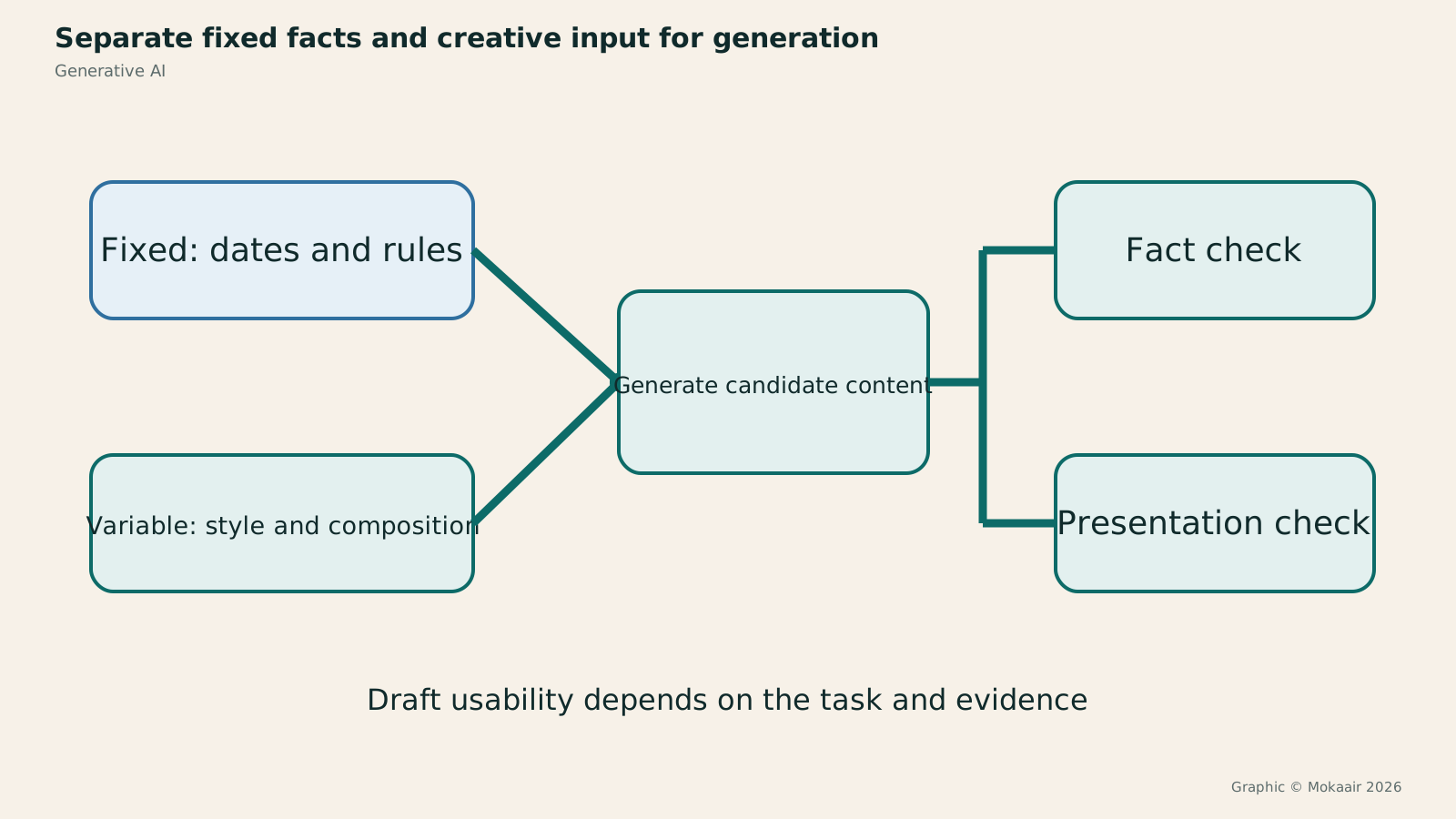
For the market task, clearly list information that must remain unchanged, such as the date, location, organizer and stall rules. List flexible elements separately, such as the headline, paragraph order and illustration style. This distinction does not guarantee that the model will avoid mistakes. It gives later checks a clear reference and prevents creative requests from overshadowing factual constraints.
Different Content Can Use Different Generative Mechanisms
Common language models predict the next token from context, building text step by step. Image generation can use diffusion models to progressively recover an image that meets the conditions from a perturbed representation. Adversarial generation learns the data distribution through training interactions between a generator and a discriminator; the original paper by Goodfellow and colleagues is an important primary source for this line of research.
These approaches are not the same mechanism with a different output file extension, and a product's ability to draw images does not establish that it uses a particular architecture. A service may include multiple models and postprocessing steps. Users do not need to master all the mathematics first, but should understand that generative AI names a range of capabilities rather than a particular chat model.
Generated results can also vary with sampling, settings and inputs. The same market information can produce different headlines and visual compositions, which is useful for exploration. When dates and addresses must be preserved, however, that variation needs to be constrained and checked. Getting something right by chance this time is not evidence that the next result will necessarily be consistent.
Give Market Materials Clear Acceptance Criteria
An original prompt could read: “Generate a draft market announcement from the attached event information. Retain all dates, locations and registration conditions; mark information not provided as pending confirmation; use a friendly tone, and add no discounts or promises about the event.” Producing only text first, checking each fact, and then developing visuals from the confirmed version makes problems easier to trace.
Next, request poster concepts themed around exchanging secondhand items, using abstract shapes of books, clothing and toys. Avoid depicting nonexistent stalls or real people as though documenting the event. The intended output is a publicity concept, not an on-site photograph. If a generated image contains text, check the dates and character forms separately; attractive visuals do not mean the information they contain can be used as is.
During review, separate content issues from presentation issues. An incorrect date requires a factual correction, text that is too small requires a layout adjustment, and visuals implying services that are not offered require a redesign. If the feedback is only “make it better” each time, the model may change the colors and composition while retaining the same incorrect date. Specific feedback helps the next revision address the actual gaps.
Read the full description
Event facts and variable styles enter a generative model through separate paths. Outputs undergo fact and presentation checks to become drafts that can be verified.
Looking New Does Not Mean All Rights Have Been Cleared
The combination a model produces may be newly generated, but that does not mean it bears no resemblance to existing works or that you have obtained all usage rights. Logos, people, voices and protected content in the material raise different issues. This article makes no legal determination for individual cases. For actual use, check the material's sources, the service terms and the context of use; do not treat the generate button as proof of authorization.
If community publicity simply needs to convey exchange and reuse, use abstract objects and event information you provide to reduce unnecessary depictions of real people or brand elements. If a particular person's photo is required, there should be an appropriate basis for its use, and edited material should be clearly distinguished from documentary photographs. These are practical areas to check, not a blanket judgment on all generated content.
Transparency with readers also matters. An illustration can be labeled as a concept visual; without actual event photos, generated scenes must not imply that a previous event was bustling. The same applies to text: generated attendee testimonials, quotations or statistics should not masquerade as real experiences. Creative ideas can be explored freely, but factual status must be labeled honestly.
Put Generation Where Its Results Can Be Checked
Generative AI is useful for brainstorming, rewriting, organizing supplied information and drafting, especially when you can judge whether the result meets your needs. It can also assist with complex work, but requires appropriate sources and verification. Having the source material in the conversation does not guarantee a faithful summary; the model may still omit negations, conditions and exceptions, so key content must be spot-checked.
If a task requires current information, obtain verifiable material before generation. If accurate calculations are needed, use a suitable calculation tool, then have the model explain the results. Dividing retrieval, calculation and generation makes the evidence clearer, but tool results can also be misread, so the final answer still needs to be checked against what was actually obtained.
Understanding generative AI can begin with a simple question: which parts allow creative invention, and which must remain faithful? Separate the two, attach sources and acceptance criteria, and keep unresolved items visible. This lets you use the speed of generation for exploration and expression without allowing fluent outputs to conceal gaps in the information.
| Function | Main Output | Market Scenario |
|---|---|---|
| Search | Existing information | Find rules supplied by the organizer |
| Classification | Categories or related scores | Determine the type of a submitted photo |
| Generation | Content created according to conditions | Create draft announcements and visual concepts |
What Is a Large Language Model?
What Is a Diffusion Model? Generating Images from Noise Step by Step
What Is an AI Hallucination? Breaking Fluent Answers into Verifiable Claims
AI Terms Index: From Loop Engineering to Generative AI
Found this guide helpful? Share it with someone who needs it
Lifestyle
Agentic Retrieval-Augmented Generation (Agentic RAG): When to Search Again
Agentic RAG lets models make retrieval decisions, choosing sources, rewriting queries or searching further based on the question and available evidence. Using a concrete LangGraph workflow and a comparison of venue-use conditions, this article contrasts it with fixed RAG and explains stopping criteria, permissions, query logs and cost control. Learn to judge whether a task needs dynamic exploration or a predictable fixed workflow is enough.
Lifestyle
Graph Retrieval-Augmented Generation (GraphRAG): Understanding a Document Collection Through Relationships
GraphRAG uses entities and relationships in retrieval to answer questions about cross-document connections and overall themes. Drawing on Microsoft's original paper and official docs, this article explains entity extraction, community summaries, and local and global search, using local event records to show why different questions need different paths. It also shows how missing links, mistaken name merges, and distorted summaries affect answers: a pretty graph is not verified fact.
Lifestyle
Knowledge Graphs: Making Entities and Relationships Clear
Knowledge graphs organize entities and relationships to trace who took part in what, where and when through links. Using community events, this article covers entity identity, relationship direction, sources and time; compares Resource Description Framework (RDF) and property graphs; and explains why graphs are not equivalent to visualizations or reliable facts. Learn when to build one and how it works with tables, vector search and graph retrieval-augmented generation (GraphRAG).
Lifestyle
Hybrid Search: Balancing Exact Terms and Meaning
Hybrid search merges full-text, vector and other retrieval results to cover exact codes and natural-language needs. An equipment-manual query explains candidate retrieval, deduplication, rank fusion and reranking, including how Reciprocal Rank Fusion (RRF) merges results by rank. Hybrid search is not always more accurate. Learn to test quality with code, paraphrase and no-answer queries and spot biases from permissions, filters and duplicate content.
Articles that cite this one
Sources
- Goodfellow et al.: Generative Adversarial NetworksChecked:
- NIST: Generative Artificial Intelligence ProfileChecked:
- Google: Introduction to Large Language ModelsChecked:
- Ho, Jain, Abbeel: Denoising Diffusion Probabilistic ModelsChecked:
Compiled from the references and verification dates listed above; fares, schedules, product features, and terms can change, so please confirm the latest details on the relevant official website before travelling, booking, or purchasing.