Lifestyle
What Is Deep Learning?
Deep learning uses multilayer neural networks to learn representations at different levels, often for image, speech and text tasks. Classifying recyclables in photos illustrates hidden layers, nonlinearity, training and inference, why models may memorize backgrounds rather than objects, and trade-offs in data, compute and interpretability. Learn its relation to machine learning and use new shooting conditions to check whether a model has learned useful patterns.
About 8 min read

Contents
Deep learning is a type of machine learning that uses multilayer neural networks to gradually transform raw input into representations useful for a task. Here, “deep” refers to multiple computational layers, not deeper thinking, and having lots of data alone does not make something deep learning. It is particularly good at handling patterns for which rules are difficult to write out individually, but results still depend on data, training and validation.
Suppose a community wants to use photos to help identify recyclables. You might want the system to distinguish cardboard boxes, metal cans and other objects. The following original scenario breaks down how multilayer networks learn and why getting demonstration photos right does not yet prove reliability in real recycling situations. Information fact-checked through 2026/9/14.
Multiple Computational Layers Gradually Transform Representations
The paper by LeCun, Bengio and Hinton explains deep learning through multiple processing layers and representations at multiple levels of abstraction. Google's neural network teaching materials explain how hidden layers and nonlinear operations handle complex relationships in data. Simply put, the network does more than receive input and fit a straight line: it applies repeated transformations to gradually form internal representations useful for the task.
For images, you can think of early processing as focusing on local edges and textures, with later processing combining more complex shapes and relationships. But this is only a conceptual illustration to aid understanding. It does not mean every layer has a fixed human-readable name, or that a particular node is necessarily dedicated to “cardboard boxes.” Actual representations are usually distributed across many numerical values and operations.
Nonlinearity is an important part. If every layer were merely a linear transformation without nonlinear changes, the stacked layers could still be mathematically combined into a single linear transformation. Their expressive power would not automatically increase just because the network looked deep. Different network architectures arrange computations differently, and image, speech and text tasks do not necessarily use exactly the same components.
How Training Tells the Network What to Adjust
Supervised training data for classifying recyclables might consist of a photo paired with a verified category. The model first produces scores for each category, then uses a loss function to measure the difference from the label. Backpropagation calculates how parameters affect the loss, and an optimizer updates the parameters based on those signals. This is a numerical adjustment procedure, not someone teaching nodes one by one to recognize particular objects.
The model encounters training examples repeatedly, but improvement during training does not mean it has met the requirements of its intended use. Photos excluded from training must be reserved to check new angles, new lighting and different appearances. If similar photos taken in a burst of the same object are split between training and testing, the test may be easier than encountering genuinely new objects, leading to an overestimate of the model's capabilities.
During inference, the model usually uses its trained parameters to produce results for new photos. A single user query does not necessarily update the entire network. If a product can improve through feedback, that also involves separate processes for data collection, retraining or personalization. Distinguishing training, inference and updates based on feedback makes it easier to understand what the model currently knows and how it changes.
Models May Learn Background Shortcuts
In this original data setup, all cardboard boxes are photographed on green tabletops, while all metal cans are photographed on white tabletops. The model may classify them using tabletop color instead of learning object shapes. If test photos follow the same shooting setup, it will appear highly accurate, yet suddenly make many errors when the tabletop changes. This illustrates the typical risk of using correlations in data in place of signals genuinely relevant to the task.
One check is to photograph the same type of object against different backgrounds, from different angles and under different lighting, then observe whether classifications remain consistent. Add photos showing damage, stains or partial obstruction to determine whether the system needs to flag cases it cannot classify. The expectation is not that it must get every photo right, but that you identify the conditions to which the model is overly sensitive and clearly state its scope of use.
If a cardboard box is classified as a metal can after the background changes, simply adjusting the tone of the response is not enough. You need to reexamine the data distribution, labels and training settings so that object categories are no longer tied to fixed backgrounds. The reasons for failure should also guide further data collection, rather than continuing to take more nearly identical photos on the same table.
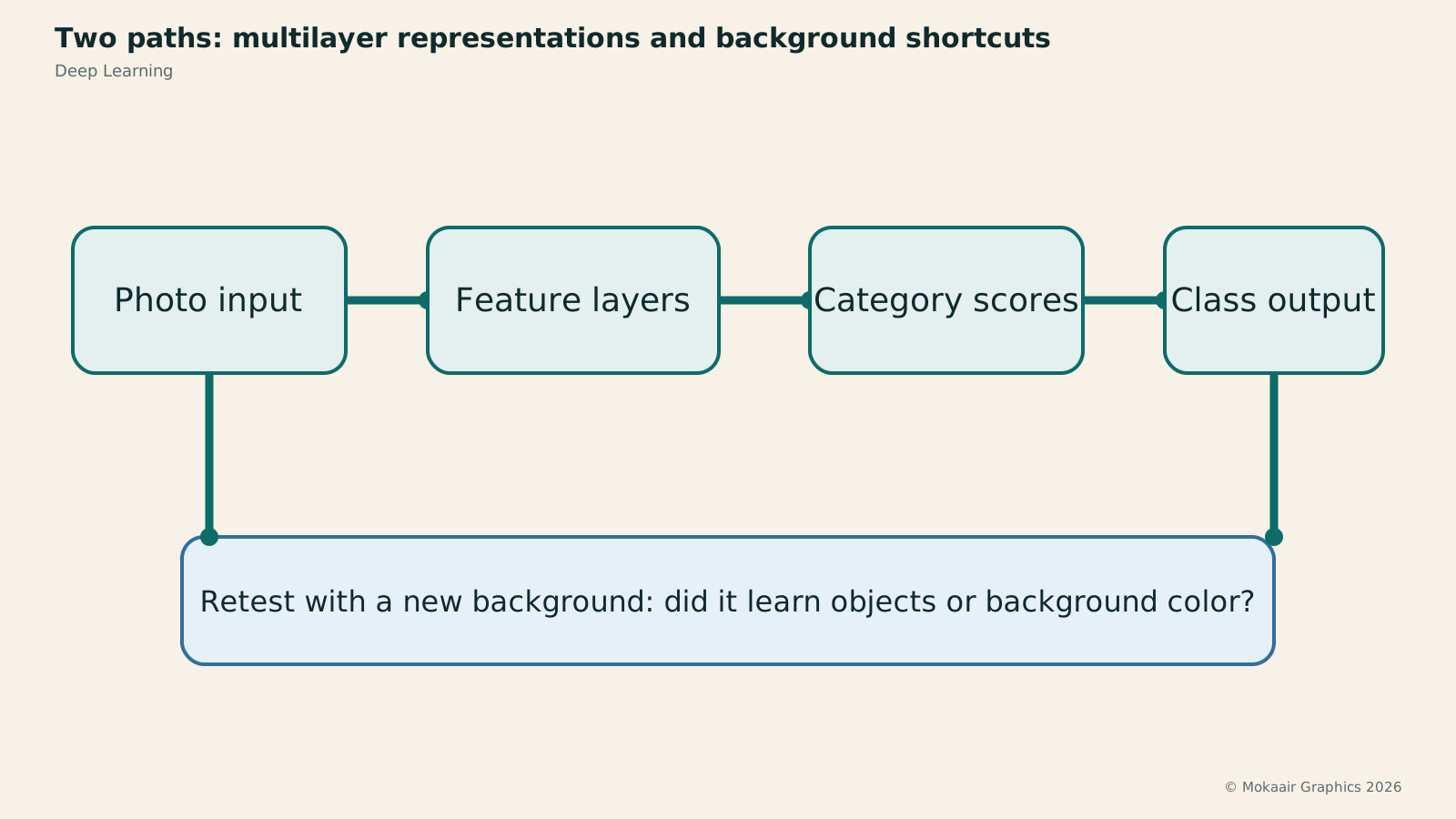
Read the full description
A photo passes through multilayer representations to a classification result. A reminder below suggests testing photos with different backgrounds to check whether the model relies only on tabletop color.
Depth Is Not the Best Answer to Every Problem
Deep learning generally requires considering training data, computing resources and deployment constraints, but not every application must train a large model from scratch. Existing models can serve as starting points and then be adapted to the task. Suitability still depends on the type of input, amount of data, accuracy requirements and maintenance costs. More layers alone do not make a model a more professional choice.
For tabular problems with few fields and clear rules, simpler models or explicit rules may suffice and be easier to understand. Conversely, when recognizing complex appearances from pixels, writing every rule by hand may be difficult, making multilayer representations attractive. When comparing methods, use the same data and task metrics, and consider speed and maintainability as well.
Interpretability is another trade-off. A model outputting a category does not mean it can provide causal reasons that humans can directly verify. A map highlighting areas of focus does not necessarily reveal the full reasons for its decision either. Users can ask to observe how the model responds to changes in its input and examine failure cases, rather than simply accepting a plausible explanation it generates separately.
Turning Technical Capabilities into Usable Features
If a recycling classification tool is intended for ordinary residents, its interface should make clear that it identifies visual appearances in photos. Actual recycling rules may still differ depending on material processing, contamination levels or local regulations. Recognizing an object does not mean the model has verified every local disposal method. Providing disposal advice requires a separate connection to applicable, verifiable rules data.
Deep learning and generative AIWhat Is Artificial Intelligence?AI covers many technologies and uses; it is not synonymous with chatbots and need not generate text. Starting with the OECD system definition, this article uses photo classification and community resource recommendations to link inputs, inference, outputs and human goals, and explains AI's relationship to machine learning, deep learning and generative AI. Learn to ask concrete questions about what an AI feature does and distinguish capability, autonomy and trustworthiness.Read the full article are not synonyms either. Classifying photos is one application of deep learning, but it need not generate new images; text generation models may also use deep neural networks. The former describes a technical method, while the latter describes output capabilities. Understanding this distinction helps avoid treating every neural network as a chat model.
The most practical check for readers is to test the model with new data that reflects its actual intended use: different phones, lighting, backgrounds and uncommon objects. If it performs well only on photos carefully selected by the demonstrator, its claimed capabilities should be limited to those conditions. A model's depth is a design feature; whether it can provide reliable help in real situations still requires evidence.
| Term | Meaning in This Example | What It Should Not Be Confused With |
|---|---|---|
| Deep learning | Processing photos with a multilayer network | Does not mean deep thinking |
| Training | Adjusting parameters based on labels | Does not mean relearning with every use |
| Inference | Producing category scores for new photos | Does not mean local recycling rules have been verified |
What Is Machine Learning?What Is Machine Learning?Machine learning uses data to adjust models to make predictions for unseen inputs or generate content. Breakfast shop prep forecasts show how features, labels, training and testing work together, distinguish supervised, unsupervised and reinforcement learning, and explain the effects of data leakage, overfitting and environmental change. Learn why models need held-out test data and which concrete questions help assess whether a seemingly accurate prediction is trustworthy.Read the full article
What Are Model Parameters?What Are Model Parameters?Model parameters are values adjusted during training to map inputs to outputs, such as weights and biases. Simple equations show how they affect predictions and distinguish them from training hyperparameters, prompts and generation settings. Learn why parameter count, numerical precision and active parameters are different metrics, how to read model specs, why more parameters do not mean more individual facts, and why each chat does not mean retraining the model.Read the full article
What Is Generative AI?What Is Generative AI?Generative AI learns patterns from data to create text, images, sound and more based on inputs. Using publicity for a community secondhand market, this article contrasts generation with classification and search, introduces language models, diffusion and adversarial generation, and explains why plausible content may be untrue. Learn to separate creative needs, facts to retain and human review, and identify outputs that are still drafts awaiting confirmation.Read the full article
AI Terminology Index: From Loop Engineering to Generative AI
Found this guide helpful? Share it with someone who needs it
Lifestyle
Agentic Retrieval-Augmented Generation (Agentic RAG): When to Search Again
Agentic RAG lets models make retrieval decisions, choosing sources, rewriting queries or searching further based on the question and available evidence. Using a concrete LangGraph workflow and a comparison of venue-use conditions, this article contrasts it with fixed RAG and explains stopping criteria, permissions, query logs and cost control. Learn to judge whether a task needs dynamic exploration or a predictable fixed workflow is enough.
Lifestyle
Graph Retrieval-Augmented Generation (GraphRAG): Understanding a Document Collection Through Relationships
GraphRAG uses entities and relationships in retrieval to answer questions about cross-document connections and overall themes. Drawing on Microsoft's original paper and official docs, this article explains entity extraction, community summaries, and local and global search, using local event records to show why different questions need different paths. It also shows how missing links, mistaken name merges, and distorted summaries affect answers: a pretty graph is not verified fact.
Lifestyle
Knowledge Graphs: Making Entities and Relationships Clear
Knowledge graphs organize entities and relationships to trace who took part in what, where and when through links. Using community events, this article covers entity identity, relationship direction, sources and time; compares Resource Description Framework (RDF) and property graphs; and explains why graphs are not equivalent to visualizations or reliable facts. Learn when to build one and how it works with tables, vector search and graph retrieval-augmented generation (GraphRAG).
Lifestyle
Hybrid Search: Balancing Exact Terms and Meaning
Hybrid search merges full-text, vector and other retrieval results to cover exact codes and natural-language needs. An equipment-manual query explains candidate retrieval, deduplication, rank fusion and reranking, including how Reciprocal Rank Fusion (RRF) merges results by rank. Hybrid search is not always more accurate. Learn to test quality with code, paraphrase and no-answer queries and spot biases from permissions, filters and duplicate content.
Articles that cite this one
Sources
- LeCun, Bengio, Hinton: Deep learningChecked:
- Google: Neural networksChecked:
- scikit-learn: Common pitfalls and recommended practicesChecked:
Compiled from the references and verification dates listed above; fares, schedules, product features, and terms can change, so please confirm the latest details on the relevant official website before travelling, booking, or purchasing.