Lifestyle
Graph Retrieval-Augmented Generation (GraphRAG): Understanding a Document Collection Through Relationships
GraphRAG uses entities and relationships in retrieval to answer questions about cross-document connections and overall themes. Drawing on Microsoft's original paper and official docs, this article explains entity extraction, community summaries, and local and global search, using local event records to show why different questions need different paths. It also shows how missing links, mistaken name merges, and distorted summaries affect answers: a pretty graph is not verified fact.
About 8 min read
Contents
GraphRAG can broadly refer to systems that use graph relationships to enhance generated answers. It also often refers specifically to the GraphRAG method and open-source project published by Microsoft Research. This article focuses on the latter's original paper and official documentation, explaining how entities and relationships are first extracted from documents and how these structures then support question answering. Different vendors' offerings with the same name may use different indexing and search methods, so they cannot be compared by name alone.
The question worth examining is this: when an answer is scattered across many documents, is retrieving a few passages with the most similar text enough to answer, "What common themes emerge across the collection?" For example, each document in a collection of local event records may cover only a single event, while readers want to understand patterns of long-term collaboration among different groups. Graphs and community summaries offer another way to organize this information, but extracted relationships still need to be checked against the original text.
A Graph Provides a Way to Connect Information
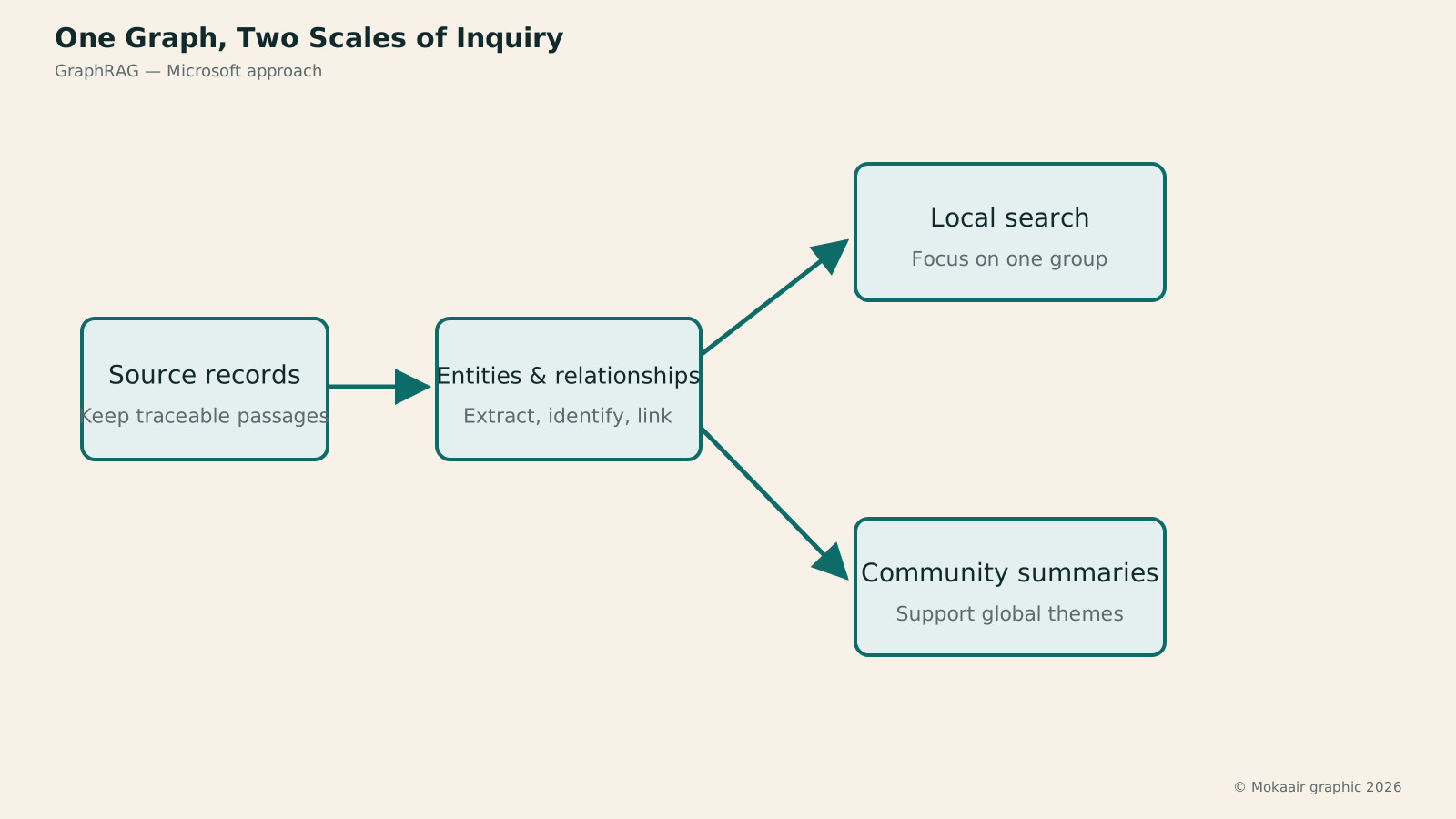
Microsoft's method first splits documents into text units, then extracts entities such as people, organizations, and places, along with their relationships. It then clusters the graph and generates community summaries for the clusters and related content. These summaries support collection-wide questions spanning multiple documents; this does not mean permanently discarding all the original text. The system still needs to link entities, relationships, summaries, and original passages so that sources can be traced.
Here, a "community" is a cluster formed through graph analysis; it does not necessarily correspond to a formal group in society. If two organizations frequently appear in linked records, they may be close together in the graph, but this does not directly imply legal, financial, or governance ties. Clustering is a result of organizing data, and an extracted relationship may merely represent a claim in the text. Treating a graph connection as causation is a leap users must take particular care to avoid.
Local and Global Questions Take Different Paths
Local search suits questions about specific entities, such as which venues a particular group has worked with. The official workflow finds entities relevant to the question, follows their relationships to retrieve nearby information, and combines it with relevant original passages in the context. It retains the characteristic of expanding from a clearly defined starting point, adding connections that are absent from one passage but appear in other records. Relationship direction and timing still matter: past collaboration does not mean collaboration is ongoing.
Global search addresses themes across the entire dataset, such as the most common difficulties in collaboration across all events. Microsoft's design uses community reports to generate partial responses, then combines them into an overall answer. This architecture organizes information before synthesizing it; it cannot directly serve as a precise statistical tool. To find how many times a word appears or the total number of events each year, structured counting is often more suitable than asking summaries to answer. In particular, "common" must not automatically be converted into a proportion.
Read the full description
Source text yields entities and relationships: one path follows specific entities for local search; the other builds community summaries to answer questions about global themes.
Example: Reading Local Event Records
Suppose a fictional collection includes event reports involving Mountain Town Book House, Riverside Association, and various venues. For the query "Which groups has Mountain Town Book House co-organized events with?", the system can first locate the book house entity, follow co-organizer relationships to identify the groups, and then find the original text supporting each relationship. The expected output is group names, the events they collaborated on, and source records, rather than a list treating every organization mentioned in the same document as a co-organizer.
Changing the question to "What difficulties do event organizers face most often in this collection of records?" shifts the need to organizing themes across documents. The system can examine content about venue coordination, staffing, and similar matters in each community summary, then consolidate recurring issues and provide traceable examples. These topics are teaching illustrations; no real data analysis was performed. If a difficulty appears in only a few records, the answer should preserve that limited scope rather than describe it as something all groups face.
To check whether the graph is useful, keep a small, manually verified sample. First check whether the book house and association were identified correctly, then verify the co-organizer relationships, and finally assess whether the answer is complete. If the error comes from merging book houses with the same name, switching the generation model may not help. If the graph is correct but the answer describes past collaboration as ongoing, generation and citation checks need to be corrected.
The Prettier the Graph, the More You Should Check Its Sources
Graph construction may miss implicit relationships or resolve an indirect reference to the wrong person. If a document says "our association" without clear context, the extractor will struggle to identify it reliably. Organizations with the same name, name changes, and different branches are even more likely to cause confusion. Data cleaning requires stable identifiers, aliases, and time information, and merge decisions need to be retained. Leaving all extraction to the model allows errors to continue spreading through relationships and summaries.
Summaries are generated content too. They may omit minority views or turn qualified statements into overly confident ones. If a global answer is then generated from those summaries, another layer of potential distortion is added. More important claims should be checked against the original text, rather than citing only another machine-generated summary. When sources contradict one another, the graph should ideally record the different sources' claims instead of silently choosing a side during indexing and leaving subsequent readers completely unaware of the conflict.
Identify the Question Type Before Adoption
GraphRAG often requires more preprocessing than ordinary document retrieval: extraction, relationship organization, clustering, and summarization all require computation, and document updates may affect existing structures. If the main need is simply to look up a specific provision or find a particular name, a more direct search workflow may be easier to maintain. Whether the indexing cost is worthwhile should be judged by how much it improves answers to cross-document questions. A graph's large number of nodes alone does not establish its value.
During acceptance testing, separately test local relationship questions, global theme questions, and questions requiring exact counts to see whether the system selects the right method. Besides answer quality, check citations, mistaken entity merges, graph consistency after updates, and whether data outside the user's permissions is isolated. General readers can understand GraphRAG as a way of reading data that adds perspectives based on relationships and clusters. It organizes paths to evidence; it does not vouch for the evidence itself.
Graph updates also require traceable data versions. When a source document is deleted, associated relationships and summaries may still contain its content. Deleting the original file alone does not mean the entire system has been updated and cleared of that content. Acceptance testing should select a withdrawn record and query it again, checking whether it still affects source citations, relationships in the graph, and summaries.
| Method | Focus | What to Watch |
|---|---|---|
| Local search | Specific entities and nearby relationships | Verify relationship direction and timing |
| Global search | Community summaries and collection-wide issues | Summaries are not complete statistics |
| Standard vector retrieval | Semantically similar source passages | May miss relationships scattered across documents |
Knowledge Graph: Making Things and Their Relationships ClearKnowledge Graphs: Making Entities and Relationships ClearKnowledge graphs organize entities and relationships to trace who took part in what, where and when through links. Using community events, this article covers entity identity, relationship direction, sources and time; compares Resource Description Framework (RDF) and property graphs; and explains why graphs are not equivalent to visualizations or reliable facts. Learn when to build one and how it works with tables, vector search and graph retrieval-augmented generation (GraphRAG).Read the full article
What Is Retrieval-Augmented Generation (RAG)? Backing Answers with Evidence You Can CheckWhat Is Retrieval-Augmented Generation (RAG)? Answers with Verifiable EvidenceRetrieval-augmented generation retrieves relevant external content for a language model to compose an answer. Using Q&A on event registration rules, this article explains indexing, retrieval, generation and source checking, compares it with search and fine-tuning, and shows why cited answers can still be wrong. Learn to distinguish outdated data, missing documents and overinterpreted evidence, and when to retain “I don't know.”Read the full article
Semantic Search: Finding Relevant Content Through Different WordingSemantic Search: Finding Relevant Content Through Different WordingSemantic search seeks data by query and content meaning, not just matching words. Customer support examples explain query encoding, document representations and candidate ranking; distinguish similarity from meeting actual needs; and show limits with negation, specific codes, cross-language search and unanswerable queries. Learn where to improve search—embedding models, data preparation, hybrid search or reranking—without mistaking natural-language answers for search itself.Read the full article
AI Terminology Index: From Loop Engineering to Generative AI
Found this guide helpful? Share it with someone who needs it
Lifestyle
Agentic Retrieval-Augmented Generation (Agentic RAG): When to Search Again
Agentic RAG lets models make retrieval decisions, choosing sources, rewriting queries or searching further based on the question and available evidence. Using a concrete LangGraph workflow and a comparison of venue-use conditions, this article contrasts it with fixed RAG and explains stopping criteria, permissions, query logs and cost control. Learn to judge whether a task needs dynamic exploration or a predictable fixed workflow is enough.
Lifestyle
Knowledge Graphs: Making Entities and Relationships Clear
Knowledge graphs organize entities and relationships to trace who took part in what, where and when through links. Using community events, this article covers entity identity, relationship direction, sources and time; compares Resource Description Framework (RDF) and property graphs; and explains why graphs are not equivalent to visualizations or reliable facts. Learn when to build one and how it works with tables, vector search and graph retrieval-augmented generation (GraphRAG).
Lifestyle
Hybrid Search: Balancing Exact Terms and Meaning
Hybrid search merges full-text, vector and other retrieval results to cover exact codes and natural-language needs. An equipment-manual query explains candidate retrieval, deduplication, rank fusion and reranking, including how Reciprocal Rank Fusion (RRF) merges results by rank. Hybrid search is not always more accurate. Learn to test quality with code, paraphrase and no-answer queries and spot biases from permissions, filters and duplicate content.
Lifestyle
What Is Retrieval-Augmented Generation (RAG)? Answers with Verifiable Evidence
Retrieval-augmented generation retrieves relevant external content for a language model to compose an answer. Using Q&A on event registration rules, this article explains indexing, retrieval, generation and source checking, compares it with search and fine-tuning, and shows why cited answers can still be wrong. Learn to distinguish outdated data, missing documents and overinterpreted evidence, and when to retain “I don't know.”
Articles that cite this one
Sources
Compiled from the references and verification dates listed above; fares, schedules, product features, and terms can change, so please confirm the latest details on the relevant official website before travelling, booking, or purchasing.