Lifestyle
What Is Artificial Intelligence?
AI covers many technologies and uses; it is not synonymous with chatbots and need not generate text. Starting with the OECD system definition, this article uses photo classification and community resource recommendations to link inputs, inference, outputs and human goals, and explains AI's relationship to machine learning, deep learning and generative AI. Learn to ask concrete questions about what an AI feature does and distinguish capability, autonomy and trustworthiness.
About 8 min read

Contents
Artificial intelligence, abbreviated AI, is a broad field that studies and builds systems capable of reasoning, recognition, planning and other tasks. It can predict, recommend, classify or generate content; it is not limited to software that chats. To understand an AI feature, start with what it receives, how it arrives at results and how those results affect people or the environment, rather than asking first whether it resembles a person.
This article uses the OECD's explanation of AI systems as a practical starting point, while acknowledging that the term's scope varies across fields. The original examples of photo organization and community resource recommendations below break abstract terms down into observable processes. Information was verified through 2026-9-14.
Start with What the System Does
The OECD definition emphasizes how a system, guided by objectives, infers predictions, content, recommendations or decisions from inputs and may influence physical or virtual environments. It also notes that systems differ in their levels of autonomy and adaptability after deployment. This offers a way to examine different applications without first assuming that a system has consciousness, emotions or human-like understanding.
The NIST glossary lists definitions of artificial intelligence from different documents and reminds readers to consult their respective contexts. This means that whether something counts as AI sometimes depends on the purpose of the discussion. Product copy, research papers and governance documents may draw different boundaries. Everyday users need not rush to assign every piece of software a single label; understanding its functions and limitations matters more.
For example, when a photo album sorts images into cats, dogs and landscapes, the input is images, and the output is categories or associated scores. A writing assistant receives a draft and instructions, then outputs revised text. Navigation route recommendations involve location, road networks and goal constraints. These products can contain AI components, but the complete product also needs interfaces, data, conventional programs and rules established by people.
AI Is More Than Learning from Data
Machine learning is one key AI method. It trains models on data so they learn relationships that can be applied to new inputs. Knowledge- and rule-based approaches are also part of AI's development, such as solving problems using explicit knowledge and inference programs. Modern systems may combine several approaches, so the absence of a neural network does not necessarily mean that a system falls outside artificial intelligence.
On the other hand, a simple reminder triggered at a fixed time does not automatically become AI just because it runs automatically. Automation describes whether a task requires a person to trigger each execution; artificial intelligence describes inference or related technologies within a system. They overlap, but address different questions. When introducing a product, identify which part performs recognition, recommendation or generation instead of merely calling it "fully automatic."
Deep learningWhat Is Deep Learning?Deep learning uses multilayer neural networks to learn representations at different levels, often for image, speech and text tasks. Classifying recyclables in photos illustrates hidden layers, nonlinearity, training and inference, why models may memorize backgrounds rather than objects, and trade-offs in data, compute and interpretability. Learn its relation to machine learning and use new shooting conditions to check whether a model has learned useful patterns.Read the full article is a category of machine learning methods that typically learns representations through multilayer neural networks. Generative AI, by contrast, is classified by its ability to produce content. These terms classify different aspects, so they cannot all be arranged into completely separate, non-overlapping boxes. A text generation model can belong to deep learning, machine learning and artificial intelligence at the same time.
An Example: Community Resource Recommendations
The request in this original example is: "Help new residents find suitable community activities." The system receives residents' self-reported interests and availability, along with activity data. It first filters out activities with incompatible times, then makes recommendations based on relevance. The intended output might be several activities and reasons for recommending them, rather than directly registering residents. Recommending activities and completing registration are different actions requiring different permissions.
If a resident says only that they enjoy the outdoors, the system might recommend gardening or walking, but this is merely an inference based on the information provided. It should not independently assume the resident's age, health status or other sensitive characteristics. Recommendation reasons should identify verifiable conditions, such as matching availability or activity content aligned with interests, giving users a chance to correct the system's understanding.
During testing, provide an input expressing a preference for evening activities and check whether early-morning activities still appear at the top. Then include a canceled activity to confirm that the system does not keep recommending it. If activity data is outdated, the problem may lie in data updates; if the data is correct but the ranking ignores availability, examine the rules or model. Breaking the issue down this way makes improvement easier than simply saying that the AI's recommendations are poor.
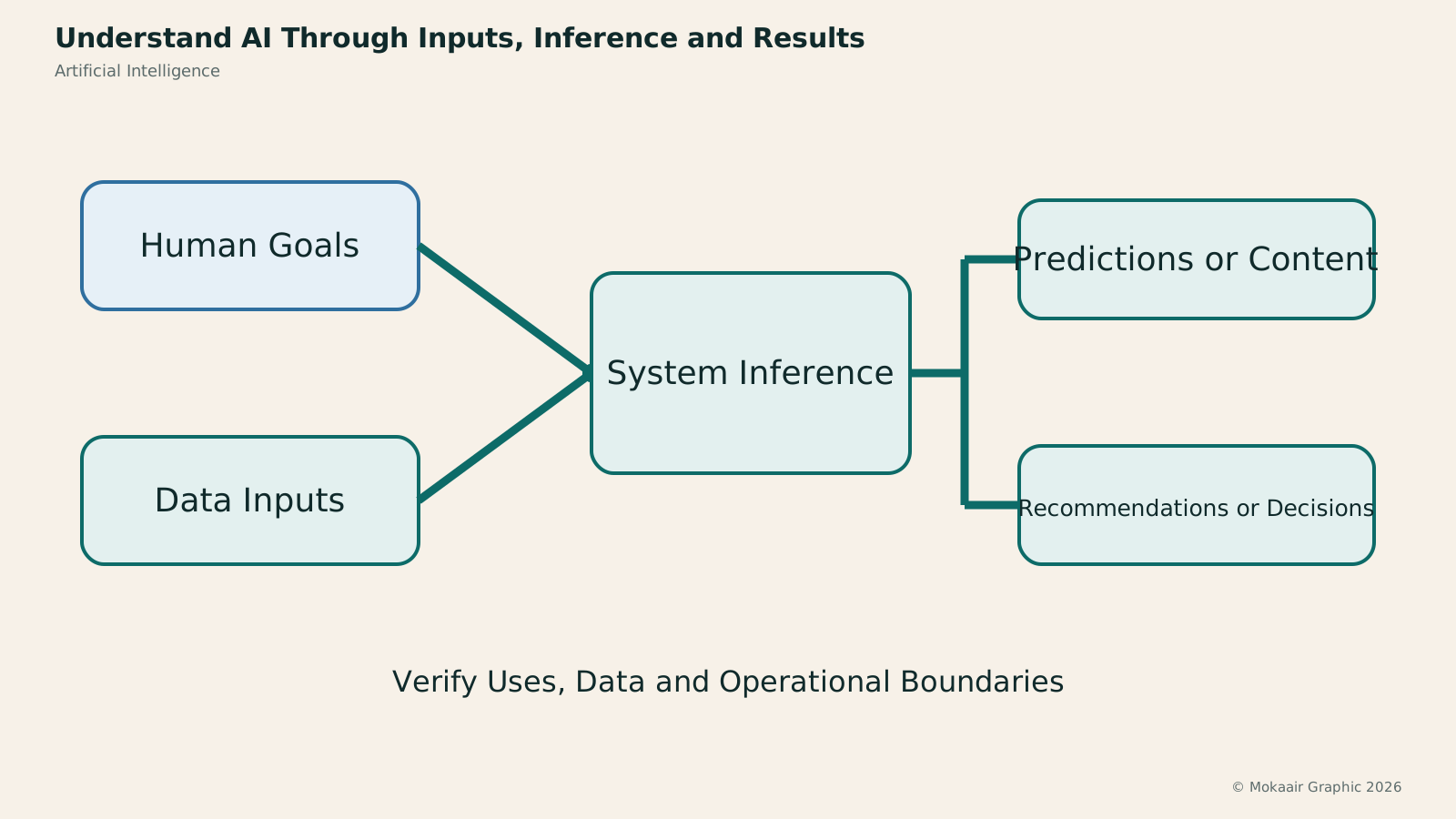
Read the full description
Human goals and data enter a system together. It produces predictions, content or recommendations, and the usage workflow determines whether action follows.
Assess Capability, Autonomy and Reliability Separately
A system's ability to complete a task does not mean it has permission to take every related action on its own. An activity recommendation model may be excellent at matching needs but still be limited to offering suggestions; another system may be authorized to complete registration. The level of autonomy depends on how the entire application is designed, not just the model's size or how confidently it answers.
Whether a system learns after deployment is a separate question. Some models remain fixed and are updated only when a new version is released; some systems may adjust rankings or personalization settings based on feedback. When users add preferences during a conversation, this may only change the current input. It does not necessarily mean that the model's weights immediately learn about that person. This depends on how the product actually stores and uses data.
Reliability must be assessed for specific uses. A photo classifier that performs well on well-lit images may struggle with blurry night scenes; an activity recommender that finds popular options may fail to adequately account for uncommon needs. A single demonstration or overall score cannot support conclusions about every situation, and fluent expression should certainly not be treated as evidence that verification is complete.
Concrete Questions Everyday Users Can Ask
When a feature is advertised as AI, start by asking: What data does it use? Is its output a prediction or a confirmed fact? Will it change an external state? Can mistakes be corrected? If the product cannot explain its data sources and operational boundaries, at least treat the results as suggestions that need checking. These questions have more impact on everyday use than debating whether it is "truly intelligent."
When using a system, provide only the information the task actually needs. Organizing photos does not necessarily require making an entire family album public, and recommending activities does not necessarily require a full address and private records. Using less data, while keeping it relevant, can make results easier to explain. You must still examine the service's data handling rules rather than infer privacy protections from the feature's name alone.
AI can provide value by helping classify things, identify patterns or produce drafts; it does not need to replace people in every decision. Once you can clearly explain the inputs, inference process, outputs and verification method, you have a starting point for understanding most AI concepts. Reading about machine learning and generative AI next will make it easier to distinguish their respective roles within this broad field.
| Term | Main Basis of Classification | Examples |
|---|---|---|
| Artificial intelligence | A broad field of technologies and systems | Recognition, planning, recommendation and generation |
| Machine learning | Methods for training models on data | Learning classification from historical examples |
| Generative AI | The ability to generate content | Generating text or images as requested |
What Is Machine Learning?What Is Machine Learning?Machine learning uses data to adjust models to make predictions for unseen inputs or generate content. Breakfast shop prep forecasts show how features, labels, training and testing work together, distinguish supervised, unsupervised and reinforcement learning, and explain the effects of data leakage, overfitting and environmental change. Learn why models need held-out test data and which concrete questions help assess whether a seemingly accurate prediction is trustworthy.Read the full article
What Is Generative AI?What Is Generative AI?Generative AI learns patterns from data to create text, images, sound and more based on inputs. Using publicity for a community secondhand market, this article contrasts generation with classification and search, introduces language models, diffusion and adversarial generation, and explains why plausible content may be untrue. Learn to separate creative needs, facts to retain and human review, and identify outputs that are still drafts awaiting confirmation.Read the full article
What Is an AI Agent? From Answering Questions to Completing Tasks
AI Terminology Index: From Loop Engineering to Generative AI
Found this guide helpful? Share it with someone who needs it
Lifestyle
Agentic Retrieval-Augmented Generation (Agentic RAG): When to Search Again
Agentic RAG lets models make retrieval decisions, choosing sources, rewriting queries or searching further based on the question and available evidence. Using a concrete LangGraph workflow and a comparison of venue-use conditions, this article contrasts it with fixed RAG and explains stopping criteria, permissions, query logs and cost control. Learn to judge whether a task needs dynamic exploration or a predictable fixed workflow is enough.
Lifestyle
Graph Retrieval-Augmented Generation (GraphRAG): Understanding a Document Collection Through Relationships
GraphRAG uses entities and relationships in retrieval to answer questions about cross-document connections and overall themes. Drawing on Microsoft's original paper and official docs, this article explains entity extraction, community summaries, and local and global search, using local event records to show why different questions need different paths. It also shows how missing links, mistaken name merges, and distorted summaries affect answers: a pretty graph is not verified fact.
Lifestyle
Knowledge Graphs: Making Entities and Relationships Clear
Knowledge graphs organize entities and relationships to trace who took part in what, where and when through links. Using community events, this article covers entity identity, relationship direction, sources and time; compares Resource Description Framework (RDF) and property graphs; and explains why graphs are not equivalent to visualizations or reliable facts. Learn when to build one and how it works with tables, vector search and graph retrieval-augmented generation (GraphRAG).
Lifestyle
Hybrid Search: Balancing Exact Terms and Meaning
Hybrid search merges full-text, vector and other retrieval results to cover exact codes and natural-language needs. An equipment-manual query explains candidate retrieval, deduplication, rank fusion and reranking, including how Reciprocal Rank Fusion (RRF) merges results by rank. Hybrid search is not always more accurate. Learn to test quality with code, paraphrase and no-answer queries and spot biases from permissions, filters and duplicate content.
Articles that cite this one
- Hybrid Search: Balancing Exact Terms and Meaning
- Semantic Search: Finding Relevant Content Through Different Wording
- What Is Multimodal AI? Understanding Images, Sound and Text Together
- What Is Tokenization? Splitting Text Before It Enters a Model
- What Are Model Parameters?
- Pretraining: Where a Model's Foundational Abilities Come From
- What Is the Transformer Architecture (Transformer)?
- What Is Generative AI?
Sources
- OECD: AI system definition explanatory memorandumChecked:
- NIST CSRC: Artificial intelligence glossaryChecked:
Compiled from the references and verification dates listed above; fares, schedules, product features, and terms can change, so please confirm the latest details on the relevant official website before travelling, booking, or purchasing.