Lifestyle
What Is the Transformer Architecture (Transformer)?
Transformer is a neural network architecture using attention for sequence relations, a basis for many language and multimodal models. Event notices' pronouns and word order show how self-attention, position data, feed-forward networks and masks cooperate, contrasting the original encoder–decoder with later variants. Learn how models use context, why attention weights are neither human attention nor full decision explanations, and why long sequences still incur compute and verification costs.
About 8 min read
Contents
Transformer is a neural network architecture that uses attention to exchange information among sequence elements, letting the model build representations relevant to the current context. It is not a single chat product, nor is it synonymous with all artificial intelligenceWhat Is Artificial Intelligence?AI covers many technologies and uses; it is not synonymous with chatbots and need not generate text. Starting with the OECD system definition, this article uses photo classification and community resource recommendations to link inputs, inference, outputs and human goals, and explains AI's relationship to machine learning, deep learning and generative AI. Learn to ask concrete questions about what an AI feature does and distinguish capability, autonomy and trustworthiness.Read the full article. Many language models are based on it or related variants. Similar ideas can also be applied to images and other data, though the specific components and uses may differ.
You do not need to work through matrix calculations before understanding Transformer. Start by looking at how different parts of a sentence influence one another. The explanations below use original sentences from community event notices and draw on the original paper and TensorFlow's official implementation tutorial. These are conceptual illustrations; the connections shown are not measurements from a real model. Information verified as of 2026/9/14.
Attention connects the current content to other positions
The original paper by Vaswani et al. proposed an attention-centered architecture for sequence transduction, replacing the recurrent processing designs common at the time. Self-attention lets a position in a sequence use its current representation to refer to other visible positions, then integrate information useful for the task at hand. “Attention” is a technical name for this computation; it does not mean the model has human subjective attention or intent.
Here is an original sentence: “The administrator moved the folding table to the common room because a talk will be held there tomorrow.” Understanding “there” requires referring to the common room and the surrounding context, rather than looking at just one adjacent character. Self-attention provides a way to compute information exchange between positions, but whether it correctly links “there” to the common room still depends on training and the specific input.
Common explanations mention query, key, and value. Think of them as different roles transformed from the current representation: making a comparison, providing a basis for comparison, and carrying the content to be integrated. They are all learned numerical operations, rather than someone first manually labeling every Chinese character as a subject, location, or pronoun.
Position information preserves word order
If words were treated only as a collection, the meanings of many sentences would become confused. For example, “Xiao Lin reminds Xiao Chen” and “Xiao Chen reminds Xiao Lin” use the same names and action, but who reminds whom differs. Transformer needs position-related information to handle order and relative relationships. The original architecture provided positional encodings, and later approaches introduced other ways to represent position. No single formulation should be treated as the only method used by every model.
Multi-head attention lets the model process relationships through different learned projections, then combine the results. Thinking of multiple viewpoints can help, but we should not claim that one head always handles grammar while another always handles common sense. The distribution of functions in real models need not fit categories that humans can easily name; the diagram only illustrates how computation is divided.
The architecture also contains more than attention. Components such as feed-forward networks, residual connections, and normalization help transform representations and support training. Saying only that “it looks at which words matter most” leaves out much of the actual computation. For general readers, understanding that attention exchanges information between positions while other layers continue processing those representations is enough to avoid mistaking the whole model for a simple system for weighting keywords.
How encoders, decoders, and masks differ
The original Transformer includes an encoder and a decoder, commonly used to transform an input sequence into another sequence, as in translation. The encoder builds input representations; the decoder generates output based on previously generated content and relevant representations. TensorFlow's tutorial demonstrates this structure and the use of masks, providing the context of a runnable official implementation rather than stopping at an abstract block diagram.
Later models also include those focused on the encoder and those using only a decoder. Decoder-only generative models typically produce subsequent tokens step by step from the known context, using a causal mask to prevent the relevant computations from looking ahead to positions not yet generated. This is distinct from computing losses for multiple positions at once during training. Parallel training does not mean all the words in an answer are decided simultaneously.
For an example of continuing a notice, take the input “The talk is canceled, so”. The expected continuation should be consistent with the cancellation. If the model continues with “please arrive on time,” it may not have adequately handled negation or contextual relationships. Knowing that the architecture can connect information only establishes that it has a mechanism for handling such relationships; it does not guarantee faithful generation every time.
Read the full description
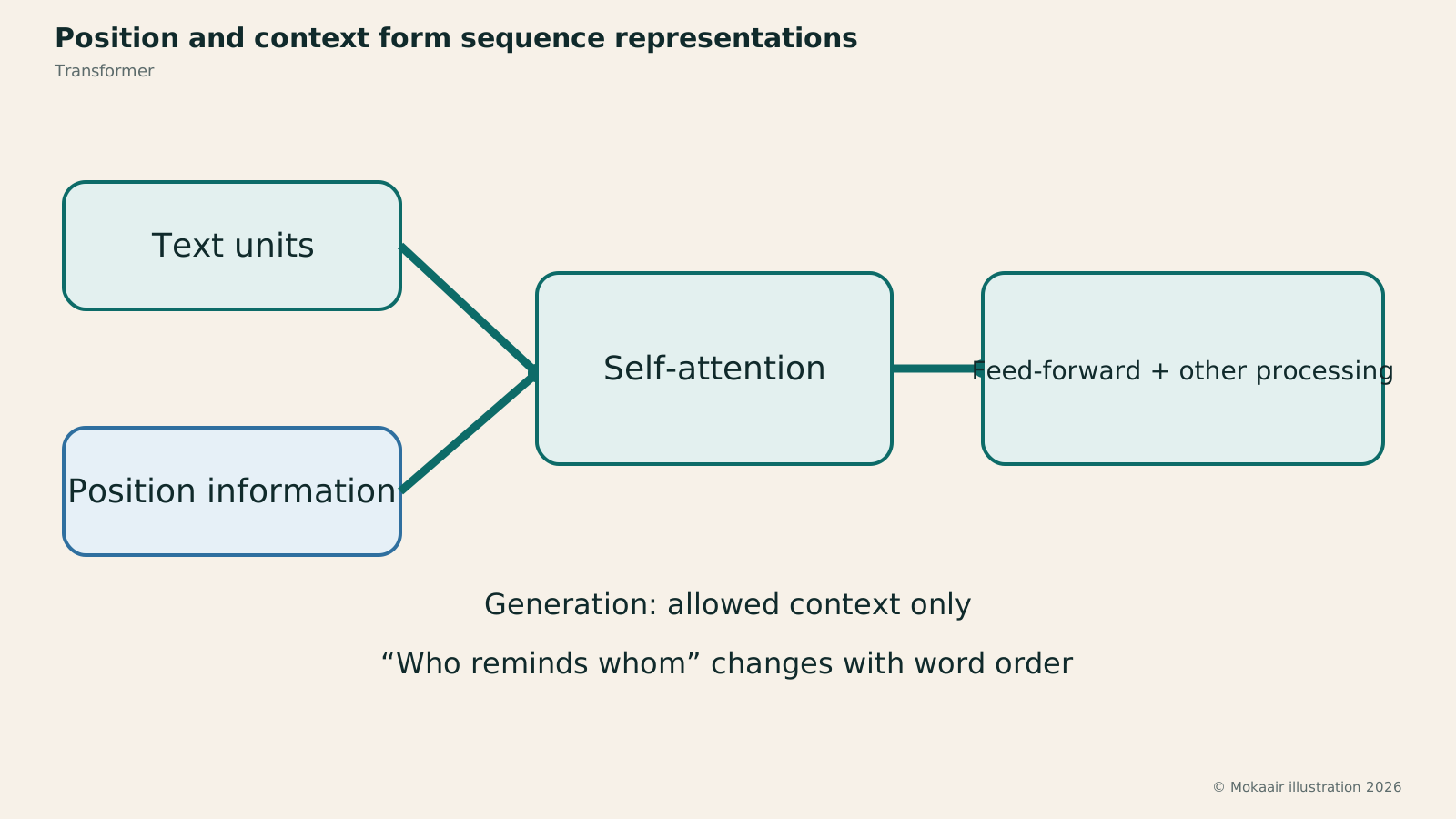
Text units gain position information, pass through self-attention and feed-forward processing, then produce task output; generation uses only the context it is allowed to see.
Test actual capabilities with reordered and negated sentences
Prepare two original test sentences: “The administrator asks the speaker to change the time” and “The speaker asks the administrator to change the time.” Ask the model to identify who makes the request. Then change “Open tomorrow” to “Not open tomorrow” and observe whether the summary preserves the negation. These inputs change only slightly but require different outputs, directly testing whether the model bases its judgments on key relationships.
The expected answer must change with the sentence and point to support in the original wording. If the model names the same role for both sentences, check whether the prompt is clear, whether the full input was passed through, and how the model handles this word order. Seeing an attention visualization connect to a name does not prove the causal basis of the entire answer.
Attention weights help research, but they are not a complete explanation of decisions. The final result also passes through other computations and combinations across multiple layers; a single weight map cannot account for every cause. For application users, reproducible input changes and output checks usually reveal more about task reliability than a heatmap that looks scientific.
Long context brings capabilities and costs
In a typical full self-attention design, pairing sequence positions with one another increases computation and memory demands. Specific systems can reduce costs through different forms of attention, caching, and implementation optimizations. Context window capacity alone therefore cannot determine speed, price, or quality, and the same cost formula should not be applied indiscriminately to every Transformer.
Long files also raise the issue of data selection. Being able to input an entire set of community regulations does not mean every passage is equally useful for answering a question, nor does it guarantee that the model will correctly integrate exceptions far away in the text. Start with relevant, sourced passages, test whether conditions are preserved, and then decide whether to add more content. Architectural capabilities and context engineering jointly influence the results.
Transformer is an important foundation for understanding modern models, but it describes only part of their technical structure. What a model learns, its training objectives, and how data and tools are organized all affect its actual capabilities. When you read that a product uses this architecture, ask next how it performs with your inputs, language, and acceptance criteria, rather than treating the architecture's name as a certification of quality.
| Component or concept | Main function | Misconception to avoid |
|---|---|---|
| Self-attention | Integrates information across positions based on visible context | It is not human subjective attention |
| Position information | Preserves word order and positional relationships | The same collection of words does not imply the same meaning |
| Causal mask | Restricts visible positions during generation | Parallel training does not mean generating the entire text simultaneously |
What Is a Large Language Model?
What Are Model Parameters?What Are Model Parameters?Model parameters are values adjusted during training to map inputs to outputs, such as weights and biases. Simple equations show how they affect predictions and distinguish them from training hyperparameters, prompts and generation settings. Learn why parameter count, numerical precision and active parameters are different metrics, how to read model specs, why more parameters do not mean more individual facts, and why each chat does not mean retraining the model.Read the full article
What Is a Context Window? The Difference Between Capacity and Understanding
AI Terminology Index: From Loop Engineering to Generative AI
Found this guide helpful? Share it with someone who needs it
Lifestyle
Agentic Retrieval-Augmented Generation (Agentic RAG): When to Search Again
Agentic RAG lets models make retrieval decisions, choosing sources, rewriting queries or searching further based on the question and available evidence. Using a concrete LangGraph workflow and a comparison of venue-use conditions, this article contrasts it with fixed RAG and explains stopping criteria, permissions, query logs and cost control. Learn to judge whether a task needs dynamic exploration or a predictable fixed workflow is enough.
Lifestyle
Graph Retrieval-Augmented Generation (GraphRAG): Understanding a Document Collection Through Relationships
GraphRAG uses entities and relationships in retrieval to answer questions about cross-document connections and overall themes. Drawing on Microsoft's original paper and official docs, this article explains entity extraction, community summaries, and local and global search, using local event records to show why different questions need different paths. It also shows how missing links, mistaken name merges, and distorted summaries affect answers: a pretty graph is not verified fact.
Lifestyle
Knowledge Graphs: Making Entities and Relationships Clear
Knowledge graphs organize entities and relationships to trace who took part in what, where and when through links. Using community events, this article covers entity identity, relationship direction, sources and time; compares Resource Description Framework (RDF) and property graphs; and explains why graphs are not equivalent to visualizations or reliable facts. Learn when to build one and how it works with tables, vector search and graph retrieval-augmented generation (GraphRAG).
Lifestyle
Hybrid Search: Balancing Exact Terms and Meaning
Hybrid search merges full-text, vector and other retrieval results to cover exact codes and natural-language needs. An equipment-manual query explains candidate retrieval, deduplication, rank fusion and reranking, including how Reciprocal Rank Fusion (RRF) merges results by rank. Hybrid search is not always more accurate. Learn to test quality with code, paraphrase and no-answer queries and spot biases from permissions, filters and duplicate content.
Articles that cite this one
Sources
- Vaswani et al.: Attention Is All You NeedChecked:
- TensorFlow: Neural machine translation with a TransformerChecked:
Compiled from the references and verification dates listed above; fares, schedules, product features, and terms can change, so please confirm the latest details on the relevant official website before travelling, booking, or purchasing.