Lifestyle
Pretraining: Where a Model's Foundational Abilities Come From
Pretraining lets models learn reusable representations and patterns from large datasets before task-specific adaptation. Examples of next-token prediction and masked-content recovery explain data, objectives and parameter updates. We distinguish pretraining, fine-tuning and context supplied at use, and why learning text does not mean recalling sources or ensuring factual accuracy. Learn the origins of base-model abilities and the effects of training data quality and evaluation contamination.
About 7 min read
Contents
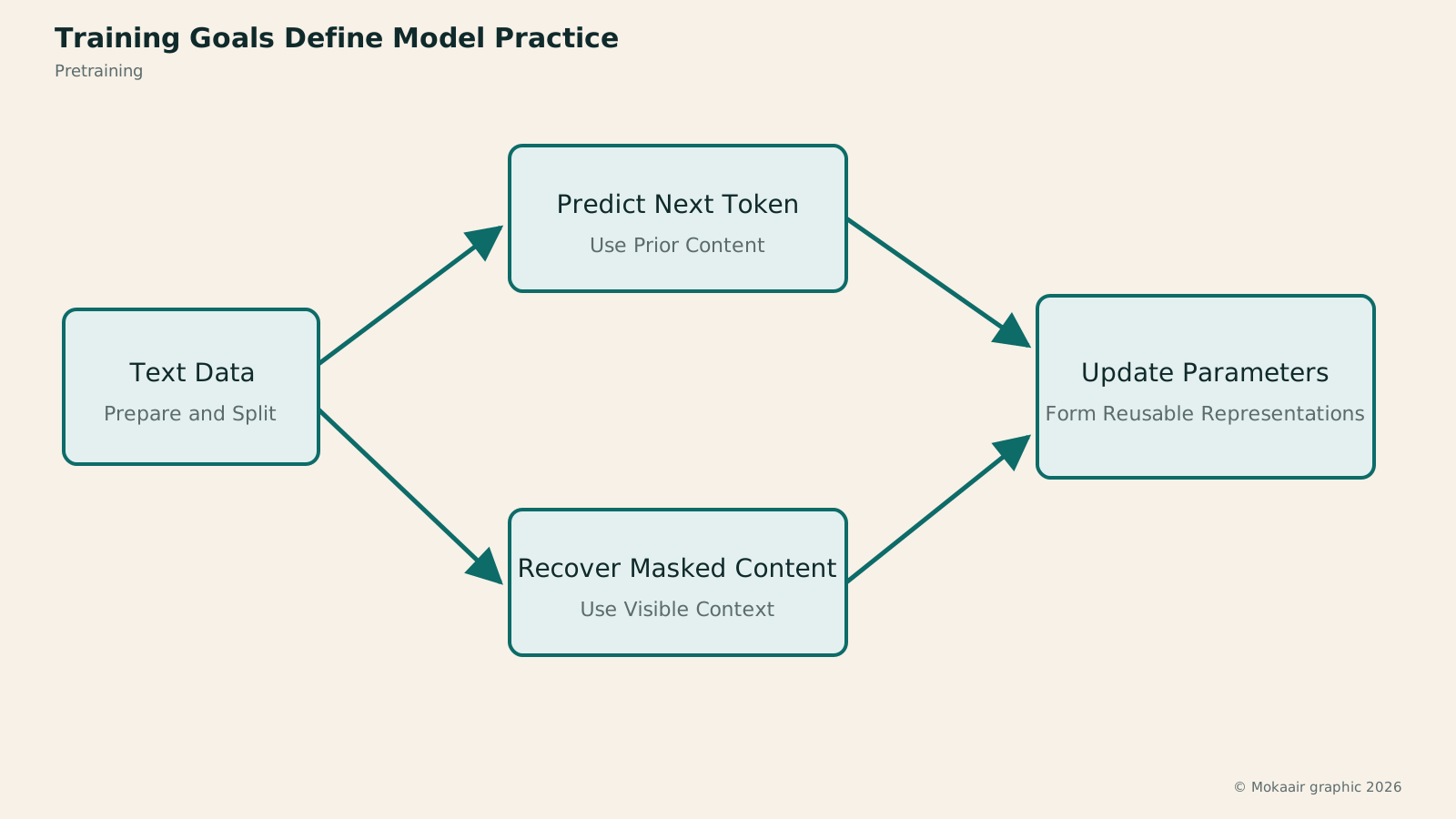
Pretraining is the training stage in which a model learns reusable patterns and representations from data before adaptation to specific tasks. In language models, common approaches include predicting the next token or using context to recover masked content. By repeatedly comparing predictions with targets and updating parameters, the model gradually develops abilities useful across many tasks, rather than having people write out every language rule in advance.
The “pre” refers to subsequent uses; it does not mean this stage is simpler or merely a warm-up. It may account for most of the work of building a model, with both data preparation and computation playing important roles. This article uses the original BERT paper and Hugging Face's language modeling documentation to explain common training objectives. All examples are simplified teaching scenarios; no single model's process is presented as the only path that all AIWhat Is Artificial Intelligence?AI covers many technologies and uses; it is not synonymous with chatbots and need not generate text. Starting with the OECD system definition, this article uses photo classification and community resource recommendations to link inputs, inference, outputs and human goals, and explains AI's relationship to machine learning, deep learning and generative AI. Learn to ask concrete questions about what an AI feature does and distinguish capability, autonomy and trustworthiness.Read the full article must follow.
What Exactly Is the Model Practicing?
Causal language modeling usually uses preceding text to predict the next token. For example, given “Due to heavy rain, the event,” the target may come from what follows in the original text. Instead of first receiving complete labels describing human intent, the model gets prediction exercises from the text sequences themselves. This approach of generating targets from data is often called self-supervision. It does not mean the data require no human processing, nor that the model can independently judge which text is true or worth learning.
Masked language modeling hides some content and asks the model to predict the hidden portions from the remaining context. BERT's original design uses this type of objective to learn representations with bidirectional context, unlike approaches that predict subsequent text using only preceding text. Both examples can teach language patterns, but their architectures, objectives and suitable downstream tasks differ. Calling both “pretraining” does not mean they produce the same abilities.
How Data and Parameters Affect Each Other
During training, the model first generates predictions, a loss function measures the gap between those predictions and the targets, and an optimizer then adjusts the parameters. The learning rate, data order, batches and training duration affect this update process. General readers do not need to memorize every formula; first grasp this point: pretraining changes the model's internal parameters. Later, simply pasting a document into a chat box usually provides context for that interaction without performing the same parameter updates.
The data's content also affects which languages, writing styles and topics the model encounters more often. If certain Taiwanese colloquial expressions, rare specialized terms or document formats are underrepresented in the data, the model may handle them less consistently. More data do not automatically mean better data; duplicates, noise and incorrect content can consume training capacity. To understand where a model's abilities come from, consider the data distribution together with the training objective, rather than asking only how many parameters it has.
Read the full description
Raw text becomes next-token prediction or masked-content recovery exercises; prediction errors guide parameter updates to produce a base model
Example: From Sentence Exercises to New Inputs
Suppose a model used for teaching reads many announcement sentences, such as “Due to heavy rain, the event is postponed” and “Registrations will not be accepted after the deadline.” Next-token prediction teaches it which fragments tend to follow certain contexts. When it later encounters the beginning of a new announcement, the model may generate a plausible continuation. But if the new event is actually proceeding as scheduled, it may still continue with “postponed,” because a plausible continuation does not mean it knows the actual decision about this event.
If a masking exercise is used instead, part of “Registrations will not be accepted after the deadline” is hidden, and the model must recover the content using the surrounding text. The expected learning outcome is a better ability to represent relationships within sentences, rather than reciting the source of every announcement. These examples deliberately use the same type of text to make the difference in training objectives easier to see. No actual training was performed, and the examples cannot be used to estimate a real model's accuracy or required data volume.
If you then paste a newly revised announcement into an existing model, it can answer based on the context, but this is the use of new data during inference. Unless a separate training process is initiated, you cannot say the model has completed pretraining or permanently learned all the content through this conversation. Whether a product collects conversations for later training is a separate question about data use policy and should also be understood separately from the model's computational mechanism during the current interaction.
Learning Does Not Mean Reliable Recall
A model may memorize some training content or learn only general patterns; you cannot assume every passage can be retrieved precisely. When answering a question, its generated sentences do not automatically include the corresponding training documents. External retrieval remains important for tasks requiring current information or source identification. Pretraining abilities and retrieval capabilities can complement each other; a larger model does not make evidence less necessary.
Evaluation must also avoid mixing test questions into training data. If the model has already seen the questions or answers, its score may overstate its ability to handle new problems. General users can observe performance with cases they have newly compiled and whose answers can be checked independently. Training teams need data deduplication, dataset splits and version records. Reporting only a high score without explaining the evaluation sources makes it difficult to judge whether the ability transfers to real situations.
What Can Happen After Pretraining?
A pretrained model can undergo continued training on domain-specific data, be fine-tuned using demonstrations of specific tasks, or receive post-training such as preference optimization. Teams may define the boundaries and names of these stages differently. What matters is which data are actually used, which objectives are optimized, and which parameters are updated. Calling every subsequent improvement “pretraining” obscures where the model's abilities were formed.
When choosing an application approach, first ask whether the missing element is general language ability, specific output behavior or current external knowledge. The first two may require a suitable base model or fine-tuning; the last usually requires a data pipeline. A typical organization does not necessarily need to pretrain from scratch. Using a suitable base model directly, then designing retrieval and evaluation, can often validate requirements more quickly. Whether to invest in training should still depend on the actual problem and available resources.
When reading model introductions, do not interpret “pretraining data up to a certain date” as meaning the model knows everything that happened before that date. At most, the date provides partial clues about the data's time range; coverage, source quality and whether the model learned the content remain uncertain. For important claims, requesting verifiable external sources is more practical than guessing what the model might have read back then.
| Method | Focus | What to Keep in Mind |
|---|---|---|
| Pretraining | Learning reusable representations and patterns | Updates model parameters |
| Fine-tuning | Adapting to a task or domain | Continues training from existing parameters |
| Providing context | Reading additional data for the current interaction | Usually does not update parameters |
Fine-tuning: Making an Existing Model Better Suited to Your TaskFine-tuning: Adapting an Existing Model to Your TaskFine-tuning continues training an existing model to fit a task or domain. Using support email classification, this article covers data preparation, parameter updates, held-out test sets and version deployment; distinguishes full fine-tuning, LoRA, supervised fine-tuning and RAG; and explains why training gains can mask real-world decline. Learn to judge whether fine-tuning is worthwhile and check format consistency, unknown types, data leakage and loss of prior abilities.Read the full article
What Are Model Parameters?What Are Model Parameters?Model parameters are values adjusted during training to map inputs to outputs, such as weights and biases. Simple equations show how they affect predictions and distinguish them from training hyperparameters, prompts and generation settings. Learn why parameter count, numerical precision and active parameters are different metrics, how to read model specs, why more parameters do not mean more individual facts, and why each chat does not mean retraining the model.Read the full article
What Is In-context Learning? Adapting to New Rules on the Spot
AI Terminology Index: From Loop Engineering to Generative AI
Found this guide helpful? Share it with someone who needs it
Lifestyle
Agentic Retrieval-Augmented Generation (Agentic RAG): When to Search Again
Agentic RAG lets models make retrieval decisions, choosing sources, rewriting queries or searching further based on the question and available evidence. Using a concrete LangGraph workflow and a comparison of venue-use conditions, this article contrasts it with fixed RAG and explains stopping criteria, permissions, query logs and cost control. Learn to judge whether a task needs dynamic exploration or a predictable fixed workflow is enough.
Lifestyle
Graph Retrieval-Augmented Generation (GraphRAG): Understanding a Document Collection Through Relationships
GraphRAG uses entities and relationships in retrieval to answer questions about cross-document connections and overall themes. Drawing on Microsoft's original paper and official docs, this article explains entity extraction, community summaries, and local and global search, using local event records to show why different questions need different paths. It also shows how missing links, mistaken name merges, and distorted summaries affect answers: a pretty graph is not verified fact.
Lifestyle
Knowledge Graphs: Making Entities and Relationships Clear
Knowledge graphs organize entities and relationships to trace who took part in what, where and when through links. Using community events, this article covers entity identity, relationship direction, sources and time; compares Resource Description Framework (RDF) and property graphs; and explains why graphs are not equivalent to visualizations or reliable facts. Learn when to build one and how it works with tables, vector search and graph retrieval-augmented generation (GraphRAG).
Lifestyle
Hybrid Search: Balancing Exact Terms and Meaning
Hybrid search merges full-text, vector and other retrieval results to cover exact codes and natural-language needs. An equipment-manual query explains candidate retrieval, deduplication, rank fusion and reranking, including how Reciprocal Rank Fusion (RRF) merges results by rank. Hybrid search is not always more accurate. Learn to test quality with code, paraphrase and no-answer queries and spot biases from permissions, filters and duplicate content.
Articles that cite this one
Sources
- Devlin et al.: BERTChecked:
- Hugging Face: Causal language modelingChecked:
Compiled from the references and verification dates listed above; fares, schedules, product features, and terms can change, so please confirm the latest details on the relevant official website before travelling, booking, or purchasing.