Lifestyle
What Is a Foundation Model?
Foundation models train on broad data and adapt to many downstream tasks; parameter count alone does not define them, nor are they complete chat products. Using Stanford CRFM's definition and a community inbox's classification, summaries and search, this article explains how shared models underpin different applications, distinguishes them from LLMs, generative AI and open weights, and clarifies the boundaries between model capabilities, application adaptation and actual deployment.
About 7 min read
Contents
A foundation model is trained on broad data and can be adapted to many downstream tasks. This article follows the usage proposed in the Stanford CRFM report: it is a "foundation" because it provides a shared starting point for many applications, not because it is easy for beginners to use, nor because it is already a complete, reliable product. Scale is often part of the context, but it cannot be defined solely by the number of parametersWhat Are Model Parameters?Model parameters are values adjusted during training to map inputs to outputs, such as weights and biases. Simple equations show how they affect predictions and distinguish them from training hyperparameters, prompts and generation settings. Learn why parameter count, numerical precision and active parameters are different metrics, how to read model specs, why more parameters do not mean more individual facts, and why each chat does not mean retraining the model.Read the full article.
A community service platform might want to classify incoming messages, summarize them and search for similar past issues. These features can use the same foundation model family, combined with different data and workflows. The following original scenario explains how shared capabilities can be adapted. Facts were checked as of 2026-9-14.
From a Single Task to an Adaptable Starting Point
Stanford CRFM describes foundation models as models trained on broad data that can be adapted to many downstream tasks, and discusses the opportunities and risks of this shared foundation. Previously, one model might specialize in recognizing a particular type of image, while another handled text classification. The foundation model approach first learns reusable capabilities, then makes different adjustments according to task requirements.
This does not mean any model can do every job well, or that all downstream features share the same interface. Language, image and cross-modal models can have different inputs and outputs; some excel at providing representations, while others excel at generating sequences. Calling them foundation models emphasizes their training background and adaptable role, rather than a fixed list of features.
Google's official model documentation provides concrete examples of general-purpose models that can be adapted for applications. However, no single model family establishes that all foundation models share the same licensing, deployment methods or hardware requirements. When reading model documentation, distinguish capabilities, access methods and application responsibilities. Downloading a model or calling an API gives you only part of a system.
One Foundation Can Support Different Applications
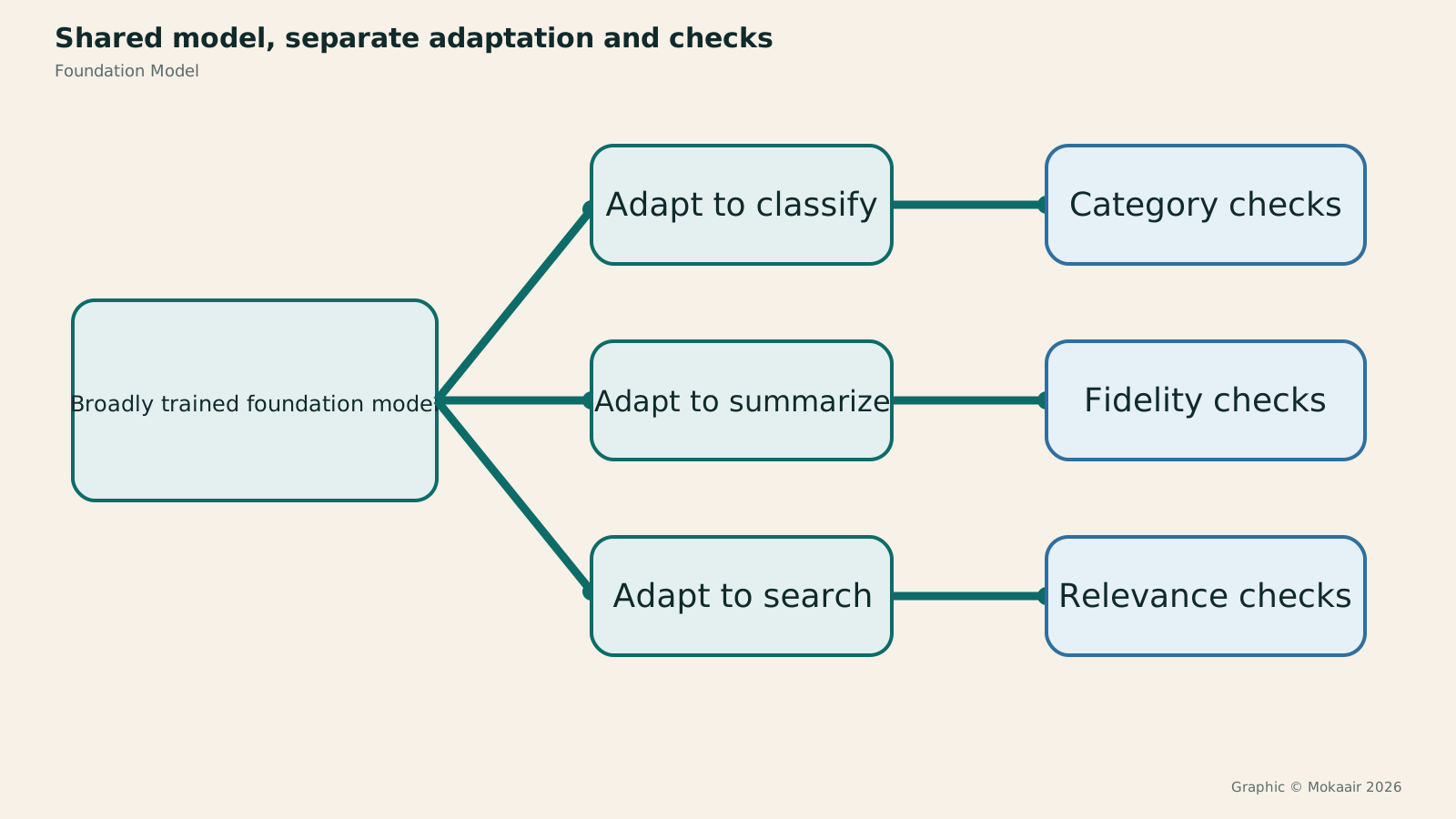
The first task in the community inbox example is to sort incoming messages into work categories such as equipment, environment and activities. The input is a resident's description; the output is an assigned category and any additional information needed. The second task summarizes long messages into key points that administrators can read quickly. The third finds similar past cases so administrators can refer to how they were handled.
Although all these tasks process text, their acceptance criteria differ. Classification must match the actual division of responsibilities, summaries must preserve negation and chronology, and search must retrieve useful cases. A shared model can reduce the work of training from scratch, but each feature still needs its own data, prompts, tools and tests. Good classification performance does not establish that summarization is also reliable.
The original example input, "The elevator is back in service today, but I would still like yesterday's unusual noise checked," should be understood as still requesting an inspection. A summary must not retain only "The elevator is back in service." If classification is correct but the summary omits the unresolved issue, examine the summarization task's configuration. This does not necessarily require replacing the entire foundation model, nor does it mean classification has also failed.
Read the full description
One foundation model connects to classification, summarization and search. Each feature has its own task data and acceptance checks; a single evaluation does not cover them all.
Adaptation Involves More Than Retraining
Adaptation can mean providing clear prompts and examples so the model performs the current task. It can also involve adding retrieval to place applicable rules and past cases in the context. Other methods change some or all model parameters through fine-tuning. These approaches differ in cost, data requirements and maintenance. Choose according to the problem, rather than always preparing to retrain first.
For the community inbox, if work category names are unclear, organizing label definitions and examples may be more necessary than fine-tuning. If the model does not know the latest management procedures, obtaining current documents and supplying them may be more direct than expecting old parameters to remember updates on their own. Only a clear understanding of the gap allows you to determine which adaptation method addresses its cause.
An adapted model or application can also regress. Adding examples for the equipment category might cause some requests to borrow equipment for activities to be misclassified as repairs. Every update should retain important existing test cases and add new failure scenarios. A general-purpose foundation offers convenience, but does not eliminate trade-offs between tasks or the need for regression testing.
A Shared Foundation Can Also Mean Shared Blind Spots
If multiple applications depend on the same model, they may inherit shared data biases, capability gaps or particular failure modes. This is one reason foundation models can have systemic effects: an underlying update can improve many features at once, but can also change the behavior of several products simultaneously. Each application cannot simply be treated as an independent small tool.
In this example, classification, summarization and search might all go wrong when residents use local colloquialisms or short phrases. This does not necessarily mean a larger model is needed. More testing in the relevant language, better prompts and exception handling may help instead. During diagnosis, checking which features fail together on the same input can help identify a shared source.
Provenance and versions therefore matter. The platform should know which foundation model it uses, which adaptation data and settings accompany it, and retain the results of checks performed before updates. If the service provider or local model version changes, important uses must be checked again. An identical model name or membership in the same family cannot, on its own, prove that behavior is completely unchanged.
How Foundation Models Differ from LLMs, Generative AI and Open Weights
Large language models are described primarily in terms of language modeling and scale; foundation models emphasize broad training followed by adaptation to multiple tasks. Many LLMs are also foundation models, but foundation models can cover images and other modalities too. Generative AIWhat Is Generative AI?Generative AI learns patterns from data to create text, images, sound and more based on inputs. Using publicity for a community secondhand market, this article contrasts generation with classification and search, introduces language models, diffusion and adversarial generation, and explains why plausible content may be untrue. Learn to separate creative needs, facts to retain and human review, and identify outputs that are still drafts awaiting confirmation.Read the full article is categorized by the ability to produce content, so these terms cannot be treated as completely interchangeable.
Open weights describes whether model weights are available and the associated conditions of use. This is separate from whether a model is a foundation model. A foundation model might be accessible only through a service, or its weights might be available. Providing weights does not mean that all training data, code and licensing are the same. Understanding these boundaries helps prevent assumptions about unverified rights and capabilities based on the word "open."
The most useful questions for ordinary users are: What task is this shared foundation being used for? What data and validation were added for that task? Who can address failures? With clear answers, a foundation model becomes a traceable technical starting point rather than an abstract term for a large black box. The features ultimately delivered to people still require application design and evidence.
| Term | What it emphasizes | What this does not imply |
|---|---|---|
| Foundation model | Adaptability to many downstream tasks | Every application has been validated |
| Large language model | Large-scale language modeling | It can only be used for chat |
| Open weights | Access to weights and conditions of use | Training data and all rights are open |
What Is a Large Language Model?
Fine-tuning: Making an Existing Model Better Suited to Your TaskFine-tuning: Adapting an Existing Model to Your TaskFine-tuning continues training an existing model to fit a task or domain. Using support email classification, this article covers data preparation, parameter updates, held-out test sets and version deployment; distinguishes full fine-tuning, LoRA, supervised fine-tuning and RAG; and explains why training gains can mask real-world decline. Learn to judge whether fine-tuning is worthwhile and check format consistency, unknown types, data leakage and loss of prior abilities.Read the full article
Open Weights: What Else Should You Check When You Can Download a Model?
AI Terminology Index: From Loop Engineering to Generative AI
Found this guide helpful? Share it with someone who needs it
Lifestyle
Agentic Retrieval-Augmented Generation (Agentic RAG): When to Search Again
Agentic RAG lets models make retrieval decisions, choosing sources, rewriting queries or searching further based on the question and available evidence. Using a concrete LangGraph workflow and a comparison of venue-use conditions, this article contrasts it with fixed RAG and explains stopping criteria, permissions, query logs and cost control. Learn to judge whether a task needs dynamic exploration or a predictable fixed workflow is enough.
Lifestyle
Graph Retrieval-Augmented Generation (GraphRAG): Understanding a Document Collection Through Relationships
GraphRAG uses entities and relationships in retrieval to answer questions about cross-document connections and overall themes. Drawing on Microsoft's original paper and official docs, this article explains entity extraction, community summaries, and local and global search, using local event records to show why different questions need different paths. It also shows how missing links, mistaken name merges, and distorted summaries affect answers: a pretty graph is not verified fact.
Lifestyle
Knowledge Graphs: Making Entities and Relationships Clear
Knowledge graphs organize entities and relationships to trace who took part in what, where and when through links. Using community events, this article covers entity identity, relationship direction, sources and time; compares Resource Description Framework (RDF) and property graphs; and explains why graphs are not equivalent to visualizations or reliable facts. Learn when to build one and how it works with tables, vector search and graph retrieval-augmented generation (GraphRAG).
Lifestyle
Hybrid Search: Balancing Exact Terms and Meaning
Hybrid search merges full-text, vector and other retrieval results to cover exact codes and natural-language needs. An equipment-manual query explains candidate retrieval, deduplication, rank fusion and reranking, including how Reciprocal Rank Fusion (RRF) merges results by rank. Hybrid search is not always more accurate. Learn to test quality with code, paraphrase and no-answer queries and spot biases from permissions, filters and duplicate content.
Sources
- Stanford CRFM: On the Opportunities and Risks of Foundation ModelsChecked:
- Google: Gemma model overviewChecked:
Compiled from the references and verification dates listed above; fares, schedules, product features, and terms can change, so please confirm the latest details on the relevant official website before travelling, booking, or purchasing.