Lifestyle
What Is Zero-shot Prompting? Start by Defining the Task Clearly
Zero-shot prompting asks a model to work from rules and new data without solved examples. It does not mean the model was never trained or that prompts cannot include data. Using appliance instructions, this article explains how to define output fields, handle missing information, and set the scope of judgment, and compares the uses of few-shot prompts and retrieved data. A comparison table and test procedure show when asking directly is enough and when examples are needed.
About 7 min read

Contents
Zero-shot prompting asks a model to process new input through instructions without including solved task examples in the prompt. “Summarize the key points of this announcement” is a common form. “Zero” refers to the number of examples provided in that prompt, not an absence of model training, nor a lack of any relevant knowledge.
You can still include complete documents, classification rules, and output requirements. Having no examples is different from having no background information. The following appliance-manual scenario shows how to establish a clear zero-shot baseline, then use the errors to decide whether to add rules, add sources, or switch to few-shot examples.
Zero-shot Does Not Mean Learning Everything from Nothing
Language models encounter many patterns during training, and some also undergo instruction fine-tuningFine-tuning: Adapting an Existing Model to Your TaskFine-tuning continues training an existing model to fit a task or domain. Using support email classification, this article covers data preparation, parameter updates, held-out test sets and version deployment; distinguishes full fine-tuning, LoRA, supervised fine-tuning and RAG; and explains why training gains can mask real-world decline. Learn to judge whether fine-tuning is worthwhile and check format consistency, unknown types, data leakage and loss of prior abilities.Read the full article to learn to perform tasks from natural-language requests. The FLAN study by Wei et al. explores how instruction fine-tuning improves zero-shot performance on unseen task types. This research shows that zero-shot capabilities may be influenced by training methods. “No examples were provided this time” should not be interpreted as the model starting entirely from scratch.
Zero-shot results in research also depend on the evaluation setup: which tasks are unseen and how training data is arranged have specific definitions. When ordinary users describe a prompt as zero-shot, they usually mean that it contains no pairs of inputs and reference answers. These usages are related, but a chat interaction should not be treated as a rigorous research test.
For example, if you ask a model to summarize a manual, it may already be familiar with common instructional document formats, while what you provide today is the actual content for a particular machine. Writing in the style of instructions and faithfully summarizing this document are still different things. What needs checking is whether the model follows the source, not whether its answer reads fluently.
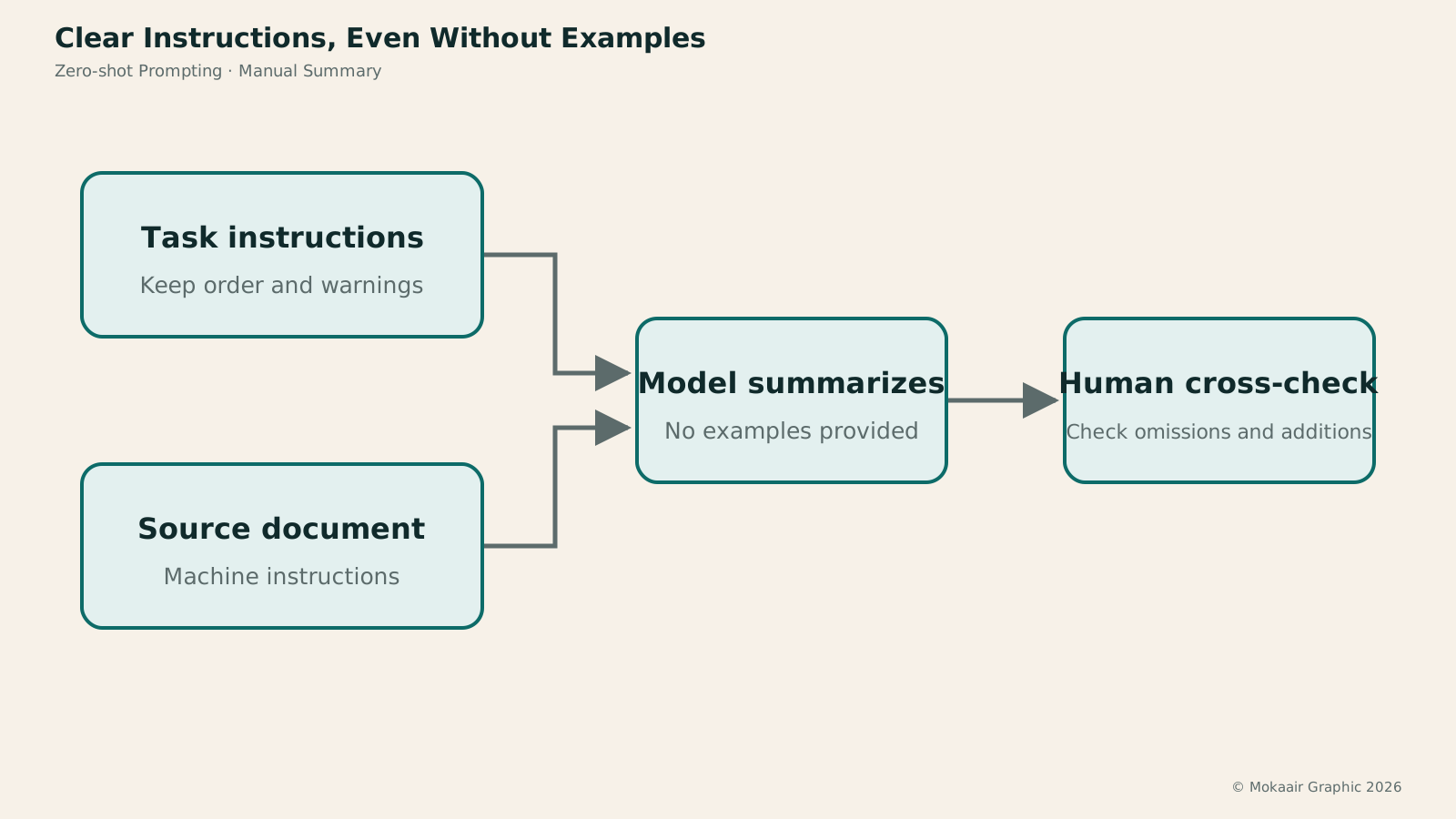
Read the full description
Task instructions and a manual are given to the model without solved examples. Conditions and formatting are checked separately after output.
Break the Task into Its Target, Action, and Deliverable Format
Instead of simply saying “Take a look at this,” you could write: “Find the filter-cleaning steps in the following dehumidifier instructions and list them in operating order. Preserve the conditions for stopping use, and do not add anything that is not mentioned.” This prompt contains no completed examples, so it is still zero-shot, but it tells the model which data to examine, what to do, and how to format the output.
Google’s prompt design documentation emphasizes clear instructions, constraints, and response formats. Applied to this case, first decide whether you want a summary of steps, extracted warnings, or an explanation for beginners. Asking for a comprehensive evaluation, troubleshooting, and purchasing advice all at once mixes different tasks, making it easier for the model to stray beyond the document.
Also define what to do when information is insufficient. Suppose the document says to clean regularly but gives no specific frequency. The expected output should retain “frequency not specified.” Insisting that every field be filled completely may encourage the model to supply numbers from general experience. A field with missing information is a useful result, not an answer defect to conceal.
Work Through a Complete Exercise with a Manual
The following scenario is purely illustrative. Prepare an excerpt of machine instructions that you have permission to use and that contains no personal information. The text should cover switching off, unplugging, removing the filter, cleaning it using the manufacturer’s method, and reinstalling it after drying. Ask the model to list the sequence stated in the source, separately mark any prerequisites, and avoid adding cleaning tools not mentioned in the original.
The expected output should let you trace every step back to its source. Check whether unplugging was omitted, whether drying was replaced with an arbitrary duration, or whether a cleaning agent was added without support. This example teaches you to verify summary fidelity. Actual maintenance should still follow the manufacturer’s instructions for that machine; do not apply these illustrative steps to every appliance.
Next, prepare another passage with the sequence information in different locations, or add prohibitions such as “Do not wash with water.” If the model can only organize clearly bulleted text and misses constraints in prose, the prompt has a narrower range of use than you expected. This is evidence that the source organization or prompt needs adjustment, not grounds to immediately declare zero-shot prompting ineffective.
Classify Errors Before Deciding What to Add
If the model misses a condition you already provided, first clarify the task’s scope or place related passages together. If it consistently uses the wrong fields, a small number of complete examples may help. If it does not know about features in a new version that the document does not cover, provide the correct sources or a lookup tool. Few-shot formatting examples cannot create missing facts.
Zero-shot prompting is particularly useful as a starting point because the prompt is shorter, making it easier to see whether basic rules are sufficient. You then have a clear baseline for comparison when you add examples later. If you start by piling in many examples, role descriptions, and exceptions, it becomes harder to identify what improved and which part actually helped.
Do not respond to the model’s first mistake merely by adding “Be sure to be correct” or “Absolutely no mistakes.” These phrases do not identify the error. A more effective revision is: “List warning conditions separately; do not merge them into general cleaning steps,” followed by another check using the same data. This change addresses a specific error and is easier to maintain.
Understand Zero-shot, Few-shot, and Supplied Data Together
Few-shot prompting includes examples, while zero-shot prompting does not; both can include retrieved documents. You can ask a model to answer from a retrieved operating manual without providing examples, so zero-shot prompting does not rule out retrieval-augmented generation. These concepts describe the arrangement of examples and the sources of facts, respectively. They are not mutually exclusive product categories.
Likewise, asking for a “step-by-step list” does not automatically make a prompt few-shot. It specifies the output format without showing a completed task answer. Understanding this distinction helps teams discuss prompts more precisely: should they add rule text, examples, or source data? Each change has different costs and uses.
Finally, retain a stable validation set containing ordinary documents, missing information, and prohibitions. Run it again after changing the rules or switching models, recording which cases improve and which regress. Zero-shot prompting is not an inferior approach. When the task is clear, the data is sufficient, and the results can be verified, a simple prompt may itself be an appropriate solution.
Validation records should also retain the version of the original text used at the time. If the manual has been updated, an old answer may no longer be correct. What needs checking again is the consistency between the source and the summary, rather than requiring the model to maintain its old account.
| Problem | What to Improve First | Can It Remain Zero-shot? |
|---|---|---|
| Request is too vague | Target, action, format | Yes |
| Formatting remains inconsistent | Complete examples | Adding them makes it few-shot |
| Current information is missing | Source documents or retrieval | Yes |
What Is Few-shot Prompting? Teach the Format Clearly with ExamplesWhat Is Few-shot Prompting? Clarifying Formats with ExamplesFew-shot prompting gives a model a few examples in the same input to guide its work on new data; it is not retraining. Using lost-and-found classification, this article shows how to choose typical, boundary, and missing-data cases so the model does more than mimic wording. Tests, a comparison table, and original diagrams explain when to add examples, when to revise classification rules first, and why examples must be kept separate from validation data.Read the full article
What Is Retrieval-Augmented Generation (RAG)? Give Answers Verifiable SupportWhat Is Retrieval-Augmented Generation (RAG)? Answers with Verifiable EvidenceRetrieval-augmented generation retrieves relevant external content for a language model to compose an answer. Using Q&A on event registration rules, this article explains indexing, retrieval, generation and source checking, compares it with search and fine-tuning, and shows why cited answers can still be wrong. Learn to distinguish outdated data, missing documents and overinterpreted evidence, and when to retain “I don't know.”Read the full article
AI Terms Index: From Loop Engineering to Generative AI
Found this guide helpful? Share it with someone who needs it
Lifestyle
Agentic Retrieval-Augmented Generation (Agentic RAG): When to Search Again
Agentic RAG lets models make retrieval decisions, choosing sources, rewriting queries or searching further based on the question and available evidence. Using a concrete LangGraph workflow and a comparison of venue-use conditions, this article contrasts it with fixed RAG and explains stopping criteria, permissions, query logs and cost control. Learn to judge whether a task needs dynamic exploration or a predictable fixed workflow is enough.
Lifestyle
Graph Retrieval-Augmented Generation (GraphRAG): Understanding a Document Collection Through Relationships
GraphRAG uses entities and relationships in retrieval to answer questions about cross-document connections and overall themes. Drawing on Microsoft's original paper and official docs, this article explains entity extraction, community summaries, and local and global search, using local event records to show why different questions need different paths. It also shows how missing links, mistaken name merges, and distorted summaries affect answers: a pretty graph is not verified fact.
Lifestyle
Knowledge Graphs: Making Entities and Relationships Clear
Knowledge graphs organize entities and relationships to trace who took part in what, where and when through links. Using community events, this article covers entity identity, relationship direction, sources and time; compares Resource Description Framework (RDF) and property graphs; and explains why graphs are not equivalent to visualizations or reliable facts. Learn when to build one and how it works with tables, vector search and graph retrieval-augmented generation (GraphRAG).
Lifestyle
Hybrid Search: Balancing Exact Terms and Meaning
Hybrid search merges full-text, vector and other retrieval results to cover exact codes and natural-language needs. An equipment-manual query explains candidate retrieval, deduplication, rank fusion and reranking, including how Reciprocal Rank Fusion (RRF) merges results by rank. Hybrid search is not always more accurate. Learn to test quality with code, paraphrase and no-answer queries and spot biases from permissions, filters and duplicate content.
Articles that cite this one
Sources
- Wei et al.: Finetuned Language Models Are Zero-Shot LearnersChecked:
- Google: Prompt design strategiesChecked:
Compiled from the references and verification dates listed above; fares, schedules, product features, and terms can change, so please confirm the latest details on the relevant official website before travelling, booking, or purchasing.