Lifestyle
SEO or paid ads? Allocate by demand, timing, and budget
SEO and paid ads each require content, maintenance, and the ability to interpret data. There is no budget split that fits every website. Using an original floral-workshop example, this guide assigns roles to organic search, search ads, and social content based on how clear demand is, event deadlines, website readiness, and the full cost of each approach. A comparison table, practical steps, and an original diagram help small teams plan spending they can review later.
About 7 min read
Contents
- 1. Start with where demand occurs
- 2. Distinguish how organic search and ads work
- 3. Plan short-term work and long-term upkeep around deadlines
- 4. Fix the shared landing page before splitting the budget
- 5. Allocate resources by the problem and record why you adjust
- 6. Compare on consistent terms and avoid counting results twice
When a website is newly built, deciding between writing articles and buying ads is rarely an either-or choice. What readers seek, when an event starts, whether the page can complete a booking, and how much maintenance time the team has all affect the plan. Listing these conditions first is more useful than copying someone else's ad-to-SEO ratio.
This guide draws on official Google Search and Google Ads material consulted on September 14, 2026 to explain channel roles. The floral workshop, activities, and resource-allocation situation are original examples. No ads were actually placed and no market prices were researched; neither organic rankings nor orders within a particular period are guaranteed.
Start with where demand occurs
Search usually begins with a question or need entered by a user, but searches vary in their distance from a purchase. Someone looking for class dates, comparing prices, or learning a basic concept may need entirely different pages. Google search ads can appear while people seek relevant products or services; that does not mean every searcher is ready to buy immediately.
The example floral workshop could divide needs into class schedules, preparation before attending, and the style of finished work. A class page clearly explains sessions, location, and content; preparation articles answer common questions; social content shows an understandable experience. These pieces need to connect so first-time visitors know where to confirm details next.
People reached through social or other visual ads might not have been searching for a class, so the creative should first explain the situation and value. That is the message split in this example, not a rule that social is only for awareness and search only for sales. Examine each touchpoint's real role using the audience, content, and data available.
Distinguish how organic search and ads work
SEO helps search engines understand a website and readers find suitable content. Google does not charge per click for a listing in organic results, but research, content production, site maintenance, and analysis all consume resources. SEO is therefore not entirely free, and an article still needs attention after it goes live.
Paid ads need a budget, configuration, creative materials, and ongoing checks; delivery conditions depend on the product used. Google's campaign types include search text, website images, video, and other formats, so choose for the need. Ads provide another entry point, but buying placement does not guarantee purchases or repair a website with unclear information.
Google explicitly states that buying Google ads does not affect a site's organic search ranking or indexing. The example workshop can improve content and run ads at the same time, but should assess the results separately. Do not call ad exposure on a search page an SEO ranking gain, or increase media spending in hopes of an organic ranking reward.
Plan short-term work and long-term upkeep around deadlines
Google's SEO Starter Guide says changes may take anywhere from hours to months to appear in search results, and not every change produces a noticeable effect. Do not turn a fixed number of months into a ranking guarantee. An event that is about to end should not depend entirely on a new article being found in time.
If the example workshop has classes coming soon, it can first complete a reliable event page, consider affordable ads and its existing social channels, and also publish evergreen answers to preparation questions. This splits work by deadline; it is not a universal rule that short-term work always means ads and long-term work only means SEO.
Ads also require review, data checks, and adjustments, so payment does not imply immediate, stable results. When an event ends, update dates, registration status, and later options. Check longer-lived articles regularly against the current service. Assign someone to maintain both time-sensitive pages and ongoing explanations so the work does not become outdated information.
Fix the shared landing page before splitting the budget
Visitors from organic search and ads alike need to understand the service, who it suits, its conditions, and the next step. Check mobile text and buttons, whether forms submit, and whether someone handles inquiries. If the entry point is broken, more traffic will only expose more people to the same obstacle.
The example workshop's class page can first state dates, location, class content, what to prepare, and how to register, then add restrictions required by the actual service. An ad for a particular session should lead to a page where that session is easy to find. A frequently asked questions article should point clearly to the class, rather than sending every link back to the home page.
Define a successful registration or qualified inquiry before checking measurement data; a button click is not necessarily a completed transaction. Work out how to separate test data from repeated actions and meet applicable requirements for tracking notices and data use. Content, entry pages, and measurement can share a foundation, while each channel's source remains distinct.
Allocate resources by the problem and record why you adjust
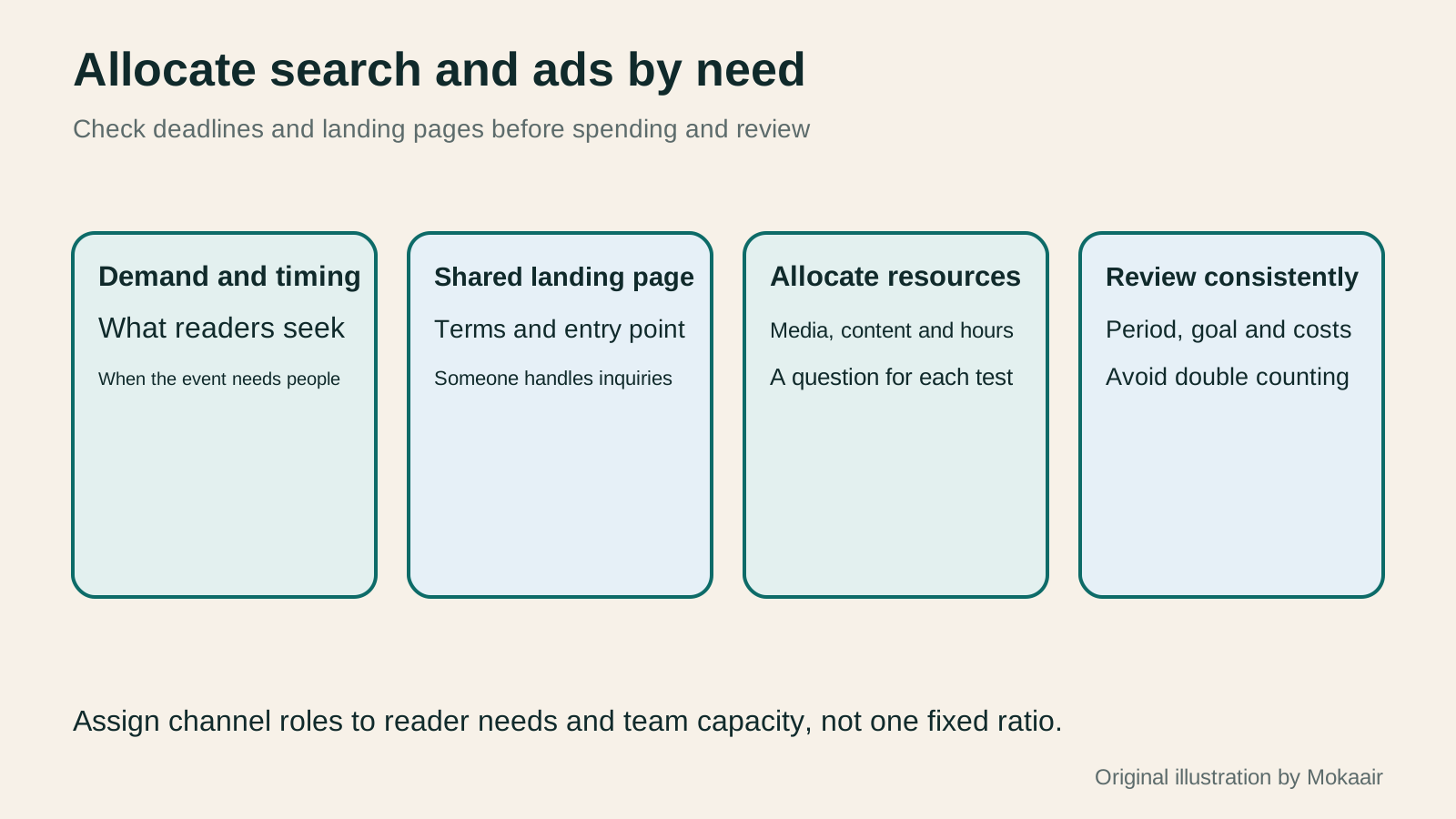
List the money and work hours available for the period, dividing them among website maintenance, content, media, creative assets, and analytics management. Preserve the basic capacity to deliver and maintain the service before choosing a limited testing budget. Without enough people to interpret data or answer inquiries, avoid launching too many platforms and campaigns at once.
Suppose the example workshop already has a clear class page but does not know what information inquiries most often lack. It can first organize customer-service questions, improve the explanation, and then observe a small ad test. If readers repeatedly search for the same preparation question, assess whether a lasting article is worthwhile. Write down the hypothesis and review date for each investment.
At review time, decide whether to continue, change, or pause, and explain the evidence. A low cost per click does not necessarily mean good inquiries, and lower organic traffic does not prove the content is useless. Check the original task and the data needed for the next question before shifting the whole budget to a channel just because it is fashionable.
- Classify reader needs, event deadlines, and the content and entry pages already available.
- Check whether the website can handle inquiries or registration and define completion consistently.
- List hours and costs separately, assigning each channel a task and a limited observation range.
- Review by period, source, and service outcome, and record why you continue or change course.
Compare on consistent terms and avoid counting results twice
Before comparing channels, align dates, goals, cost scope, and the definition of a conversion. Ad reports, website analytics, and actual orders may use different attribution methods. Do not add together every conversion each system claims. A single registration that touched social content, a search article, and an ad is still one registration, not three independent ones.
The example workshop can examine media spend, content and management costs, and verifiable qualified inquiries or completed registrations separately. If you divide only media spend by orders, clearly mark that production and service costs are excluded. Record maintenance hours for organic search as well so figures with different cost scopes are not treated as a fair comparison.
Common questions from ads may suggest content updates, and explanations readers repeatedly need in articles may sharpen ad messages. But ad performance does not by itself prove the same level of organic search demand or a ranking opportunity. Treat the channels as sources of clues for one another while preserving their separate limits; that is how a workable allocation develops.
| Workstream | Task for the original floral workshop | Watch for |
|---|---|---|
| Organic-search content | Answer recurring questions before attendance | Needs upkeep; indexing and ranking are not guaranteed |
| Search ads | Reach people seeking relevant classes | Needs budget, setup, and inquiry-quality checks |
| Social content or promotion | Introduce the experience and event details | Creative and response capacity must keep pace |
| Shared website page | Explain sessions, terms, and registration | Confirm it works before increasing traffic |
| Results and cost review | Align source, period, and actual registrations | Do not simply add cross-platform attribution totals |
Build a step-by-step SEO learning planA beginner's SEO learning roadmap: make your site readable before measuring traffic and resultsSEO beginners need not memorize ranking factors or buy a suite of tools. Using a small Taiwan website, this guide orders five topics: how search works, site readability, content planning, Search Console metrics, and results. Exercises by stage, a resource table, and a change log help you make pages readers and search engines can understand, then plan further work from data instead of tool scores or short-term swings.Read the full article
Start with a marketing plan for a small brandHow to write a small-shop marketing plan: goals, customers, and monthly reviewsA small-shop marketing plan can begin with one clear business problem; there is no need to schedule every social channel and ad at once. Using an original example about a florist's weekday orders, this guide works through goals, customers, channel roles, budgets, and monthly reviews. It provides practical worksheet fields, a comparison table, and an original diagram so owners can turn ideas into assigned, trackable actions they can revise. Completing a campaign is not a promise of sales.Read the full article
Separate services and fees when hiring an agency
Found this guide helpful? Share it with someone who needs it
Lifestyle
Evaluating Influencer Partnerships: KOLs, KOCs and Deliverable Reviews
Influencer partnerships take more than follower counts: check audience fit, formats and follow-up service capacity. Using an original illustrated postcard brand example, this guide covers practical KOL and KOC selection, briefs, asset rights and performance checks. A comparison table, steps and original diagram help small teams agree separately on deliverables and observed results, avoiding vague quotes and unverifiable traffic promises.
Lifestyle
How affiliate marketing works: Links, disclosures, and checking results
Affiliate marketing pays commissions for qualifying purchases or actions under a program's terms. Using an original desk cable-management guide, this article covers applications, link creation, disclosure, tracking windows, returns, and validation. It distinguishes clicks, pending commissions, withdrawable balances, and actual bank receipts. A workflow, comparison table, and original diagram help creators assess rules and costs before choosing reader-appropriate partnerships.
Lifestyle
Agentic Retrieval-Augmented Generation (Agentic RAG): When to Search Again
Agentic RAG lets models make retrieval decisions, choosing sources, rewriting queries or searching further based on the question and available evidence. Using a concrete LangGraph workflow and a comparison of venue-use conditions, this article contrasts it with fixed RAG and explains stopping criteria, permissions, query logs and cost control. Learn to judge whether a task needs dynamic exploration or a predictable fixed workflow is enough.
Lifestyle
Graph Retrieval-Augmented Generation (GraphRAG): Understanding a Document Collection Through Relationships
GraphRAG uses entities and relationships in retrieval to answer questions about cross-document connections and overall themes. Drawing on Microsoft's original paper and official docs, this article explains entity extraction, community summaries, and local and global search, using local event records to show why different questions need different paths. It also shows how missing links, mistaken name merges, and distorted summaries affect answers: a pretty graph is not verified fact.
Sources
- Google Search Central: SEO basics and time for changes to take effectChecked:
- Google Search Central: ads versus organic search resultsChecked:
- Google Ads: choose a campaign type for your goalChecked:
Compiled from the references and verification dates listed above; fares, schedules, product features, and terms can change, so please confirm the latest details on the relevant official website before travelling, booking, or purchasing.