Lifestyle
Plan Social Content: Topics, Conversation, and Moderation Boundaries
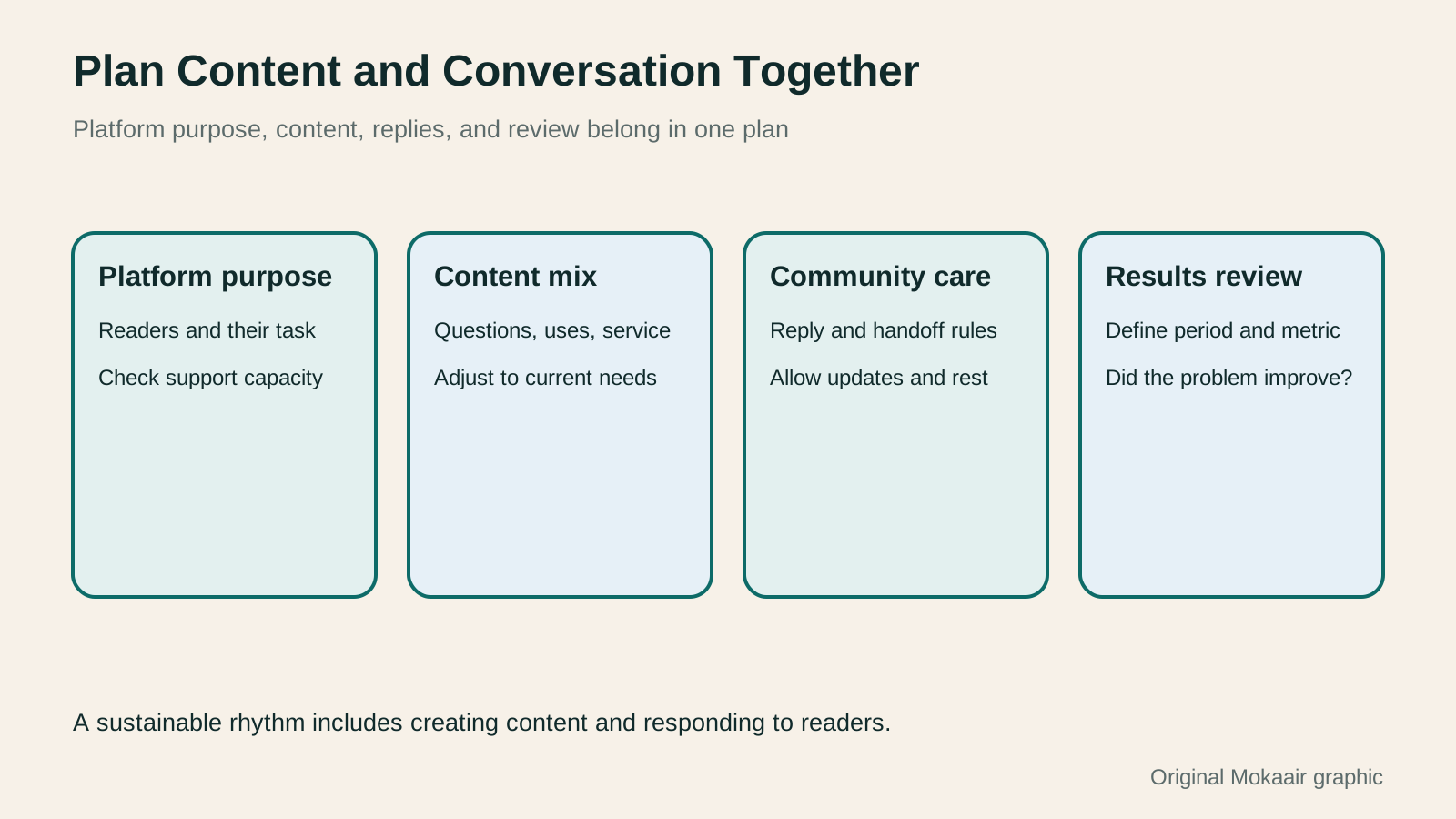
Running social accounts means planning content, conversation, and maintenance together, not just counting weekly posts. Using a fictional jigsaw-puzzle shop, this guide shows how to assign each platform a purpose, choose a flexible mix of topics, adapt formats, and set rules for replies and handoffs. A work table, practical steps, and an original diagram help small teams build a sustainable rhythm and review readers' questions and subsequent actions.
About 7 min read
Contents
- 1. Give each platform a one-sentence job
- 2. Choose a content mix by purpose, not a fixed formula
- 3. Rework one topic for how each format is consumed
- 4. Define reply, handoff, and moderation boundaries
- 5. Schedule replies, rest, and last-minute changes too
- 6. Review with consistent definitions, not likes alone
Posting the same product photo on every platform may look productive, while readers still cannot find the specifications or know whom to ask. A social plan should first decide the role of each account, then allocate content and people to answer questions so public messages connect to actual service.
This guide draws on YouTube's official scheduling advice, the GDS social-media playbook, and Mailchimp's writing guide, checked on September 14, 2026. The puzzle shop, post mix, and work arrangements are original examples. No account was actually operated, and no platform performance data was collected.
Give each platform a one-sentence job
List where intended readers meet the brand and what they usually need there. An account might help them discover a product, find event details, or ask a service question; ‘increase exposure’ alone is too vague. A brand can have several touchpoints, but each needs content, upkeep, and the capacity to respond.
The fictional puzzle shop might use its main social account to show use cases and answer common questions, keep full dimensions on its website, and direct order-specific matters to a suitable support channel. That is a division of work for this example, not a rule that each platform can do only one thing. Adjust it to reader habits and team capacity.
Before opening another account, ask whether a different audience or task actually needs it. Joining only because a platform is popular can make existing service harder to maintain. Specify the content source, owner, and review method before a small trial. Without enough information, do not treat an imagined audience as an established community.
Choose a content mix by purpose, not a fixed formula
For this period, content can play roles such as answering questions, showing use cases, explaining services, or inviting discussion. These are planning categories, not platform rules. Let current needs shape the mix: if specifications are often misunderstood, explain them more clearly; if an event is coming, include the essential participation details and reminders.
One illustrative week for the fictional shop could include two posts about specifications or use questions, one product use case, and one event notice. This only demonstrates a work split; four posts do not guarantee traffic. If material is thin or nobody can reply, post less and complete what is already planned properly.
For each post, write down the main question, key message, required material, next step, and owner. An ‘engagement post’ is not a random ‘How are you feeling today?’ Ask about a problem readers are working on, such as which label is hardest to understand when choosing a puzzle, and have someone ready to organize and answer the responses.
Rework one topic for how each format is consumed
Verified product information can become short copy, a graphic, or a demonstration video, but each format should accomplish a clear small task. A graphic can point to the specification; a short video can show an operating sequence; text can supply necessary conditions. A shrunken screenshot of a long article does not automatically become readable social content.
In the fictional shop, a short post about storage should state which products and situations it applies to and link clearly to full specifications. Do not remove important limits merely to fit a word count. Without testing, do not call an illustrative arrangement the most space-saving or efficient.
Mailchimp's social-media guide pairs clear writing with brand principles and advises care with unrelated trending topics. This article adopts that writing approach without reusing the guide's old platform character limits. Before posting, check the target platform's current formats, link display, and preview rather than assuming a cross-platform copy is finished.
Define reply, handoff, and moderation boundaries
The GDS playbook treats community management as ongoing interaction and calls for a plan to handle and hand off issues. A small shop can first separate questions that can be answered publicly, those requiring an order lookup, and those beyond the account manager's authority. Each category needs a next owner; ‘we passed it on’ is not enough.
The fictional shop could publicly answer questions about product specifications and event locations. To check an order, direct the customer to a designated support channel for the necessary details; do not ask them to post a phone number or address in comments. If a product owner must confirm an answer, say that you are checking and give a follow-up you can actually deliver.
Try to understand reasonable criticism instead of treating unfavorable comments as rule violations. Handle spam, harassment, or disclosure of others' information under clear community rules and platform mechanisms, keeping necessary records. Boundaries let discussion and service continue; they are not meant to make the comment section look as if everyone is pleased.
Schedule replies, rest, and last-minute changes too
YouTube's official scheduling advice emphasizes sustainability and asks creators to consider production time and content purpose. For other social work, estimate actual hours for research, graphics, writing, approval, and replies. Leave room in the schedule instead of filling every gap with a publishing task.
The fictional shop could prepare a few answers to common questions that are unaffected by short-term events as backup material for busy periods. Recheck time-sensitive content before it goes live. Scheduled does not mean unattended: when opening hours, stock, or outside events change, someone should check whether the post is still suitable.
If team members take turns managing the account, hand over unresolved inquiries, promised replies, and posts needing verification. Public reply hours should match real staffing so readers do not assume someone is available around the clock. An automatic reply can state the channel and hours; it must not pretend that an individual issue has already been checked.
- Define each platform's readers and task, and confirm that someone can maintain it and reply.
- Choose content roles around current questions; give each post material and a next step.
- Adapt formats, preserve essential details, and schedule review, publishing, and reply time.
- Review questions and later service work, then adjust the content mix and moderation rules.
Review with consistent definitions, not likes alone
Start with what each post was meant to achieve, then choose observations you can actually obtain. For event details, you might check whether people found the registration link; for an answer post, note what remains unclear. Platform interactions offer clues, but they are not the same as a sale, understanding, or trust in the brand.
Record the platform, format, observation period, and whether paid promotion was used. Similar-looking metrics can be calculated differently across platforms, so do not simply add them into one result. To compare engagement rates, state the numerator and denominator first and keep the definition consistent.
At each review, the fictional shop might keep one practice, change one, and pause one, with reasons. If a post generates many questions nobody can handle, improve service capacity first. A rhythm is worth keeping when social content continues to answer reader needs and the team can handle the conversations that follow.
| Content role | Fictional puzzle-shop example | Work after posting |
|---|---|---|
| Answer a question | Show where dimensions appear on the product page | Note which fields remain unclear |
| Show a use case | Show a desk setup for a specific product | Check applicability and related questions |
| Service information | Event date, place, and participation link | Update changes and answer participation questions |
| Invite discussion | Ask what information readers lack when choosing | Organize answers and respond where possible |
| Maintain and correct | Update service details in an older post | Correct the website and other touchpoints too |
Use a content calendar for materials and reviewPlanning a Content Marketing Calendar Around Reader Questions and UpdatesA content marketing calendar does more than assign publication dates to headlines. It also schedules reader questions, asset production, fact-checking and ownership of updates. Using a fictional fabric shop, this guide turns customer-service questions into an idea bank and plans articles, diagrams and short posts together. A four-week schedule, production steps and an original diagram show how to allow time for review and maintenance, then test whether each piece helps readers complete a task.Read the full article
Keep a consistent brand voice across situationsBrand voice and atmosphere marketing: stay consistent while answering real questionsBrand voice and atmosphere are more than a consistent palette or the same emoji in every sentence. Readers should understand how a brand speaks and serves them across different situations. Using an original rain-gear brand, this guide covers voice principles, visual information hierarchy, situational tone and ways to check understanding. Product launches, instructions, delay notices and an original diagram help teams create coherent content without rigidity or sacrificing readability for mood.Read the full article
Connect social channels to the customer journeyCustomer Journeys and Marketing Funnels: Find Where Readers Drop OffCustomer journeys explain touchpoints and needs; marketing funnels count people at each step using consistent criteria. Using an original bicycle repair booking example, this article explains how to map online and offline contacts, define completion events, calculate step conversion rates, and set up GA4 open or closed funnels. A calculation table, practical steps, and original diagrams help identify improvement hypotheses to test without mistaking data gaps for causes of customer drop-off.Read the full article
Found this guide helpful? Share it with someone who needs it
Lifestyle
How to Read the BCG Matrix: Uses and Limits of Product Portfolio Analysis
The BCG matrix maps product portfolios by market growth and relative share; stars, cash cows, question marks and dogs do not establish actual profit. An original home goods store example shows how to define markets, check comparison periods and denominators, understand model assumptions, and allocate resources using costs, turnover and customer needs. Includes a four-category table, practical steps, original diagrams and options when reliable market data is lacking.
Lifestyle
How to Use the Ansoff Matrix: Four Options for Expanding Products and Markets
The Ansoff matrix maps four growth paths using existing or new products and markets: market penetration, market development, product development and diversification. An original canvas goods studio example shows how to define the current business and compare the capabilities and evidence each path needs. A comparison table, steps and original diagrams turn growth ideas into small, testable plans, without treating the model as a success-rate table.
Lifestyle
How to Write Marketing Copy: Clarify Value, Conditions, and Next Steps
Marketing copy should explain who it suits, its value, conditions, and what happens next. Using an original journal-binding workshop example, this article revises information hierarchy, features and benefits, evidence for claims, and action buttons step by step. A before-and-after table and original diagrams show how to retain appeal without overstating promises, and check that prices, limits, images, and links align before publication.
Lifestyle
Customer Journeys and Marketing Funnels: Find Where Readers Drop Off
Customer journeys explain touchpoints and needs; marketing funnels count people at each step using consistent criteria. Using an original bicycle repair booking example, this article explains how to map online and offline contacts, define completion events, calculate step conversion rates, and set up GA4 open or closed funnels. A calculation table, practical steps, and original diagrams help identify improvement hypotheses to test without mistaking data gaps for causes of customer drop-off.
Articles that cite this one
Sources
- YouTube: A sustainable publishing scheduleChecked:
- GDS: Social media playbookChecked:
- Mailchimp: Principles for social copy and engagementChecked:
Compiled from the references and verification dates listed above; fares, schedules, product features, and terms can change, so please confirm the latest details on the relevant official website before travelling, booking, or purchasing.