Lifestyle
2026 Tech News Roundup: Key Points on Hardware, Platforms, Telecom, and Regulation
This site's 2026 tech-news explainers in five groups — hardware, platforms, computing infrastructure, Taiwan policy, EU regulation: iPhone Duo and September hardware, M6/M5 Ultra, Snapdragon 8 Elite Gen 6, Project Zenith, Pixel Drop, App Store subscriptions, WordPress and Synology patches, NVIDIA, 6G, the Taiwan–Matsu cables, the sovereign AI corpus, the Cyber Resilience Act, the KIDS Act and Apple's EU terms. No purchase advice; vendor claims attributed; official sources and check dates.
Updated: About 18 min read
This index collects this site's 2026 tech-news explainers. The event dates in this batch fall between June and September 2026, and the subject matter is hardware, operating systems and platforms, telecommunications, and regulation — not AI models themselves. The content is organized into five groups — consumer hardware and chips; platforms and software; computing infrastructure and semiconductors; Taiwan's telecom and digital policy; and EU cybersecurity regulation and platform terms — and each entry traces back to the vendor's own press release and technical documentation, or to the regulator's announcement or the original text of the regulation, before linking to the full explainer article.
This index was checked on September 17, 2026 and expanded on September 27, 2026. This site has not tested any product, software, or service itself, and offers no advice on whether to buy, upgrade, or switch devices; this series lays out the differences in official pricing, specifications, and conditions, but does not conclude “whether you should buy” or “which one is better.” Performance figures a vendor measured or claimed itself are always attributed — “Apple states,” “NVIDIA says” — together with the comparison model, test conditions, and qualifiers such as “up to”; figures without a primary source are left out. Each article states its own fact-check date near the top, and pricing, launch timing, and the regions where a feature applies follow that official page's current announcement.
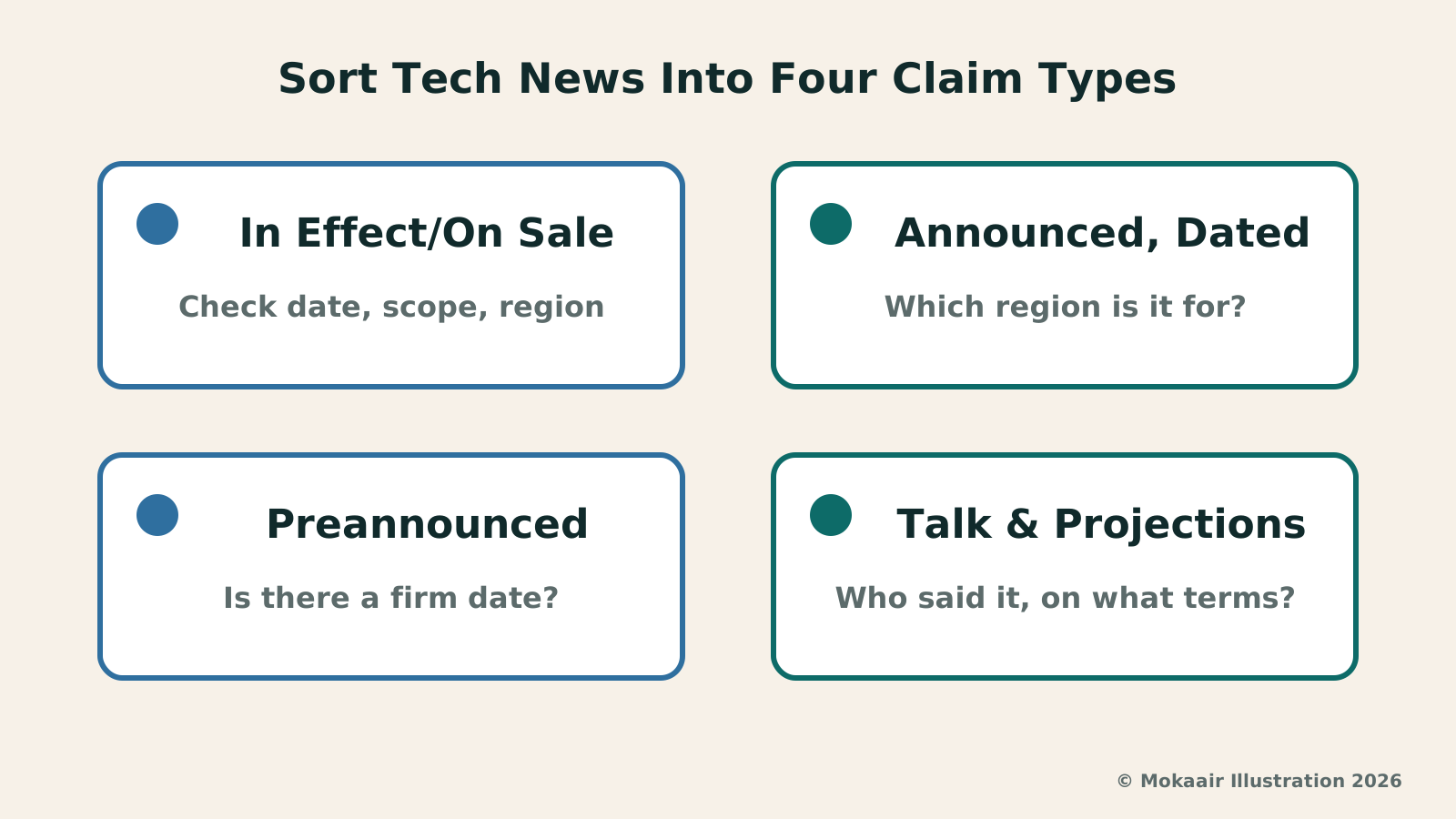
First, Sort the Claim Type: In Effect, Announced, Preannounced, or Discussed
Not all “news” is equally reliable. In this batch, an example of something already in effect is the EU's Cyber Resilience Act: Article 71(2) moved up Article 14's reporting obligations to apply from September 11, 2026, requiring manufacturers to report actively exploited vulnerabilities or severe incidents within set deadlines — 24 hours, 72 hours, and so on — once they become aware; the Regulation as a whole, in principle, does not apply until December 11, 2027. An example of something already on sale is the iPhone 18 Pro lineup, Apple Watch Series 12, Apple Watch Ultra 4, and AirPods 5, which Apple announced on September 9; Apple's Taiwan press release states they go on sale September 18.
The second kind is already announced, with a date given, but the date hasn't arrived yet: iPhone Duo was likewise announced on September 9, and Apple's Traditional Chinese press release states that pre-orders open in Taiwan at 8 p.m. Taiwan time on October 16, with availability from October 23. Apple's announcement adjusting its EU App business terms was published August 18, with primary updates taking effect October 1, in a scope limited to EU storefronts. Reading this kind of news means checking the region along with the date — the same announcement often carries different dates, prices, and features from one region to another.
The third kind is a preannouncement or a preview: Apple says iPhone Duo's support for Apple Pencil (USB-C) is “coming later this year,” without giving a date; NVIDIA's technical documentation labels CUDA-Q Logical a preview, meaning its API and behavior may change substantially in later versions, yet the press release describes its availability only as now available via GitHub, and the word “preview” does not appear anywhere in it; neither of Microsoft's two Project Zenith announcements gives a price, launch timing, or region; and moda describes the Taiwan–Matsu No. 4 submarine cable as “coming to completion soon,” while the official document that article cites gives no completion date.
The fourth kind is remarks made at a symposium, and a vendor's own projections. At moda's international 6G spectrum symposium, the press release uses words like “explore” and “hope”; a deputy minister said global 6G is expected to gradually become commercially available starting in 2030, but that is his own read on the international landscape, not a Taiwanese timeline. NVIDIA states that DSX MaxLPS can deliver up to 40% more GPUs within the same site's power envelope; when that figure is applied to Vera Rubin NVL72, NVIDIA's own article notes it is based on NVIDIA's own projections, limited to suitable deployment environments, and paired with data-center power planning — not a measured result. Going back to the original document to see which of these four kinds a headline like “X has already launched” or “Country Y has already decided” actually belongs to is something every article in this series does.
| Type of claim | Examples in this batch | What to check first |
|---|---|---|
| Already in effect or already on sale | The reporting obligations under Article 14 of the EU's Cyber Resilience Act; Apple's new devices, on sale from September 18 | The effective or ship date, and who and where it applies to |
| Already announced, with a date | iPhone Duo's pre-order and ship dates in Taiwan; Apple's EU App business terms, effective October 1 | Which region the date applies to, and whether the conditions carry a proviso |
| Preannouncement or preview | Apple Pencil support “coming later this year,” CUDA-Q Logical's preview status, Project Zenith, the Taiwan–Matsu No. 4 cable “coming to completion soon” | Whether there's a firm date, version, or price |
| Symposium remarks or vendor projection | Remarks at the international 6G spectrum symposium; NVIDIA's 40% figure, labeled a projection | Who said it, on what conditions, and whether it's a measured result |
Consumer Hardware and Chips: Specs, Taiwan Pricing, and Their Own Conditions
Apple announced iPhone Duo on September 9, 2026; its press release calls it the company's first folding iPhone, with a built-in 7.6-inch display when open and a 5.4-inch outer display when closed, an eSIM-only design worldwide, and Taiwan pricing starting at NT$74,900. That article also sorted out an easy-to-miss detail: Apple's Traditional Chinese press release states the first wave covers 「超過 63 個國家和地區」 (more than 63 countries and regions), while the English and Singapore versions say more than 70, and the qualifier “up to” was also dropped in several places in the Traditional Chinese version of the performance figures. Announced the same day, the iPhone 18 Pro lineup, Apple Watch Series 12, Apple Watch Ultra 4, and AirPods 5 form a separate article, focused on Taiwan pricing and the Health Sensing System the two watches share; a footnote in the Taiwan press release states that the hypertension notification feature will not launch in Taiwan at first, and is expected to arrive next year.
On August 25, Apple introduced two chips, M6 and M5 Ultra, debuting in the new Mac mini and new Mac Studio respectively. Apple states M6 is Apple's first chip built on a 2-nanometer process, and M5 Ultra supports up to 512GB of unified memory and 1.2TB/s of bandwidth; the Mac mini with M6 is priced from NT$29,900 in Taiwan, and the Mac Studio with M5 Ultra from NT$199,900. That article spends considerable space on one issue: the same M5 Ultra's AI-performance multiple is given as different figures in the chip press release and the Mac Studio press release, with different test months and different wording, and the two cannot be used interchangeably. The performance, battery-life, and accuracy figures in all three of these articles are Apple's own tests or claims.
On September 22, Qualcomm unveiled two flagship mobile platforms at once, the Snapdragon 8 Elite Extreme Gen 6 and the Snapdragon 8 Elite Gen 6, in a press release datelined Maui; beyond the 2nm process node it gives no specification figures, and it names no foundry, launch date, price or Taiwan information.
Platforms and Software: Features Each Tied to Their Own Devices, Regions, and Languages
Microsoft announced Project Zenith on September 4, preinstalling development tools and adjusting interface defaults for “developer-class devices” with 64GB or more of unified memory and 250GB/s or more of bandwidth, and stating it would first ship with AMD's Ryzen AI Halo; neither of Microsoft's two announcements gives a price, launch timing, or region, and neither mentions Taiwan.
Google published its September Pixel Drop on September 15, and each feature carries its own conditions: the keyboard scam alert, per the announcement, starts in the United States and covers Pixel 6 and later; notification-based Scam Detection adds 9 countries and 6 languages this time; and the Pixel Watch update goes only to Pixel Watch 5, where the “proactive suggestions” feature additionally requires a Pixel 11. None of the four sources that article cites lists Taiwan, and Google does not state that Taiwan is excluded either.
Also on September 16, Apple announced the subscription changes that come with iOS 27: several subscriptions may be sold as one purchase, as a bundle or a suite, with up to five developers taking part; multiseat purchases are on by default in App Store Connect, volume purchasing is scheduled for October 22 and group purchases are only promised for this winter. The official pages name no country or region.
On September 18, Synology published security advisory Synology-SA-26:13, covering eight CVE entries in DSM, two of them rated Critical by Synology, with a CVSS 3.1 base score of 9.8, and exploitable without authentication; on September 22, WordPress released 7.1.2, a security release patching a core vulnerability it rates as critical severity, with patches reaching back from the 7.1 branch to the 4.7 branch; both articles set out the patched versions and how to check your own version number.
Computing Infrastructure and Semiconductors: Estimates, Projections, and Regulatory Filings
NVIDIA made two announcements in September. On September 14, NVIDIA added CUDA-Q Logical to its open-source CUDA-Q platform; its technical documentation defines it as a resource-estimation tool for fault-tolerant quantum computing that does not submit a schedule to hardware for execution, and no new quantum computer appears in the announcement. The figure it cites — that 1,000 logical qubits would need just 150,000 physical qubits — is a modeling estimate Iceberg Quantum obtained using this tool, not hardware that has actually been built. At the September 15 AI Infra Summit, neither of the two official announcements introduces a new chip; both are about power: NVIDIA states that the metric for measuring an AI data center is shifting from peak performance to how many tokens can be produced per megawatt. That article keeps a partner's own measurements, NVIDIA's own projections, and figures NVIDIA relays from third parties clearly separate.
On August 31, NVIDIA and MediaTek announced they were deepening their cooperation in three areas — AI infrastructure, local AI computing, and automotive — and NVIDIA invested US$3.5 billion in convertible bonds issued by MediaTek. The press release states only that figure; the terms of the bond issue — a total issuance of US$3.9 billion, a 0% coupon, and provisional issue and maturity dates — appear in MediaTek's own pricing announcement filed with the Market Observation Post System (MOPS) the same day. NVIDIA subscribed to bonds, not shares, and neither press release announces a new product; this site offers no investment advice.
Taiwan: Spectrum, Submarine Cables, and the Training Corpus
moda held the “Spectrum for Tomorrow” International Symposium on September 10, discussing the integration of 6G terrestrial and non-terrestrial networks and the spectrum demand created by AI; the press release does not name a single frequency band or give Taiwan its own 6G timeline, and the Radio Frequency Supply Plan (無線電頻率供應計畫, amended February 2025) does not contain the term “6G” anywhere in its full text. On June 23, moda explained that the Taiwan–Matsu No. 4 submarine cable and the microwave stations in Matsu's four townships, built with Forward-looking Infrastructure budget subsidies to Chunghwa Telecom, were “coming to completion soon”; that article also lays out what happened when the Taiwan–Matsu No. 3 cable's Beigan–Dongyin section suffered a complete break on April 29, 2026, and Chunghwa Telecom switched to microwave communications as a backup.
On September 15, moda launched a public call for content for the “Taiwan Sovereign AI Training Corpus” (臺灣主權AI訓練語料庫), inviting publishers and writers to license their published works for AI training. The official approach is royalty-free licensing; the license terms state that the license may not be sublicensed or transferred, and that even if the original corpus data is later withdrawn from use, this does not affect training results already completed. As for opting out, the four official documents that article cites state only that “a complete process for requesting withdrawal is in place,” with no URL, form, or processing time given for that process.
On September 18, Chunghwa Telecom announced that the nearly 300-kilometre fourth Taiwan–Matsu cable had been built, landed and tested, taking the Taiwan–Matsu links from two cables to three and the overall capacity to about 1.9 Tbps; it put the investment at nearly NT$1.4 billion but gave no date for commercial service, and moda's press-release page carried no matching release on the day this site checked.
EU: Reporting Obligations Take Effect, App Business Terms Revised
The reporting obligations under Article 14 of the Cyber Resilience Act (CRA) have applied since September 11, 2026, and the European Union Agency for Cybersecurity (ENISA) simultaneously launched its Single Reporting Platform: once a manufacturer becomes aware of an actively exploited vulnerability or a severe incident, it must send an early warning within 24 hours at the latest, and a full notification within 72 hours. ENISA's FAQ states that this obligation also applies to products already on the market before December 11, 2027; the platform is currently at “initial operating capability,” supports only an English interface, and the voluntary reporting feature under Article 15 is not yet available.
Apple announced on August 18 that it was adjusting its EU App business terms: the previous Core Technology Fee is replaced by a Core Technology Commission of 5%, charged on alternative marketplaces themselves and on iOS and iPadOS apps distributed through an alternative marketplace or website, and apps are now allowed to offer Apple In-App Purchase alongside alternative payment options, with primary updates taking effect October 1. These terms apply only to apps listed on EU storefronts; none of the four Apple pages that article cites says whether Taiwan or any other region will adopt the same terms.
On September 16, Apple told developers in its news feed that the App Tracking Transparency prompt has another version in the EU: from iOS 27.2 and iPadOS 27.2, only the new version may be used in Germany, France, Italy, Poland and Romania, the device setting is renamed in the EU, and a developer may ask again a year after the user last answered; Apple named no regulator and no law. On September 17, the European Commission adopted its KIDS Act proposal, under which social media platforms may not let children under 13 hold an account and a minor may open one alone only at 15; it is a proposal sent to the European Parliament and the Council, and the official pages give no date of application.
Frequently asked questions
Why doesn't this series give purchase advice?
This is an editorial boundary for this site's tech content: it lays out the differences in official pricing, specifications, and conditions so readers can judge for themselves, but it does not write “whether you should buy,” “whether it's worth upgrading,” or “which one is better,” and it does not turn a price comparison into a conclusion like “now is the best time to buy.” Official pricing is included, with a source and fact-check date; every article's Taiwan price is the figure on the official page as of its fact-check date, and actual pricing and availability follow the official page's current announcement.
How does this series handle performance figures a vendor provides?
They are always attributed, together with their conditions. This site has not tested any of these products, so claims like “up to 40% faster” or “the most accurate” are written as “Apple states,” “NVIDIA says,” or “in Google's own words,” together with the comparison model, the test month, and qualifiers such as “up to”; the article also states whether the figure is a measurement, the vendor's own projection, or a result the vendor is relaying from a third party. When two official documents give different figures for the same thing, both are listed — this site does not pick one on the vendor's behalf.
What do these stories have to do with readers in Taiwan?
Each article states Taiwan's own situation, and where it can't, it says plainly that the official source doesn't address it. For example, Apple's new devices have Taiwan pricing and Taiwan pre-order and ship dates, though a footnote in the Taiwan press release says the hypertension notification feature won't launch in Taiwan at first; Pixel Drop's notification-based Scam Detection and Audible trial don't list Taiwan on their official lists; Apple's EU App business terms and the Cyber Resilience Act govern the EU market; and neither of Microsoft's two Project Zenith announcements mentions Taiwan. Readers should not infer that something is already available or already in effect in Taiwan just because it was announced abroad.
Will these articles keep being updated?
Each one is a news explainer as of its own fact-check date, not a live tracker. Pricing, launch timing, the regions a feature applies to, and the official pages themselves can all change; several articles cite official pages that are themselves updated on an ongoing basis, so each one explains how to go back to the official page to check the current status. This index will be updated as new articles are added to the series.
Consumer Hardware and Chips
Apple Unveils iPhone Duo: Displays, Battery, and Taiwan Launch TimelineApple Unveils iPhone Duo: Displays, Battery, and Taiwan Launch TimelineOn September 9, 2026, Apple unveiled iPhone Duo, its first foldable iPhone: a 7.6-inch inner display when open and a 5.4-inch outer display when closed, with an eSIM-only design. Drawing on Apple official press releases and its technical specifications page, this article covers the display and body specs, battery and charging figures, and Taiwan launch timeline and pricing, and flags where the Traditional Chinese press release differs from the English version. Fact-checked September 17, 2026.Read the full article
iPhone 18 Pro, Watch Series 12/Ultra 4, AirPods 5: Taiwan Pricing and the Health Sensing SystemiPhone 18 Pro, Watch Series 12/Ultra 4, AirPods 5: Taiwan Pricing and the Health Sensing SystemOn September 9, 2026, Apple's Taiwan Newsroom announced the iPhone 18 Pro lineup, Apple Watch Series 12, Apple Watch Ultra 4 and AirPods 5. Based on the official press releases, this article lays out Taiwan pricing, pre-order and availability dates, and the new watches' shared "Health Sensing System," plus Apple's own note that the hypertension notification feature will not launch in Taiwan at first. It contains no purchase advice, and this site has not tested any of the products.Read the full article
Apple Introduces M6 and M5 Ultra: Mac mini and Mac Studio Debut, and Taiwan PricingApple Introduces M6 and M5 Ultra: Mac mini and Mac Studio Debut, and Taiwan PricingOn August 25, 2026, Apple introduced two new chips, M6 and M5 Ultra, debuting in the new Mac mini and Mac Studio. M6 is Apple's first 2-nanometer chip, and M5 Ultra is the first to use UltraFusion to form a quad-die architecture. Based on the official press releases, this article lays out Taiwan pricing and each chip's unified memory specs; the performance multiples are Apple's own test results, this site has not tested them, and it offers no purchase or upgrade advice.Read the full article
Qualcomm Unveils Two Snapdragon Flagship Mobile Platforms: How the Extreme and 8 Elite Gen 6 DifferQualcomm Unveils Two Snapdragon Flagship Mobile Platforms: How the Extreme and 8 Elite Gen 6 DifferOn September 22, 2026, Qualcomm unveiled two flagship mobile platforms at once, the Snapdragon 8 Elite Extreme Gen 6 and the Snapdragon 8 Elite Gen 6, dated from Maui. A look at how the press release splits the two, which brands its Snapdragon Summit partner quotes named, and the foundry, clock speeds and other spec numbers, launch dates and Taiwan information the press release does not state. (Checked September 2026)Read the full article
Platforms and Software
Microsoft Unveils Project Zenith: A Unified Memory and Bandwidth Baseline for Windows Dev MachinesMicrosoft Unveils Project Zenith: A Unified Memory and Bandwidth Baseline for Windows Dev MachinesOn September 4, 2026, Microsoft announced Project Zenith on the Windows Developer Blog: preinstalled tools and interface defaults for "developer-class devices" with 64GB+ unified memory and 250GB/s+ bandwidth, said to run 30B+ parameter models locally. Based on three Microsoft posts and one AMD post, this article explains what actually changes, how the baseline is defined, and the price, timeline, and regions both announcements leave unstated.Read the full article
Google's September Pixel Drop: Model, Region, Language, and Pixel Watch 5 ConditionsGoogle's September Pixel Drop: Model, Region, Language, and Pixel Watch 5 ConditionsOn September 15, 2026, Google published its September Pixel Drop on the official blog, linking to forum posts on device and region conditions and to the Pixel Watch 5 update notes. This article covers the device, region, and language conditions for Scam Detection, the expiry dates for the Harry Potter pack and the Audible trial, the table that leaves Pixel Tablet unchecked, and the features that require pairing a Pixel Watch 5 with a Pixel 11. Checked September 17, 2026.Read the full article
New App Store Subscription Rules: Bundles Cap at Five Developers, Multiseat Purchases On by Default, Volume Purchasing Arrives October 22New App Store Subscription Rules: Bundles Cap at Five Developers, Multiseat Purchases On by Default, Volume Purchasing Arrives October 22On September 16, 2026, Apple announced App Store subscription changes for iOS 27: subscriptions can combine into one purchase as a Bundle or Suite with up to five developers; multiseat purchases have defaulted on in App Store Connect since the announcement, Volume Purchasing launches October 22, and Group Purchases is only previewed for this winter. Apple names no region and does not mention Taiwan; checked and compiled September 18, 2026.Read the full article
WordPress 7.1.2 Patches a Critical Core Vulnerability: Patched Versions by Branch and How to Check Your SiteWordPress 7.1.2 Patches a Critical Core Vulnerability: Patched Versions by Branch and How to Check Your SiteOn September 22, 2026, WordPress released 7.1.2, a security release patching a core vulnerability it rates as critical severity; the patch reaches back from the current 7.1 branch to the 4.7 branch. On September 25 (US time), CISA added it to its Known Exploited Vulnerabilities catalog based on evidence of active exploitation. This piece lays out the patched version for each branch and how to check your own site's version number (verified September 2026).Read the full article
Synology Advisory SA-26:13: Two Unauthenticated 9.8 Flaws — Check Your Version Before UpdatingSynology Advisory SA-26:13: Two Unauthenticated 9.8 Flaws — Check Your Version Before UpdatingAt 4:17 PM Taipei time on September 18, 2026, Synology published security advisory Synology-SA-26:13, addressing eight CVE entries in DSM — two rated Critical with a CVSS 3.1 score of 9.8, exploitable without authentication. The advisory's Mitigation field reads None. Here are the fixed releases for each branch and how to check your NAS's current version yourself (verified September 2026).Read the full article
Computing Infrastructure and Semiconductors
NVIDIA's AI Infra Summit Power Efficiency Talk: What's New With Vera Rubin and DSXNVIDIA's AI Infra Summit Power Efficiency Talk: What's New With Vera Rubin and DSXOn September 15, 2026, at the AI Infra Summit in Santa Clara, California, NVIDIA presented the Vera Rubin platform and DSX data-center power-management software, saying the metric for AI infrastructure is shifting from peak performance to tokens produced per megawatt. Based on NVIDIA's blog posts from that day and its January and August press releases, this article checks what was actually new, which numbers are measured, which NVIDIA labels as projections, and what remains unstated.Read the full article
NVIDIA Adds CUDA-Q Logical to Its Open Source CUDA-Q Platform: A Resource Estimator, Not a Quantum ComputerNVIDIA Adds CUDA-Q Logical to Its Open Source CUDA-Q Platform: A Resource Estimator, Not a Quantum ComputerOn September 14, 2026, NVIDIA announced CUDA-Q Logical, an orchestration layer for its open-source CUDA-Q platform that helps researchers estimate the hardware a fault-tolerant quantum application would need, not a new quantum computer. Based on NVIDIA's press release and technical documentation, this article explains what the tool can and cannot do, where the two sources differ, and QUOPS, the cross-platform benchmark built by Sandia National Laboratories. Checked September 17, 2026.Read the full article
NVIDIA Invests US$3.5 Billion in MediaTek: What the Partnership Announcement and the Convertible Bond Filing Each SayNVIDIA Invests US$3.5 Billion in MediaTek: What the Partnership Announcement and the Convertible Bond Filing Each SayOn August 31, 2026, NVIDIA and MediaTek announced a deepened collaboration in AI infrastructure, local AI computing and automotive, and NVIDIA invested $3.5 billion in convertible bonds issued by MediaTek. Based on the official press releases and MediaTek's pricing filing with Taiwan's Market Observation Post System, this article covers what the releases say, what terms the filing adds, and what remains unaddressed. Checked September 17, 2026.Read the full article
Taiwan: Telecom and Digital Policy
moda Hosts International 6G Spectrum Symposium: What Was Discussed, What Remains Undecidedmoda Hosts International 6G Spectrum Symposium: What Was Discussed, What Remains UndecidedOn September 10, 2026, Taiwan's Ministry of Digital Affairs (moda) held the "Spectrum for Tomorrow" International Symposium, inviting ITU-R Study Group 5's chairman and spectrum-policy experts from several countries to discuss 6G's spectrum demand from land-space integration and AI. Using moda's press release, program page, and the Radio Frequency Supply Plan (amended February 2025), this article lays out what was discussed and what the official documents had not yet said as of the check date.Read the full article
Taiwan–Matsu No. 4 Submarine Cable and Matsu’s Microwave Stations: moda Says Completion Is Coming Soon, and the State of Matsu’s Communications BackupsTaiwan–Matsu No. 4 Submarine Cable and Matsu’s Microwave Stations: moda Says Completion Is Coming Soon, and the State of Matsu’s Communications BackupsOn June 23, 2026, moda said the Taiwan–Matsu No. 4 cable and microwave stations in Matsu’s four townships, built with Forward-looking Infrastructure subsidies, are due to be completed soon; once active, there will be 3 cables and at least 2 microwave systems per township. This article traces the cable outages and backups of the first half of 2026 from official notices, plus the official cable list as of September 17, 2026. This site did no on-site testing and gives no travel or carrier advice.Read the full article
Chunghwa Telecom Announces Completion of the Taiwan–Matsu Fourth Cable: Nearly NT$1.4 Billion, Triple-Route Backup, and 1.9 TbpsChunghwa Telecom Announces Completion of the Taiwan–Matsu Fourth Cable: Nearly NT$1.4 Billion, Triple-Route Backup, and 1.9 TbpsOn September 18, 2026, Chunghwa Telecom announced the nearly 300 km Taiwan–Matsu Fourth Cable has completed construction, landing, and testing; cables to Matsu rise from two to three, capacity reaching about 1.9 Tbps. Using Chunghwa Telecom and moda announcements, this article compares June's preannouncement with September's, adds moda's same-day 5G showcase in Matsu, and notes what goes unstated: the commercial-service date and single-cable capacity. No on-site tests, no carrier advice.Read the full article
Taiwan Sovereign AI Training Corpus Opens Public Call for Content: License Terms and the State of Its Hakka-Language DataTaiwan Sovereign AI Training Corpus Opens Public Call for Content: License Terms and the State of Its Hakka-Language DataOn September 15, 2026, Taiwan's Ministry of Digital Affairs (moda) announced a public call for content for the Taiwan Sovereign AI Training Corpus, inviting publishers and writers to license their works for AI training. Drawing on three moda press releases and the license-terms page of the corpus website, this article covers the scope of the call, the royalty-free terms, the real limits of the "opt-out" option, and what the official documents leave unsaid. Checked September 17, 2026.Read the full article
EU: Cybersecurity Regulation and Platform Terms
EU Cyber Resilience Act Reporting Obligations Begin September 11: Who Must Report, How FastEU Cyber Resilience Act Reporting Obligations Begin September 11: Who Must Report, How FastOn September 11, 2026, the reporting obligations under Article 14 of the EU's Cyber Resilience Act took effect, and ENISA launched its Single Reporting Platform. Based on the European Commission's reporting page, ENISA's press release and FAQ, and the Regulation's text in the Official Journal, this article explains how fast manufacturers must report, where reports go, which obligations already apply, which wait until December 2027, and the fine ceiling in Article 64.Read the full article
European Commission Adopts KIDS Act Proposal: No Social Accounts Under 13, Own Account at 15European Commission Adopts KIDS Act Proposal: No Social Accounts Under 13, Own Account at 15On September 17, 2026, the European Commission adopted the EU KIDS Act proposal, barring social platforms from letting children under 13 hold accounts and setting 15 as the minimum age to open one. This article uses the Commission's press release, FAQ and proposal summary to lay out the age tiers, design duties, age-verification methods and penalty thresholds, and notes this is still a proposal before the European Parliament and Council, with no stated date of entry into force.Read the full article
Apple Announces New EU App Business Terms: A 5% Core Technology Commission, and Alternative Payments Alongside Apple In-App PurchaseApple Announces New EU App Business Terms: A 5% Core Technology Commission, and Alternative Payments Alongside Apple In-App PurchaseOn August 18, 2026, Apple announced new EU App Store business terms: the Core Technology Fee becomes a 5% Core Technology Commission, commissions run 26%/20%/15% by payment method, and apps may offer Apple In-App Purchase alongside alternative payments. Primary updates take effect October 1, 2026, for EU storefronts only. Checked against Apple's own announcements and support pages on September 17, 2026.Read the full article
Apple Adjusts EU App Tracking Transparency Prompt: Five Countries Get the New Version, a Renamed Setting, Yearly RepromptsApple Adjusts EU App Tracking Transparency Prompt: Five Countries Get the New Version, a Renamed Setting, Yearly RepromptsOn September 16, 2026, Apple announced that the EU's App Tracking Transparency prompt will get an alternative version: from iOS 27.2 and iPadOS 27.2, Germany, France, Italy, Poland, and Romania can only use it, and the EU device setting has been renamed. Developers can now ask again a year after a user's last response. Based on Apple's announcement and support page, this article covers what changed, what did not, and what the announcement does not mention, including Taiwan.Read the full article
Lifestyle
Cloudflare launches Traces in public beta: site operators can follow every step a request takes through the platform on one timeline
On October 2, 2026, Cloudflare announced the public beta of Cloudflare Traces. Website operators and developers using Cloudflare can see a request pass through security rules, caching, routing and the origin server on a single timeline, making it easier to find why a request was blocked or slowed. New pricing takes effect on December 1, 2026. Information comes from the official Cloudflare blog.
Lifestyle
Cloudflare launches Web Search API via AI Gateway, requiring search partners to follow its crawler rules
On October 2, 2026, Cloudflare announced a Web Search API that lets AI agents query live web information through AI Gateway. The first partners are Ceramic.ai, Exa and Linkup. Cloudflare says these partners' crawlers must meet its Verified bots requirements and cite sources. This matters both to developers building AI applications and to website owners whose content may be crawled.
Lifestyle
Cloudflare open-sources Streamline: a demo of using its cloud services to add graphics to live streams and burn subtitles into videos
On October 2, 2026, Cloudflare launched and open-sourced Streamline, a developer playground showing how developers can combine Stream, Workers, Containers and Durable Objects to build their own video processing pipelines, such as adding graphics to live streams in real time or adding subtitles to videos. This article explains what it is, how it works, its limitations, and what it means for viewers and developers.
Lifestyle
Google unveils Gemini 4 Argon: cyber defenders get it first, everyone else still has to wait
On September 30, 2026, Google announced Gemini 4 Argon, which it calls its new frontier (most advanced) AI model. For now it is available only to trusted cyber defenders through the Fairwind Program. Here is what Google says the model can do, what it will cost developers, how Google says it is managing the risks, and what it means for everyday users. All figures come from Google itself.
Articles that cite this one
- WordPress 7.1.2 Patches a Critical Core Vulnerability: Patched Versions by Branch and How to Check Your Site
- Synology Advisory SA-26:13: Two Unauthenticated 9.8 Flaws — Check Your Version Before Updating
- Qualcomm Unveils Two Snapdragon Flagship Mobile Platforms: How the Extreme and 8 Elite Gen 6 Differ
- Chunghwa Telecom Announces Completion of the Taiwan–Matsu Fourth Cable: Nearly NT$1.4 Billion, Triple-Route Backup, and 1.9 Tbps
- European Commission Adopts KIDS Act Proposal: No Social Accounts Under 13, Own Account at 15
- Apple Adjusts EU App Tracking Transparency Prompt: Five Countries Get the New Version, a Renamed Setting, Yearly Reprompts
- New App Store Subscription Rules: Bundles Cap at Five Developers, Multiseat Purchases On by Default, Volume Purchasing Arrives October 22
- Microsoft Unveils Project Zenith: A Unified Memory and Bandwidth Baseline for Windows Dev Machines
Latest travel guides

GuideTokyo
Where to Stay in Tokyo: Comparing Shinjuku, Ueno, Tokyo Station, Shibuya, Asakusa, Ikebukuro, and Ginza, Plus Airport Access, Accommodation Tax, and Luggage Delivery
Where should you stay in Tokyo? Compare Shinjuku, Ueno, Tokyo Station, Shibuya, Asakusa, Ikebukuro, and Ginza by the same criteria: access from Narita and Haneda, transit routes, nearby attractions, neighborhood character, and who each area suits. Includes a comparison table, a Yamanote Line diagram, Tokyo’s accommodation tax as verified in 2026/9 (changing to 3% in 2027/4), and Airport TA-Q-BIN luggage shipping rules.
- Budget
- Hotels

GuideTokyo
How to Choose Tokyo Transit Passes: Are Suica, Welcome Suica, the Tokyo Subway Ticket, and the JR Pass Worth It?
On a first Tokyo trip, start with an IC card and pay per ride (Welcome Suica has no deposit and is valid for 28 days). If you take four or more subway rides in a day, add a 72-hour Tokyo Subway Ticket for 2,000 yen; a JR Pass is never worthwhile if you stay in Tokyo and do not go to Kansai. See what TOURIST PASMO, Suica on iPhone, and the Tokyo Metro day pass do and do not cover, with a decision chart. Prices verified in September 2026.
- Transport
- Budget

GuideTokyo
Tokyo Disneyland and DisneySea Guide: Ticket Prices, Fantasy Springs, Disney Premier Access (DPA), Standby Pass, and Which Park to Choose for Your First Visit
Tokyo Disney one-day Passport prices vary: most weekdays in 9/2026 cost ¥9,900 and weekends ¥10,900. At 14:00 daily, tickets go on sale for the same date two months later. Free Priority Pass is no longer on the official service list; only paid Disney Premier Access (¥1,000–3,500 per person per use) shortens waits. Covers hours, the 25th anniversary, Standby Pass, Entry Request, Fantasy Springs access and first-visit park choice; checked on the official site in 9/2026.
- Itineraries
- Family
Sources
- Apple unveils iPhone Duo · Checked:
- Apple debuts iPhone 18 Pro and iPhone 18 Pro Max · Checked:
- Apple introduces M6 and M5 Ultra for a big leap in performance and AI compute · Checked:
- Announcing Project Zenith: The ready-to-code Windows experience on developer-class devices · Checked:
- September Pixel Drop: New Pixel VIP updates, Pixel Watch features, and more · Checked:
- AI Infra Summit: NVIDIA Vera Rubin and DSX Platform Advancements Showcase Energy Efficiencies of Optimizing Tokens Per Watt for AI Factories · Checked:
- NVIDIA Newsroom press release: NVIDIA Expands Open Source CUDA-Q Platform for Fault-Tolerant Quantum Computing · Checked:
- NVIDIA and MediaTek Deepen Long-Standing Partnership to Build AI Edge to Cloud Computing Platforms · Checked:
- MODA Hosts Spectrum for Tomorrow International Symposium, Focusing on Forward-looking 6G Deployment and AI Applications · Checked:
- moda Actively Advances Construction of the Taiwan–Matsu No. 4 Cable and Microwave Stations in Matsu’s Four Townships to Strengthen Outlying-Island Communications Resilience · Checked:
- moda Launches Public Call for Content for Sovereign AI Corpus, Rallying Writers and Publishers to Take Part · Checked:
- European Commission: Cyber Resilience Act Reporting Obligations Page · Checked:
- Changes for apps in the European Union · Checked:
- Get your subscriptions ready for iOS 27 · Checked:
- Chunghwa Telecom Completes Construction of the ‘Taiwan–Matsu Fourth Cable,’ Building Three-Route Backup to Comprehensively Strengthen Matsu's Communications Resilience · Checked:
- European Commission: EU KIDS Act to restrict social media platforms' access to children in the EU (news page) · Checked:
- Updates to App Tracking Transparency in the European Union · Checked: