Lifestyle
moda Hosts International 6G Spectrum Symposium: What Was Discussed, What Remains Undecided
On September 10, 2026, Taiwan's Ministry of Digital Affairs (moda) held the "Spectrum for Tomorrow" International Symposium, inviting ITU-R Study Group 5's chairman and spectrum-policy experts from several countries to discuss 6G's spectrum demand from land-space integration and AI. Using moda's press release, program page, and the Radio Frequency Supply Plan (amended February 2025), this article lays out what was discussed and what the official documents had not yet said as of the check date.
About 14 min read
On September 10, 2026, Taiwan's Ministry of Digital Affairs (moda) held the "Spectrum for Tomorrow" International Symposium, inviting the Chairman of Study Group 5 of the International Telecommunication Union Radiocommunication Sector (ITU-R), along with spectrum-policy experts from the United States, the United Kingdom, and international and industry organizations, to discuss the integration of 6G terrestrial and non-terrestrial networks and the spectrum demand created by artificial intelligence. This was a symposium, not a policy announcement: the body of moda's press release does not name a single frequency band, nor does it give Taiwan its own 6G timeline.
This article was checked on September 17, 2026, against moda's press release, the Department of Resource Management's program page for the "6G Land-Space Integration Spectrum Planning Program," and the full text of the Radio Frequency Supply Plan (amended February 2025), cross-checked with the official page of International Telecommunication Union Radiocommunication Sector (ITU-R) Study Group 5. This site did not attend the symposium and has not tested anything itself, and it offers no purchase advice on equipment or rate plans; the text below marks whether each statement comes from an official document or from something an official said at the symposium.
What the Symposium Covered: Who Came, What Was Said
According to moda's press release, the symposium invited Dr. Wee Kyu-jin, Chairman of Study Group 5 of the International Telecommunication Union Radiocommunication Sector (ITU-R), who was visiting Taiwan again, along with several international experts visiting Taiwan for the first time -- spectrum-policy officials from bodies including the National Telecommunications and Information Administration (NTIA) of the United States, the Office of Communications (Ofcom) of the United Kingdom, the Global System for Mobile Association (GSMA), and the National Economic Research Associates (NERA). The titles, "visiting again," and "visiting for the first time" are all moda's own description; this article did not independently verify them with each of these bodies.
In his remarks, moda Deputy Minister Ning Yeh said 6G changes not only network speed but also serves as the key to integrating terrestrial and non-terrestrial networks and achieving ubiquitous coverage, and that 6G's AI-native network architecture will become the cornerstone supporting future AI computing power and massive data traffic. Deputy Minister Yeh also said that 6G is expected to gradually become commercially available worldwide starting in 2030, and that Taiwan's 6G deployment cannot wait until the technology and applications are mature -- it must keep pace with international trends and prepare in advance. This is his own reading of the global situation; the press release gives no separate licensing date or commercialization timeline for Taiwan itself.
The press release frames the symposium itself with words like "explore," "hope," and "lay the groundwork": starting from a vision for 6G development, it explores the spectrum demand raised by land-space network integration and innovative AI applications, hoping international exchange will help Taiwan grasp global technological and policy trends and lay the groundwork for its 6G spectrum preparation and strategic deployment. On the day this article was checked, a word-by-word count of the press release's body found zero occurrences of "decide," "approve," "announce," "release," "auction," "MHz," "GHz," or "frequency band."
The Symposium Isn't Policy: How the Supply Plan Sorts "Already Scheduled" from "Still Under Watch"
Apart from the symposium, moda's website carries a separate execution program directly related to 6G spectrum, the "6G Land-Space Integration Spectrum Planning Program," published by the Department of Resource Management. The page was created on March 5, 2026, and as of the day this article was checked (September 17, 2026), its listed update date was September 15, 2026. The program page describes two goals of its own: advancing the release of 6G land-space integration spectrum, and the re-farming and release of spectrum as 4G licenses expire; it also calls for strengthening cross-agency coordination, connecting academic research capacity, and building industry consensus. That description does not itself name any frequency band or year.
One of the documents that sets out the rules for Taiwan's spectrum planning is the Radio Frequency Supply Plan (無線電頻率供應計畫); this article cites the version amended February 2025, and did not verify whether any further amendment has been announced since. In its preamble, the plan describes itself as "a substantive regulatory order, distinct from the administrative plans previously offered for reference," which will produce certain legal effects once formally announced. But as of September 17, 2026, the date this article was checked, the plan's full text does not contain the word "6G" anywhere, nor "IMT-2030," the name the ITU Radiocommunication Assembly has confirmed for 6G.
The Supply Plan sorts every band's progress into three tiers: short-term bands have an established international standard, equipment that is already available or expected to become available, clear demand, and are expected to be released within three years or already have preparation work underway; medium-term bands are ones the government will begin preparing within three years (for example, defining technical specifications or coordinating a clearance plan with existing users); long-term bands are ones where international development trends as currently understood, equipment availability, or actual domestic demand are not yet clear, so the plan will keep tracking them as candidates and will not yet prepare or release them.
| Band (MHz) | Status in the Supply Plan | Priority |
|---|---|---|
| 703-748, 758-803 | For mobile broadband use; license runs through ROC year 119 (2030) | - (already licensed, awaiting expiry) |
| 885-915, 930-960 | For mobile broadband use; license runs through ROC year 119 (2030) | - (already licensed, awaiting expiry) |
| 4700-4800, 4900-5000 | For public-sector microwave relay systems | Short/medium |
| 632-652, 678-698 | None | Long |
| 2300-2390 | None | Long |
What "Land-Space Integration" and "AI-Native" Actually Mean
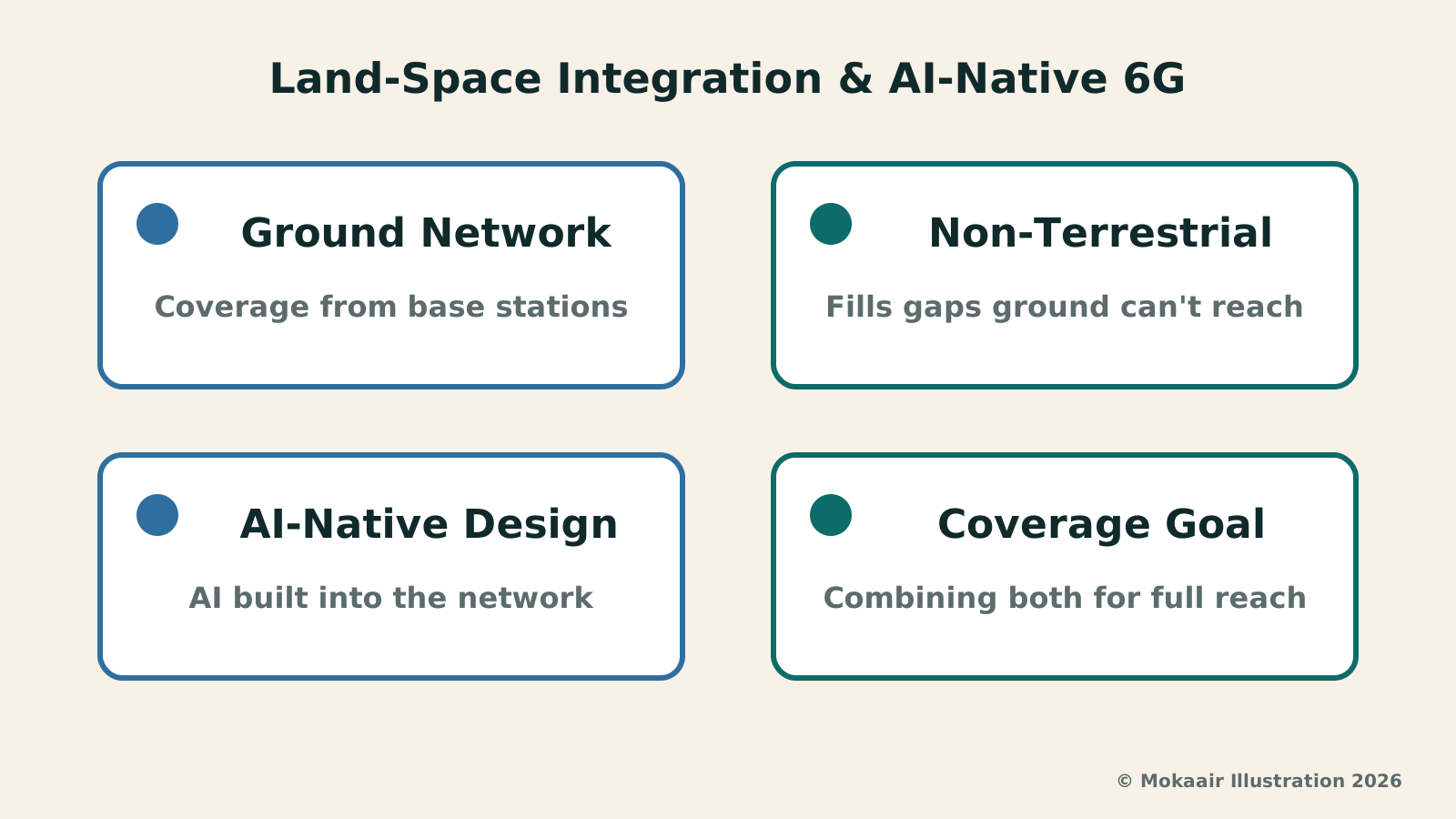
"Land-space integration" means linking terrestrial mobile networks with non-terrestrial networks such as satellites, so signal coverage reaches places ground-based base stations cannot. In his remarks, Deputy Minister Yeh described this as one of 6G's core shifts, and said moda needs to build a governance framework for the harmonious and effective sharing of spectrum that prevents cross-system interference, so that the people of Taiwan can enjoy ubiquitous, reliable communication services.
"AI-native" means building AI capability directly into 6G's network architecture from the start, rather than adding it on afterward. Deputy Minister Yeh said the rapid spread of generative AI and various AI applications has caused network traffic demand to surge, profoundly shaping the design direction of 6G's AI-native network architecture; he also said telecom operators could open up a new industry growth curve if they can secure a key position in the AI value chain and pivot to new business models. This entire passage is the Deputy Minister's own view and expectation; the press release attaches no data, targets, or timeline to it.
The Supply Plan already contains a set of rules directly related to "land-space integration" that are in effect right now -- not something said at the symposium: an operator applying to use the 27900-29500MHz band to set up fixed-satellite communications using synchronous or non-synchronous satellites must complete an agreement with existing mobile broadband operators, including a procedure for handling interference, and must obtain approval from the competent authority. The same set of rules goes on to say that the fixed-satellite communications band opened in this round is reserved for future mobile communications use, and that existing fixed-satellite communications operators may not interfere with mobile communications and must tolerate interference from mobile communications. This is how the Supply Plan has written down the way terrestrial and non-terrestrial systems are meant to share spectrum.
"2030" Appears Twice, and It Isn't the Same Thing Both Times
In the body of this symposium's press release, the only year that appears is 2030, and it appears exactly once, attached to a single sentence: Deputy Minister Yeh said global 6G is expected to gradually become commercially available starting in 2030, and that Taiwan's preparations must begin early. That is his own reading of the international situation, not Taiwan's own timetable.
The same year also appears in the Radio Frequency Supply Plan, but as a separate matter: in the Supply Plan's mobile communications table, three groups of bands have a "current status" entry reading that their licenses run through ROC year 119 -- 703-748 and 758-803MHz (90MHz of bandwidth combined), 885-915 and 930-960MHz (60MHz combined), and 1710-1775 and 1805-1870MHz (130MHz combined) -- and ROC year 119 converts to 2030 on the Gregorian calendar. Other already-licensed mobile communications bands in the same table have licenses running through ROC year 122 (2033) or ROC year 129 (2040).
Whether these two 2030s are the same thing is something the Supply Plan does not say. The program page describes the Department of Resource Management's work as "the re-farming and release of spectrum as 4G licenses expire," but does not name which band; the Supply Plan's full text also contains no instance of "4G," "5G," or "re-farming" at all, and the "current status" entry for these three groups of bands simply reads "for mobile broadband use." The overlap between the license-expiry year and the global commercialization year Deputy Minister Yeh cited is an observation this article made by comparing the official documents -- it is not a conclusion moda itself wrote down.
Will Ordinary Users Notice Anything Yet? What Officials Haven't Said
As of September 17, 2026, when this article was checked, none of the official documents it cites say anything about several things that would directly matter to an ordinary user: there are no 6G phone specifications or launch dates, no 6G rate plans, no indication of which counties or regions would get coverage first, and no explanation of whether existing 4G or 5G service would be affected by this round of spectrum discussion.
The 6425-7125MHz band in the Radio Frequency Supply Plan currently holds the status of a "specific experimental frequency" in Taiwan: it is available nationwide for testing experimental networks using low-power radio-frequency devices such as mobile communications equipment and license-exempt, low-power wireless information transmission devices, on the condition that it must not interfere with lawful communications and must tolerate interference from lawful communications. That is an experimental use; the Supply Plan does not say whether or when this band might be opened up for commercial telecom service.
As of September 17, 2026, when this article was checked, it found no spectrum-regulation amendment that was issued because of this symposium. Readers who want to check for any later announcement can look at moda's own website, under "Core Operations - Resource Management - Execution Programs," for the latest status; that page is updated over time, so what a reader sees there now may already differ from what this article found.
Frequently asked questions
When will Taiwan have 6G?
As of September 17, 2026, when this article was checked, none of the official documents it cites give a licensing date, commercialization date, or policy timeline for 6G in Taiwan. At the symposium, moda Deputy Minister Ning Yeh said global 6G is expected to gradually become commercially available starting in 2030 -- that is his own reading of the international situation, not Taiwan's own timetable. This article also found no spectrum-regulation amendment that was issued because of this symposium.
Did the symposium make any decisions?
moda's press release does not describe any decision being made. A word-by-word count of the press release's body text, done on the day this article was checked, found zero occurrences of "decide," "approve," "announce," "release," or "auction" -- only "explore," "hope," and "lay the groundwork." The press release frames the event as an international exchange, not a spectrum-release or regulatory-amendment procedure. This site did not attend the symposium and can only go by the press release's own text; readers are welcome to check the original for themselves.
Is 6425-7125MHz one of Taiwan's 6G bands?
Not currently. The Radio Frequency Supply Plan (amended February 2025) lists this frequency as a "specific experimental frequency," available nationwide for testing experimental networks using low-power radio-frequency devices such as mobile communications equipment and license-exempt, low-power wireless information transmission devices, on the condition that it must not interfere with lawful communications and must tolerate interference from lawful communications. That is an experimental use; the Supply Plan does not say whether or when it might be opened up for commercial telecom service.
Three bands in the Supply Plan happen to have licenses expiring in 2030 -- does that mean they're being re-farmed for 6G?
The Supply Plan does not say that. The Department of Resource Management's program page describes its work as "the re-farming and release of spectrum as 4G licenses expire," but does not name which band; the Supply Plan's full text also contains no instance of "4G," "5G," "6G," or "re-farming." The three groups of bands -- 703-748 and 758-803MHz, 885-915 and 930-960MHz, and 1710-1775 and 1805-1870MHz -- all have licenses running through ROC year 119 (2030); other already-licensed mobile communications bands in the same table run through ROC year 122 (2033) or ROC year 129 (2040), and some bands have "none" listed in the current-status column. The overlap between the license-expiry year and the global commercialization year Deputy Minister Yeh cited is a coincidence this article noticed by comparing the official documents -- it is not a conclusion moda itself wrote down.
What do "land-space integration" and "AI-native network" mean?
"Land-space integration" means linking terrestrial mobile networks with non-terrestrial networks such as satellites, so signal coverage reaches places ground-based base stations cannot. "AI-native" networking means building AI capability directly into 6G's network architecture from the start, rather than adding it on afterward. Both terms come from what moda Deputy Minister Ning Yeh said at the symposium; the press release attaches no technical specifications or timeline for realizing either concept.
How can I check the latest status myself?
You can check the "6G Land-Space Integration Spectrum Planning Program" page, under "Core Operations - Resource Management - Execution Programs" on moda's own website, for the latest update. On the day this article was checked, September 17, 2026, that page's listed update date was September 15, 2026, and it is published by the Department of Resource Management. The Radio Frequency Supply Plan cited in this article is the version amended February 2025; this article did not verify whether any further amendment has been announced since.
2026 Tech News Roundup: Key Points on Hardware, Platforms, Telecom, and Regulation2026 Tech News Roundup: Key Points on Hardware, Platforms, Telecom, and RegulationThis site's 2026 tech-news explainers in five groups — hardware, platforms, computing infrastructure, Taiwan policy, EU regulation: iPhone Duo and September hardware, M6/M5 Ultra, Snapdragon 8 Elite Gen 6, Project Zenith, Pixel Drop, App Store subscriptions, WordPress and Synology patches, NVIDIA, 6G, the Taiwan–Matsu cables, the sovereign AI corpus, the Cyber Resilience Act, the KIDS Act and Apple's EU terms. No purchase advice; vendor claims attributed; official sources and check dates.Read the full article
Taiwan–Matsu No. 4 Submarine Cable and Matsu’s Microwave Stations: moda Says Completion Is Coming Soon, and the State of Matsu’s Communications BackupsTaiwan–Matsu No. 4 Submarine Cable and Matsu’s Microwave Stations: moda Says Completion Is Coming Soon, and the State of Matsu’s Communications BackupsOn June 23, 2026, moda said the Taiwan–Matsu No. 4 cable and microwave stations in Matsu’s four townships, built with Forward-looking Infrastructure subsidies, are due to be completed soon; once active, there will be 3 cables and at least 2 microwave systems per township. This article traces the cable outages and backups of the first half of 2026 from official notices, plus the official cable list as of September 17, 2026. This site did no on-site testing and gives no travel or carrier advice.Read the full article
Lifestyle
Taiwan–Matsu No. 4 Submarine Cable and Matsu’s Microwave Stations: moda Says Completion Is Coming Soon, and the State of Matsu’s Communications Backups
On June 23, 2026, moda said the Taiwan–Matsu No. 4 cable and microwave stations in Matsu’s four townships, built with Forward-looking Infrastructure subsidies, are due to be completed soon; once active, there will be 3 cables and at least 2 microwave systems per township. This article traces the cable outages and backups of the first half of 2026 from official notices, plus the official cable list as of September 17, 2026. This site did no on-site testing and gives no travel or carrier advice.
Lifestyle
Taiwan Sovereign AI Training Corpus Opens Public Call for Content: License Terms and the State of Its Hakka-Language Data
On September 15, 2026, Taiwan's Ministry of Digital Affairs (moda) announced a public call for content for the Taiwan Sovereign AI Training Corpus, inviting publishers and writers to license their works for AI training. Drawing on three moda press releases and the license-terms page of the corpus website, this article covers the scope of the call, the royalty-free terms, the real limits of the "opt-out" option, and what the official documents leave unsaid. Checked September 17, 2026.
Lifestyle
Cloudflare launches Traces in public beta: site operators can follow every step a request takes through the platform on one timeline
On October 2, 2026, Cloudflare announced the public beta of Cloudflare Traces. Website operators and developers using Cloudflare can see a request pass through security rules, caching, routing and the origin server on a single timeline, making it easier to find why a request was blocked or slowed. New pricing takes effect on December 1, 2026. Information comes from the official Cloudflare blog.
Lifestyle
Cloudflare launches Web Search API via AI Gateway, requiring search partners to follow its crawler rules
On October 2, 2026, Cloudflare announced a Web Search API that lets AI agents query live web information through AI Gateway. The first partners are Ceramic.ai, Exa and Linkup. Cloudflare says these partners' crawlers must meet its Verified bots requirements and cite sources. This matters both to developers building AI applications and to website owners whose content may be crawled.
Articles that cite this one
- Taiwan Sovereign AI Training Corpus Opens Public Call for Content: License Terms and the State of Its Hakka-Language Data
- Taiwan–Matsu No. 4 Submarine Cable and Matsu’s Microwave Stations: moda Says Completion Is Coming Soon, and the State of Matsu’s Communications Backups
- 2026 Tech News Roundup: Key Points on Hardware, Platforms, Telecom, and Regulation
Latest travel guides

GuideTokyo
Where to Stay in Tokyo: Comparing Shinjuku, Ueno, Tokyo Station, Shibuya, Asakusa, Ikebukuro, and Ginza, Plus Airport Access, Accommodation Tax, and Luggage Delivery
Where should you stay in Tokyo? Compare Shinjuku, Ueno, Tokyo Station, Shibuya, Asakusa, Ikebukuro, and Ginza by the same criteria: access from Narita and Haneda, transit routes, nearby attractions, neighborhood character, and who each area suits. Includes a comparison table, a Yamanote Line diagram, Tokyo’s accommodation tax as verified in 2026/9 (changing to 3% in 2027/4), and Airport TA-Q-BIN luggage shipping rules.
- Budget
- Hotels
GuideTokyo
How to Choose Tokyo Transit Passes: Are Suica, Welcome Suica, the Tokyo Subway Ticket, and the JR Pass Worth It?
On a first Tokyo trip, start with an IC card and pay per ride (Welcome Suica has no deposit and is valid for 28 days). If you take four or more subway rides in a day, add a 72-hour Tokyo Subway Ticket for 2,000 yen; a JR Pass is never worthwhile if you stay in Tokyo and do not go to Kansai. See what TOURIST PASMO, Suica on iPhone, and the Tokyo Metro day pass do and do not cover, with a decision chart. Prices verified in September 2026.
- Transport
- Budget

GuideTokyo
Tokyo Disneyland and DisneySea Guide: Ticket Prices, Fantasy Springs, Disney Premier Access (DPA), Standby Pass, and Which Park to Choose for Your First Visit
Tokyo Disney one-day Passport prices vary: most weekdays in 9/2026 cost ¥9,900 and weekends ¥10,900. At 14:00 daily, tickets go on sale for the same date two months later. Free Priority Pass is no longer on the official service list; only paid Disney Premier Access (¥1,000–3,500 per person per use) shortens waits. Covers hours, the 25th anniversary, Standby Pass, Entry Request, Fantasy Springs access and first-visit park choice; checked on the official site in 9/2026.
- Itineraries
- Family