Lifestyle
Apple Introduces M6 and M5 Ultra: Mac mini and Mac Studio Debut, and Taiwan Pricing
On August 25, 2026, Apple introduced two new chips, M6 and M5 Ultra, debuting in the new Mac mini and Mac Studio. M6 is Apple's first 2-nanometer chip, and M5 Ultra is the first to use UltraFusion to form a quad-die architecture. Based on the official press releases, this article lays out Taiwan pricing and each chip's unified memory specs; the performance multiples are Apple's own test results, this site has not tested them, and it offers no purchase or upgrade advice.
About 13 min read
On August 25, 2026, Apple used three official press releases to introduce two custom chips, M6 and M5 Ultra, at the same time. They debut in the new Mac mini and the new Mac Studio respectively, and each of the two new machines is also offered in an M5 Pro or M5 Max version. Apple states that M6 is Apple's first chip built on a 2-nanometer process; M5 Ultra is the first to use UltraFusion technology to form a quad-die architecture, and Apple calls it its most powerful chip ever.
This article was checked on September 17, 2026, against the three official press releases that Apple's U.S. and Taiwan Newsroom made available that day (the chip release was read in its U.S. version); this site has not tested any of the products, and it offers no purchase or upgrade advice. Unless noted otherwise, every performance multiple, process-node figure, and environmental figure in this article is Apple's own test result or claim, not a measurement by this site.
Three Press Releases: Two New Chips and Two New Machines at Once
Of the three official press releases, one covers the M6 and M5 Ultra chips themselves, and the other two separately cover the new Mac mini and new Mac Studio that carry them. The chip release does not mention pricing, the pre-order date, or the ship date; that information appears only in the two Mac press releases.
The new Mac mini can be configured with M6 or M5 Pro, and the new Mac Studio with M5 Max or M5 Ultra, so this announcement involves four chips in total — but the chip press release covers only two of them, M6 and M5 Ultra: a word-for-word check for “M5 Pro” turns up zero mentions in either the U.S. or Taiwan version of the chip release, and its specs appear only in the Mac mini release.
All three press releases carry a stated publication date of August 25, 2026; the pages’ metadata shows they were revised on August 27, 2026, and the version this article read on its check date was the revised one.
M6: Apple’s First 2-Nanometer Chip, Debuting in the New Mac mini
Apple states that M6 is Apple’s first chip built on a 2-nanometer process, packing higher-density transistors into a smaller die to improve performance and energy efficiency; checking for “TSMC” and its Chinese name “台積電” through September 17 turns up neither term on any of the four official pages, and there is no transistor count or die-area figure either. M6 features a 12-core CPU — two more cores than M5 — made up of 2 super cores, 4 performance cores, and 6 efficiency cores. Apple says it delivers the world’s fastest single-threaded performance, with up to 1.2x faster multithreaded performance than M5 and up to 2.4x faster than M1; the footnote attached to that sentence lists only Apple’s own M6, M5, and M1 machines, and names no competing product.
On the GPU side, M6 features a 12-core GPU, also two more cores than before, with a Neural Accelerator built into each core; Apple states that peak GPU compute for AI is up nearly 30 percent over M5 and more than 8x over M1, with a 50 percent increase in geometry rates for complex graphics. The dual 16-core Neural Engine delivers up to 2x the peak compute of previous generations, unified memory tops out at 32GB, and bandwidth tops out at 170GB/s.
With M6 inside, Apple states the new Mac mini delivers up to 4x faster AI performance, up to 2x faster storage and graphics, and 40 percent faster CPU performance. The AI, graphics, and CPU figures are attached to a footnote naming the previous-generation M4 Mac mini (10-core CPU, 10-core GPU, 32GB, 2TB SSD) as the comparison; “2x faster storage” is attached to a separate footnote that states only that testing was conducted in July 2026, without naming a comparison machine. The M5 Pro configuration offers up to an 18-core CPU and a 20-core GPU, supports up to 64GB of unified memory, and reaches 307GB/s of bandwidth.
| Chip | Unified Memory Maximum | Memory Bandwidth | Machine |
|---|---|---|---|
| M6 | 32GB | 170GB/s | Mac mini |
| M5 Pro | 64GB | 307GB/s | Mac mini |
| M5 Max | 128GB | 614GB/s | Mac Studio |
| M5 Ultra | 512GB | 1.2TB/s | Mac Studio |
M5 Ultra: Two M5 Max Chips Joined into a Quad-Die by UltraFusion, Debuting in the New Mac Studio
Apple states that M5 Ultra uses UltraFusion technology to connect two dual-die M5 Max chips, forming a quad-die architecture that is a first for Apple silicon; inter-die bandwidth rises to over 4.4TB/s, connection density increases by more than 6x, and the four dies operate as a single processor. M5 Ultra features up to a 36-core CPU (12 super cores and 24 performance cores) and an 80-core GPU, and Apple states that this GPU brings Neural Accelerators to an Ultra chip for the first time.
The chip release and the Mac Studio release give different AI multiples for M5 Ultra, and the two cannot be swapped for each other: the chip release states “peak GPU compute for AI” of up to 4.5x M3 Ultra and more than 6x M1 Ultra, with a footnote stating the testing was done in August 2026; the Mac Studio release states “peak AI compute performance” of up to 4.3x M3 Ultra and 9.8x M1 Ultra, with a footnote stating only that testing was done in July 2026. Apple also states that M5 Max delivers up to 3.9x faster AI performance than the prior generation, with its GPU up to 50 percent faster than the previous generation and bandwidth of up to 614GB/s.
Apple states that the new Mac Studio can use Thunderbolt 5 and RDMA (Remote Direct Memory Access) to link multiple systems into a cluster with a shared memory pool; a cluster of four Mac Studio systems delivers up to 3x faster AI inference than a single system, with a footnote stating the testing was done in July 2026; the release gives only this one example, a cluster of four.
Unified Memory and Bandwidth: How Big a Model Can Run Locally
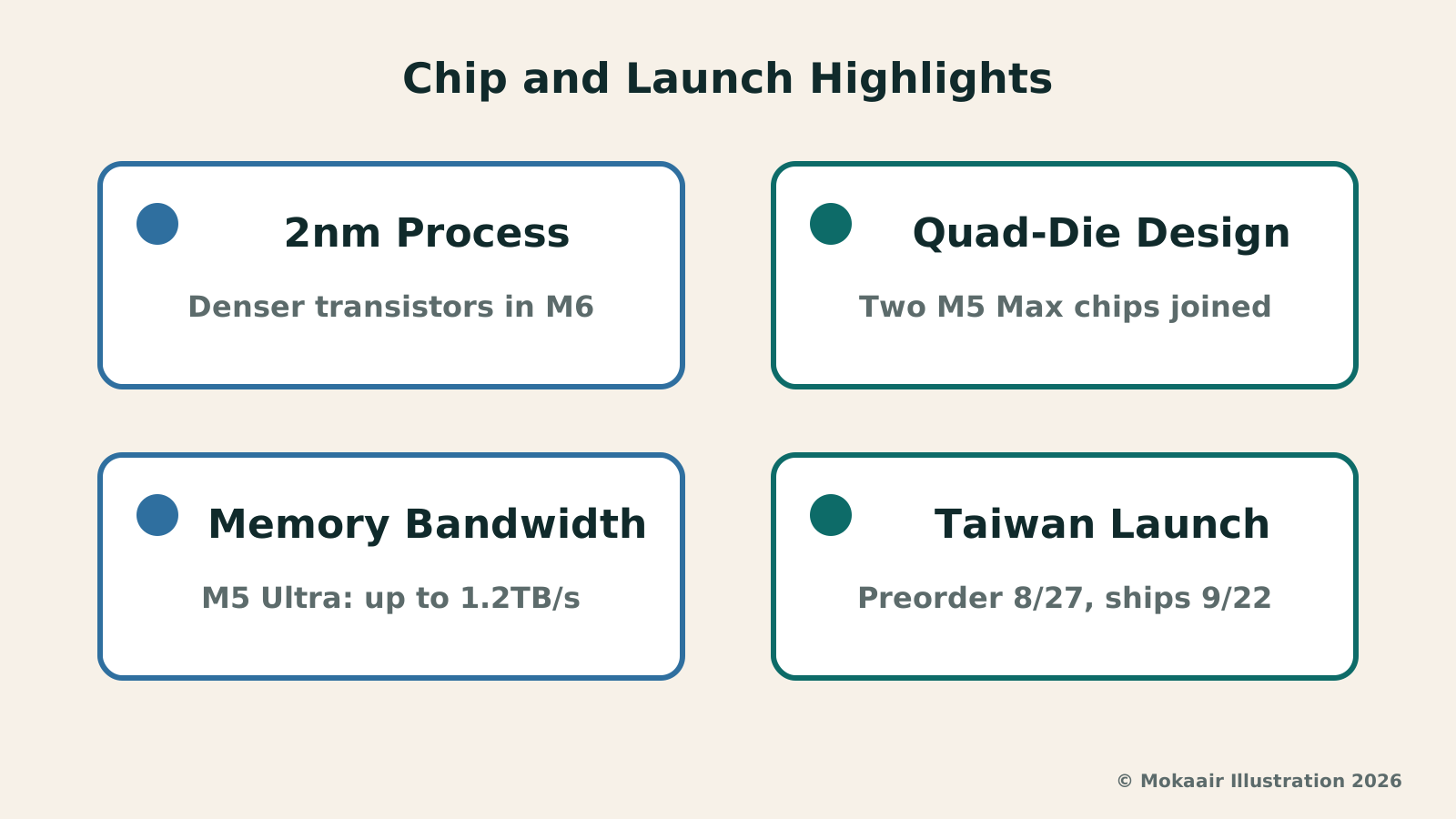
The four chips’ unified memory ceilings and bandwidth form a staircase, running from M6’s maximum of 32GB and 170GB/s up to M5 Ultra’s maximum of 512GB and 1.2TB/s; the two steps in between are shown in the table above. Apple states that this configuration on M5 Ultra lets users store huge datasets entirely in local memory, increase the tokens-per-second speed, and run huge large language models with hundreds of billions of parameters entirely on device, though it does not name any specific model.
Here is an example designed by the editors: running a local language model on your own Mac, so the data never has to go to the cloud — Apple’s Mac Studio release describes this approach as offering “complete privacy,” and this site has not actually tested it. Apple explains that Thunderbolt 5 can be used to cluster multiple Mac mini systems together to run large AI models, but the same passage also states that the M6 configuration of Mac mini has three Thunderbolt 4 ports on the back, and the release does not further state whether the clustering feature applies to it.
Developers can tap the hardware of both chips directly through frameworks such as Core AI and Core ML to build and run AI work on device. The next generation of Apple Intelligence features is currently open for testing through the Apple Beta Software Program and is set to arrive with macOS 27 this fall; the list of supported languages Apple provides includes Traditional Chinese, and some features may not be available in every region or language.
Taiwan Pricing, the Launch Timeline, and What Is Not Yet Clear
According to Apple’s Taiwan press releases, both new machines opened for pre-order at 9 a.m. Taiwan time on August 27, 2026, with availability from September 22. The Mac mini with M6 is priced from NT$29,900, and with M5 Pro from NT$59,900; the Mac Studio with M5 Max is priced from NT$84,900, and with M5 Ultra from NT$199,900.
On the environmental figures, Apple states that the new Mac mini is made with 50 percent recycled material overall and the new Mac Studio with 35 percent, and both enclosures are 100 percent recycled aluminum; for the electricity used in manufacturing, Mac mini’s is entirely sourced from renewable energy such as wind and solar power, while Mac Studio’s manufacturing uses 40 percent renewable energy. The two machines’ proportions and baselines are not the same, so they should not be compared directly.
Both new machines will pair with macOS 27, expected this fall, bringing the next generation of Apple Intelligence features; the final release is a free software update. None of the four official pages this article checked contain the term “Siri AI,” so this article does not cover its timeline.
Frequently asked questions
Are M6 and M5 Ultra the same chip?
No. M6 and M5 Ultra are two different chips that debut in two different machines: M6 is in the new Mac mini, and M5 Ultra is in the new Mac Studio. The new Mac mini is also offered with M5 Pro, and the new Mac Studio is also offered with M5 Max. Apple explains that M5 Ultra is formed by connecting two dual-die M5 Max chips with UltraFusion technology.
Is M5 Ultra also built on the 2-nanometer process?
None of the four official pages this article checked say so. The three press releases state only that M6 is Apple’s first 2-nanometer chip; as checked through September 17, 2026, no process-node figure appears next to M5 Ultra or the M5 Max chips that make it up.
Is M6 manufactured by TSMC?
The official press releases do not say. Checking for “TSMC” and its Chinese name “台積電” through September 17, 2026, turns up neither on any of the four official pages cited in this article; Apple calls M6 only “Apple’s first” 2-nanometer chip and does not state which foundry manufactures it.
Does Apple say M5 Ultra’s AI compute performance is 4.5x or 4.3x faster?
Both numbers come from Apple, but from two different press releases, and Apple attaches a different label to each. The chip press release states “peak GPU compute for AI” of up to 4.5x M3 Ultra and more than 6x M1 Ultra, with a footnote stating the test was conducted in August 2026 using a preproduction Mac Studio with M5 Ultra (36-core CPU, 80-core GPU, 256GB of memory) against a Mac Studio with M3 Ultra (32-core CPU, 80-core GPU, 256GB of memory) and a Mac Studio with M1 Ultra (20-core CPU, 64-core GPU, 64GB of memory); the Mac Studio press release states “peak AI compute performance” of up to 4.3x M3 Ultra and 9.8x M1 Ultra, and its footnote states only that testing was conducted in July 2026, without listing the compared machines’ configurations. The two figures cannot be used interchangeably.
Can you really run large language models on a Mac mini or Mac Studio?
Apple states that it can be done entirely on device, but none of the four official pages cited in this article name any specific model. Here is an example designed by the editors: say you wanted to run an open-source large language model locally — unified memory capacity and bandwidth would determine how large and how fast a model can run. Apple states that M5 Ultra supports up to 512GB of unified memory and 1.2TB/s of bandwidth, enough to run huge large language models with hundreds of billions of parameters entirely on device; this site has not actually tested this capability.
When can you buy these in Taiwan, and how much do they cost?
According to Apple’s Taiwan press releases, both new machines opened for pre-order at 9 a.m. Taiwan time on August 27, 2026, with availability rolling out from September 22. The Mac mini with M6 is priced from NT$29,900 and with M5 Pro from NT$59,900; the Mac Studio with M5 Max is priced from NT$84,900 and with M5 Ultra from NT$199,900; the Mac Studio configuration with 512GB of unified memory does not arrive until late October, and education pricing is listed separately.
How were these performance multiples measured?
All of them are Apple’s own test results, and this site has not tested any of them itself. Apple states the test machines and comparison configurations in its footnotes; for example, several of M6’s multiples were measured using a preproduction Mac mini (M6, 12-core CPU, 12-core GPU, 32GB of memory) against a 14-inch MacBook Pro (M5, 10-core CPU, 10-core GPU, 32GB of memory) and an older Mac mini (M1, 8-core CPU, 8-core GPU, 16GB of memory), with testing conducted in August 2026; different multiples are tied to different comparison machines and different test months. The chip press release’s mention of “shipping competitive systems and select industry-standard benchmarks” is a separate footnote, attached to the opening line’s claim of the “world’s fastest CPU core,” and Apple again does not name which competing products or which benchmarks were used.
2026 Tech News Roundup: Key Points on Hardware, Platforms, Telecom, and Regulation2026 Tech News Roundup: Key Points on Hardware, Platforms, Telecom, and RegulationThis site's 2026 tech-news explainers in five groups — hardware, platforms, computing infrastructure, Taiwan policy, EU regulation: iPhone Duo and September hardware, M6/M5 Ultra, Snapdragon 8 Elite Gen 6, Project Zenith, Pixel Drop, App Store subscriptions, WordPress and Synology patches, NVIDIA, 6G, the Taiwan–Matsu cables, the sovereign AI corpus, the Cyber Resilience Act, the KIDS Act and Apple's EU terms. No purchase advice; vendor claims attributed; official sources and check dates.Read the full article
iPhone 18 Pro, Watch Series 12/Ultra 4, AirPods 5: Taiwan Pricing and the Health Sensing SystemiPhone 18 Pro, Watch Series 12/Ultra 4, AirPods 5: Taiwan Pricing and the Health Sensing SystemOn September 9, 2026, Apple's Taiwan Newsroom announced the iPhone 18 Pro lineup, Apple Watch Series 12, Apple Watch Ultra 4 and AirPods 5. Based on the official press releases, this article lays out Taiwan pricing, pre-order and availability dates, and the new watches' shared "Health Sensing System," plus Apple's own note that the hypertension notification feature will not launch in Taiwan at first. It contains no purchase advice, and this site has not tested any of the products.Read the full article
Lifestyle
iPhone 18 Pro, Watch Series 12/Ultra 4, AirPods 5: Taiwan Pricing and the Health Sensing System
On September 9, 2026, Apple's Taiwan Newsroom announced the iPhone 18 Pro lineup, Apple Watch Series 12, Apple Watch Ultra 4 and AirPods 5. Based on the official press releases, this article lays out Taiwan pricing, pre-order and availability dates, and the new watches' shared "Health Sensing System," plus Apple's own note that the hypertension notification feature will not launch in Taiwan at first. It contains no purchase advice, and this site has not tested any of the products.
Lifestyle
Apple Unveils iPhone Duo: Displays, Battery, and Taiwan Launch Timeline
On September 9, 2026, Apple unveiled iPhone Duo, its first foldable iPhone: a 7.6-inch inner display when open and a 5.4-inch outer display when closed, with an eSIM-only design. Drawing on Apple official press releases and its technical specifications page, this article covers the display and body specs, battery and charging figures, and Taiwan launch timeline and pricing, and flags where the Traditional Chinese press release differs from the English version. Fact-checked September 17, 2026.
Lifestyle
Cloudflare launches Traces in public beta: site operators can follow every step a request takes through the platform on one timeline
On October 2, 2026, Cloudflare announced the public beta of Cloudflare Traces. Website operators and developers using Cloudflare can see a request pass through security rules, caching, routing and the origin server on a single timeline, making it easier to find why a request was blocked or slowed. New pricing takes effect on December 1, 2026. Information comes from the official Cloudflare blog.
Lifestyle
Cloudflare launches Web Search API via AI Gateway, requiring search partners to follow its crawler rules
On October 2, 2026, Cloudflare announced a Web Search API that lets AI agents query live web information through AI Gateway. The first partners are Ceramic.ai, Exa and Linkup. Cloudflare says these partners' crawlers must meet its Verified bots requirements and cite sources. This matters both to developers building AI applications and to website owners whose content may be crawled.
Articles that cite this one
Latest travel guides

GuideTokyo
Where to Stay in Tokyo: Comparing Shinjuku, Ueno, Tokyo Station, Shibuya, Asakusa, Ikebukuro, and Ginza, Plus Airport Access, Accommodation Tax, and Luggage Delivery
Where should you stay in Tokyo? Compare Shinjuku, Ueno, Tokyo Station, Shibuya, Asakusa, Ikebukuro, and Ginza by the same criteria: access from Narita and Haneda, transit routes, nearby attractions, neighborhood character, and who each area suits. Includes a comparison table, a Yamanote Line diagram, Tokyo’s accommodation tax as verified in 2026/9 (changing to 3% in 2027/4), and Airport TA-Q-BIN luggage shipping rules.
- Budget
- Hotels

GuideTokyo
How to Choose Tokyo Transit Passes: Are Suica, Welcome Suica, the Tokyo Subway Ticket, and the JR Pass Worth It?
On a first Tokyo trip, start with an IC card and pay per ride (Welcome Suica has no deposit and is valid for 28 days). If you take four or more subway rides in a day, add a 72-hour Tokyo Subway Ticket for 2,000 yen; a JR Pass is never worthwhile if you stay in Tokyo and do not go to Kansai. See what TOURIST PASMO, Suica on iPhone, and the Tokyo Metro day pass do and do not cover, with a decision chart. Prices verified in September 2026.
- Transport
- Budget

GuideTokyo
Tokyo Disneyland and DisneySea Guide: Ticket Prices, Fantasy Springs, Disney Premier Access (DPA), Standby Pass, and Which Park to Choose for Your First Visit
Tokyo Disney one-day Passport prices vary: most weekdays in 9/2026 cost ¥9,900 and weekends ¥10,900. At 14:00 daily, tickets go on sale for the same date two months later. Free Priority Pass is no longer on the official service list; only paid Disney Premier Access (¥1,000–3,500 per person per use) shortens waits. Covers hours, the 25th anniversary, Standby Pass, Entry Request, Fantasy Springs access and first-visit park choice; checked on the official site in 9/2026.
- Itineraries
- Family
Sources
- Apple introduces M6 and M5 Ultra for a big leap in performance and AI compute · Checked:
- Apple Introduces M6 and M5 Ultra, a Big Leap in Performance and AI Compute · Checked:
- Apple unveils a more powerful Mac mini featuring the all-new M6 and M5 Pro · Checked:
- Apple introduces new Mac Studio with M5 Max and M5 Ultra · Checked: