Lifestyle
iPhone 18 Pro, Watch Series 12/Ultra 4, AirPods 5: Taiwan Pricing and the Health Sensing System
On September 9, 2026, Apple's Taiwan Newsroom announced the iPhone 18 Pro lineup, Apple Watch Series 12, Apple Watch Ultra 4 and AirPods 5. Based on the official press releases, this article lays out Taiwan pricing, pre-order and availability dates, and the new watches' shared "Health Sensing System," plus Apple's own note that the hypertension notification feature will not launch in Taiwan at first. It contains no purchase advice, and this site has not tested any of the products.
About 12 min read
On September 9, 2026, Apple's Taiwan Newsroom announced iPhone 18 Pro, iPhone 18 Pro Max, Apple Watch Series 12, Apple Watch Ultra 4 and AirPods 5 — all four press releases carry that date in their dateline. This article is based only on those four releases; iPhone Duo is covered in a separate article linked at the end.
This article was checked on September 17, 2026, against the four Traditional Chinese press releases published that day on Apple's Taiwan Newsroom. This site has not tested any of the products and offers no purchase or upgrade advice. Unless otherwise noted, all performance, battery-life or accuracy figures are Apple's own test results or claims.
Taiwan Pricing, Pre-Orders and Availability
The iPhone 18 Pro lineup comes in black, silver, glacier blue and the new burgundy red, in 256GB, 512GB, 1TB and 2TB capacities; Taiwan pricing starts at NT$44,900 for the Pro and NT$49,900 for the Pro Max. Apple Watch Series 12 starts at NT$13,900 and Ultra 4 at NT$27,900; AirPods 5 is NT$4,490, or NT$5,190 for the version with the wireless charging case.
Series 12, Ultra 4 and AirPods 5 are open for pre-order the same day, September 9; the iPhone 18 Pro lineup does not open for pre-order until 8 p.m. Taiwan time on September 12. All of the above go on sale September 18; iPhone 18 Pro additionally reaches another 20 countries and regions starting September 25, though the press release does not list them.
On regional availability, Apple's Taiwan press release describes iPhone 18 Pro's first wave as "65 or more countries and regions," with Taiwan among them; Series 12 and Ultra 4 as "more than 50 countries and regions"; and AirPods 5 as "more than 65 countries and regions." These are three separate figures for three separate products, and in each case Apple names only example countries rather than a full list, so this article does not merge them into one range.
iPhone 18 Pro: Variable-Aperture Camera and the A20 Pro Chip
The iPhone 18 Pro lineup's main camera is a 48-megapixel Fusion Main camera with variable aperture; Apple says this is the first time iPhone has gained aperture control — six laser-cut blades switch between apertures, and Apple's own caption lists three values: opening as wide as ƒ/1.48 in low light, ƒ/1.8 for portraits, and closing to ƒ/4 for group shots.
The press release also describes the "Apple Reference Image" mode: the main camera's new sensor adds a digital signature to every pixel, and shooting in this mode records that signed data, which "Private Cloud Compute" then renders into a reference image that cannot be altered and can be placed side by side with the main image for comparison. Apple also mentions upcoming support for the SynthID standard to help identify AI-generated or -edited images; a footnote says SynthID will arrive in a software update later this year and will apply to most edited images, depending on the edits made.
The A20 Pro chip, Apple says, is built on a 2-nanometer process: the 6-core CPU's memory bandwidth is up 50% over A19 Pro, the 7-core GPU is up to 40% faster, and the dual 16-core Neural Engine totals 32 cores, giving AI performance Apple says is double that of A19 Pro. The vapor chamber's cooling surface area is triple the previous generation, for up to a 40% gain in sustained performance. The N1 chip supports Wi-Fi 7, Bluetooth 6 and Thread; the C2 modem uploads significantly faster than C1X while using 15% less power.
On battery life, Apple's Taiwan press release states iPhone 18 Pro plays video for up to 34 hours and Pro Max for up to 43 hours; iPhone 18 Pro can charge to 50% in as fast as about 15 minutes, or 30 minutes wirelessly. Pro Max can also get about 7 hours of video playback from 5 minutes of wired charging. These figures were measured by Apple in July and August 2026 using pre-production units and software; Apple notes actual results may vary.
| Product | Taiwan price | Pre-order | Availability |
|---|---|---|---|
| iPhone 18 Pro | From NT$44,900 | 9/12 | 9/18 |
| iPhone 18 Pro Max | From NT$49,900 | 9/12 | 9/18 |
| Apple Watch Series 12 | From NT$13,900 | 9/9 | 9/18 |
| Apple Watch Ultra 4 | From NT$27,900 | 9/9 | 9/18 |
| AirPods 5 | NT$4,490 | 9/9 | 9/18 |
| AirPods 5 (with charging case) | NT$5,190 | 9/9 | 9/18 |
The Health Sensing System: New Heart-Rate Sensors and the S11 Chip
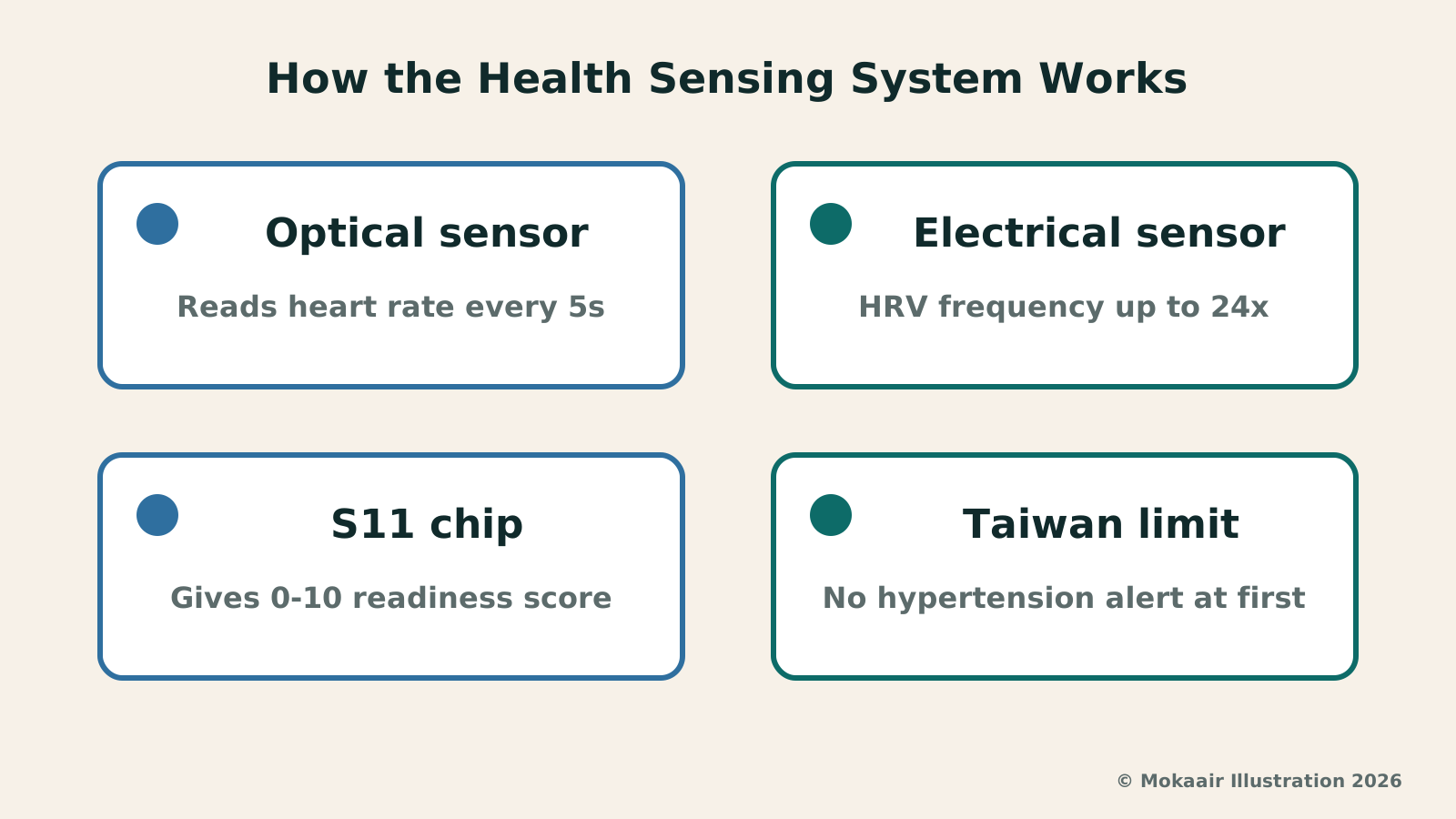
Series 12 and Ultra 4 share an all-new Health Sensing System: new optical and electrical heart-rate sensors paired with the S11 chip let both watches take a heart-rate reading every five seconds, around the clock. Apple claims this is "the most accurate heart rate sensing in a wearable," based on its own study — not a third-party review — conducted in July and August 2026 with more than 1,000 participants, comparing against the best-selling wearables on the market as of June 2026.
Heart rate variability (HRV) can now be measured up to 24 times as often as before. Apple offers two metrics: Recovery HRV, for day-to-day stress and recovery signals, and Overall HRV, for a fuller picture of health. Overnight Vitals now adds Recovery HRV analyzed against a personal baseline, and a new daytime Vitals view lets users switch between nighttime and daytime metrics.
The new readiness score analyzes recent activity, training load, Vitals and sleep score into a single 0-to-10 rating, paired with one of four recommendations: Recover, Pace Yourself, Ready or Go For It. Apple developed the scoring algorithm using data from the Apple Heart and Movement Study together with its exercise scientists and physicians.
The S11 chip also enables Sound Recognition and Shazam: the former alerts deaf or hard-of-hearing users to sounds such as sirens, alarms, doorbells or a crying baby, and works even when iPhone is not nearby; the latter shows the song and artist in the Smart Stack. Apple says S11 has a dedicated, isolated Secure Exclave that processes audio and deletes it immediately afterward, with the raw audio inaccessible to the operating system, apps, the user or Apple. Both watch press releases also preview a further S11-enabled feature arriving later this year, likewise meant to help deaf or hard-of-hearing users notice important sounds.
How Apple Frames the System: Wellness Use and Taiwan's Regulatory Limits
The sentence most relevant to medical use appears in a footnote: "The Vitals app is intended for wellness purposes only and is not intended for medical use." None of the four press releases states that the Health Sensing System, the every-five-seconds heart rate, HRV, or the readiness score has been approved or certified by any regulator. Two other, existing features each carry their own qualifier: the ECG app is for users 22 years or older, and the Sleep Apnea Notifications feature is for users 18 years or older who have not been diagnosed.
The sentence most relevant to Taiwan appears, identically, in a footnote of both the Series 12 and Ultra 4 Taiwan press releases: "The hypertension notification feature on Apple Watch Series 12 or Ultra 4 will not launch in Taiwan at first, as other regulatory approvals for these models are still in progress. It is expected to launch next year." That footnote does not name a regulator or give a month, and none of the four press releases' body text explains how the feature works or what it measures, so this article does not describe its mechanism or accuracy.
Ultra 4 and AirPods 5: Battery Life and Noise-Cancellation Differences
Ultra 4 comes in natural and black titanium cases, with day-to-day battery life of up to 2 days, or up to 50 hours; up to 84 hours in Low Power Mode; and up to 18 additional hours of battery life from a 15-minute charge. Extended Workout mode, with full GPS and heart-rate tracking, runs up to 25 hours, a 25% gain over the previous model; Max Extended Workout mode can track outdoor runs, walks and hikes for up to 45 hours, which Apple describes as "typically enough to finish a 100-mile race."
Apple claims Ultra 4 has "the most accurate on-device GPS in a sports watch," based on route-mapping accuracy in demanding urban environments, compared in August 2026 against the industry-leading dual-frequency GPS sports watches on the market at the time, with data processed on-device.
AirPods 5 is built around noise cancellation for an open-ear design: Apple claims it delivers the best-in-class open-ear "Active Noise Cancellation," canceling up to 50% more noise than the AirPods 4 ANC model, measured to the IEC 60268-24 standard. The version with the wireless charging case adds a force sensor for sliding to adjust volume, plus longer battery life. Live Translation, powered by Apple Intelligence, is now supported, Apple says, across the AirPods lineup, though not in every language or region.
Frequently asked questions
What are iPhone 18 Pro's Taiwan price and availability dates?
iPhone 18 Pro starts at NT$44,900 and iPhone 18 Pro Max at NT$49,900 in Taiwan; both come in 256GB, 512GB, 1TB and 2TB capacities. Pre-orders open at 8 p.m. Taiwan time on Saturday, September 12, with availability starting Friday, September 18; another 20 countries and regions get it starting September 25.
What's the difference between Apple Watch Series 12 and Ultra 4?
Both watches carry the all-new Health Sensing System and the S11 chip, and both press releases describe the every-five-seconds heart rate, HRV and readiness score the same way. What differs is battery life and positioning: Series 12 has day-to-day battery life of up to 24 hours and up to 10 hours during outdoor workouts (a 25% gain over the previous generation, Apple says), starting at NT$13,900; Ultra 4 has day-to-day battery life of up to 2 days, or up to 50 hours, up to 84 hours in Low Power Mode, and carries Apple's claim of "the most accurate on-device GPS in a sports watch," starting at NT$27,900. The Series 12 press release does not make that GPS claim.
Can the Apple Watch hypertension notification feature be used in Taiwan now?
No. A footnote in Apple's Taiwan press releases states that this feature on Apple Watch Series 12 and Ultra 4 will not launch in Taiwan at first, because other regulatory approvals are still in progress, and it is expected to launch next year. That footnote does not name which regulator, and none of the four press releases' body text explains how the feature actually works or what it measures.
Are the health-sensing figures in this article Apple's own testing, or did this site test the products?
All of them are Apple's own test results or claims; this site has not tested any of the products. For example, "the most accurate heart rate sensing in a wearable" and "the most accurate on-device GPS in a sports watch" are both based on Apple's own research or testing: the heart-rate accuracy study was conducted in July and August 2026, comparing against the best-selling wearables on the market as of June 2026; the GPS claim was compared in August 2026 against the industry-leading dual-frequency GPS sports watches on the market at the time.
Why isn't iPhone Duo covered in this article?
This article is based on the four press releases Apple's Taiwan Newsroom published on September 9, 2026, for the iPhone 18 Pro lineup, Apple Watch Series 12, Apple Watch Ultra 4 and AirPods 5 — none of which mentions iPhone Duo. iPhone Duo is covered in a separate article, linked at the end of this one.
What's the difference between the two AirPods 5 versions?
The standard version is NT$4,490; the version with the wireless charging case is NT$5,190 and adds a force sensor for sliding to adjust volume on the stem. Apple also says its battery life is longer: with Active Noise Cancellation on, listening time is up to 5 hours per charge — an hour more than the AirPods 4 ANC model — and up to 22 hours total with the charging case and Active Noise Cancellation enabled. Note that the "an hour more" comparison is against the AirPods 4 ANC model, not the standard AirPods 5; the press release does not give a battery figure for the standard version.
How can readers verify these specs and prices themselves?
Apple's Taiwan Newsroom published four press releases on September 9, 2026, for the iPhone 18 Pro lineup, Apple Watch Series 12, Apple Watch Ultra 4 and AirPods 5. This article's pricing, dates and specifications all come from those four releases.
2026 Tech News Roundup: Key Points on Hardware, Platforms, Telecom, and Regulation2026 Tech News Roundup: Key Points on Hardware, Platforms, Telecom, and RegulationThis site's 2026 tech-news explainers in five groups — hardware, platforms, computing infrastructure, Taiwan policy, EU regulation: iPhone Duo and September hardware, M6/M5 Ultra, Snapdragon 8 Elite Gen 6, Project Zenith, Pixel Drop, App Store subscriptions, WordPress and Synology patches, NVIDIA, 6G, the Taiwan–Matsu cables, the sovereign AI corpus, the Cyber Resilience Act, the KIDS Act and Apple's EU terms. No purchase advice; vendor claims attributed; official sources and check dates.Read the full article
Apple Unveils iPhone Duo: Displays, Battery, and Taiwan Launch TimelineApple Unveils iPhone Duo: Displays, Battery, and Taiwan Launch TimelineOn September 9, 2026, Apple unveiled iPhone Duo, its first foldable iPhone: a 7.6-inch inner display when open and a 5.4-inch outer display when closed, with an eSIM-only design. Drawing on Apple official press releases and its technical specifications page, this article covers the display and body specs, battery and charging figures, and Taiwan launch timeline and pricing, and flags where the Traditional Chinese press release differs from the English version. Fact-checked September 17, 2026.Read the full article
Lifestyle
Apple Unveils iPhone Duo: Displays, Battery, and Taiwan Launch Timeline
On September 9, 2026, Apple unveiled iPhone Duo, its first foldable iPhone: a 7.6-inch inner display when open and a 5.4-inch outer display when closed, with an eSIM-only design. Drawing on Apple official press releases and its technical specifications page, this article covers the display and body specs, battery and charging figures, and Taiwan launch timeline and pricing, and flags where the Traditional Chinese press release differs from the English version. Fact-checked September 17, 2026.
Lifestyle
Apple Introduces M6 and M5 Ultra: Mac mini and Mac Studio Debut, and Taiwan Pricing
On August 25, 2026, Apple introduced two new chips, M6 and M5 Ultra, debuting in the new Mac mini and Mac Studio. M6 is Apple's first 2-nanometer chip, and M5 Ultra is the first to use UltraFusion to form a quad-die architecture. Based on the official press releases, this article lays out Taiwan pricing and each chip's unified memory specs; the performance multiples are Apple's own test results, this site has not tested them, and it offers no purchase or upgrade advice.
Lifestyle
Cloudflare launches Traces in public beta: site operators can follow every step a request takes through the platform on one timeline
On October 2, 2026, Cloudflare announced the public beta of Cloudflare Traces. Website operators and developers using Cloudflare can see a request pass through security rules, caching, routing and the origin server on a single timeline, making it easier to find why a request was blocked or slowed. New pricing takes effect on December 1, 2026. Information comes from the official Cloudflare blog.
Lifestyle
Cloudflare launches Web Search API via AI Gateway, requiring search partners to follow its crawler rules
On October 2, 2026, Cloudflare announced a Web Search API that lets AI agents query live web information through AI Gateway. The first partners are Ceramic.ai, Exa and Linkup. Cloudflare says these partners' crawlers must meet its Verified bots requirements and cite sources. This matters both to developers building AI applications and to website owners whose content may be crawled.
Articles that cite this one
Latest travel guides

GuideTokyo
Where to Stay in Tokyo: Comparing Shinjuku, Ueno, Tokyo Station, Shibuya, Asakusa, Ikebukuro, and Ginza, Plus Airport Access, Accommodation Tax, and Luggage Delivery
Where should you stay in Tokyo? Compare Shinjuku, Ueno, Tokyo Station, Shibuya, Asakusa, Ikebukuro, and Ginza by the same criteria: access from Narita and Haneda, transit routes, nearby attractions, neighborhood character, and who each area suits. Includes a comparison table, a Yamanote Line diagram, Tokyo’s accommodation tax as verified in 2026/9 (changing to 3% in 2027/4), and Airport TA-Q-BIN luggage shipping rules.
- Budget
- Hotels

GuideTokyo
How to Choose Tokyo Transit Passes: Are Suica, Welcome Suica, the Tokyo Subway Ticket, and the JR Pass Worth It?
On a first Tokyo trip, start with an IC card and pay per ride (Welcome Suica has no deposit and is valid for 28 days). If you take four or more subway rides in a day, add a 72-hour Tokyo Subway Ticket for 2,000 yen; a JR Pass is never worthwhile if you stay in Tokyo and do not go to Kansai. See what TOURIST PASMO, Suica on iPhone, and the Tokyo Metro day pass do and do not cover, with a decision chart. Prices verified in September 2026.
- Transport
- Budget

GuideTokyo
Tokyo Disneyland and DisneySea Guide: Ticket Prices, Fantasy Springs, Disney Premier Access (DPA), Standby Pass, and Which Park to Choose for Your First Visit
Tokyo Disney one-day Passport prices vary: most weekdays in 9/2026 cost ¥9,900 and weekends ¥10,900. At 14:00 daily, tickets go on sale for the same date two months later. Free Priority Pass is no longer on the official service list; only paid Disney Premier Access (¥1,000–3,500 per person per use) shortens waits. Covers hours, the 25th anniversary, Standby Pass, Entry Request, Fantasy Springs access and first-visit park choice; checked on the official site in 9/2026.
- Itineraries
- Family