Lifestyle
Microsoft Unveils Project Zenith: A Unified Memory and Bandwidth Baseline for Windows Dev Machines
On September 4, 2026, Microsoft announced Project Zenith on the Windows Developer Blog: preinstalled tools and interface defaults for "developer-class devices" with 64GB+ unified memory and 250GB/s+ bandwidth, said to run 30B+ parameter models locally. Based on three Microsoft posts and one AMD post, this article explains what actually changes, how the baseline is defined, and the price, timeline, and regions both announcements leave unstated.
About 12 min read
On September 4, 2026, Microsoft published a post on the Windows Developer Blog announcing Project Zenith — what Microsoft calls the "ready-to-code" Windows experience, aimed at "developer-class devices": 64GB or more of unified memory and 250GB/s or more of bandwidth. Microsoft says Zenith will first become available with AMD's Ryzen AI Halo, with devices from other OEM and silicon partners following "in the coming months."
This article was checked on September 17, 2026, against the full text of three official Microsoft blog posts and one official AMD blog post. This site has not tested any Project Zenith device and does not offer buying or upgrade advice; every specification and performance figure below is stated by Microsoft or AMD.
What Microsoft Announced: A Bundled Windows Development Setup
Microsoft's own one-line definition: devices ship with a preconfigured Windows development environment plus a curated set of tools chosen to get developers up and running fastest. The announcement says Microsoft has been improving Windows 11 search, File Explorer, and everyday memory use since the start of the year, and says Zenith devices will benefit from these existing improvements.
Microsoft also addresses what differs across devices: through OEM partnerships, developers still have a choice among devices and performance tiers — "the hardware may vary, but the developer promise is consistent" — which suggests Zenith spans multiple devices and performance tiers rather than a single model.
The Baseline for a "Developer-Class Device": Unified Memory and Bandwidth
Microsoft defines a "developer-class device" by two numbers: 64GB or more of unified memory, and 250GB/s or more of memory bandwidth. Unified memory means the CPU and GPU share the same pool of memory, which in theory allows larger models to fit; bandwidth is the speed at which data moves in and out of that memory — the higher the number, the less likely a model is to stall waiting for data during computation. Microsoft uses memory specifications rather than processor specifications as the bar, and the announcement ties these two numbers to running models locally.
Microsoft states that on Zenith devices, developers can run 30B+ parameter models locally, and that this is "unmetered" — Microsoft contrasts this with metered cloud tokens, saying it helps lower token costs; the announcement does not name a model, and gives no figures for running speed or benchmark scores. Microsoft's framing is that top-tier models handle the hardest problems while the rest of the work runs mostly on-device — that is Microsoft's own description, not a test result.
Ten days later, Microsoft's devices blog, reporting from IFA, again wrote "64GB+ unified memory," but wrote the bandwidth as "250gbps" — that is Microsoft's own two announcements using inconsistent wording, not the same figure written a different way. This article uses the bandwidth figure from the September 4 announcement, "250+ GB/s."
| Source | Unified memory | Stated local model scale | Notes |
|---|---|---|---|
| Windows Developer Blog, 9/4 | 64GB or more | 30B+ parameters | Microsoft states |
| Microsoft Devices Blog, 9/14 | 64GB or more | No parameter figure given | Microsoft states; bandwidth written as 250gbps |
| AMD Ryzen AI Halo, 5/20 | Up to 128GB | Up to 200 billion | AMD states |
| AMD next-gen platform, Q3 preview | Up to 192GB | 300 billion (4-bit quantization) | AMD states |
18 Preinstalled Tools, Tucked Inside a Chart
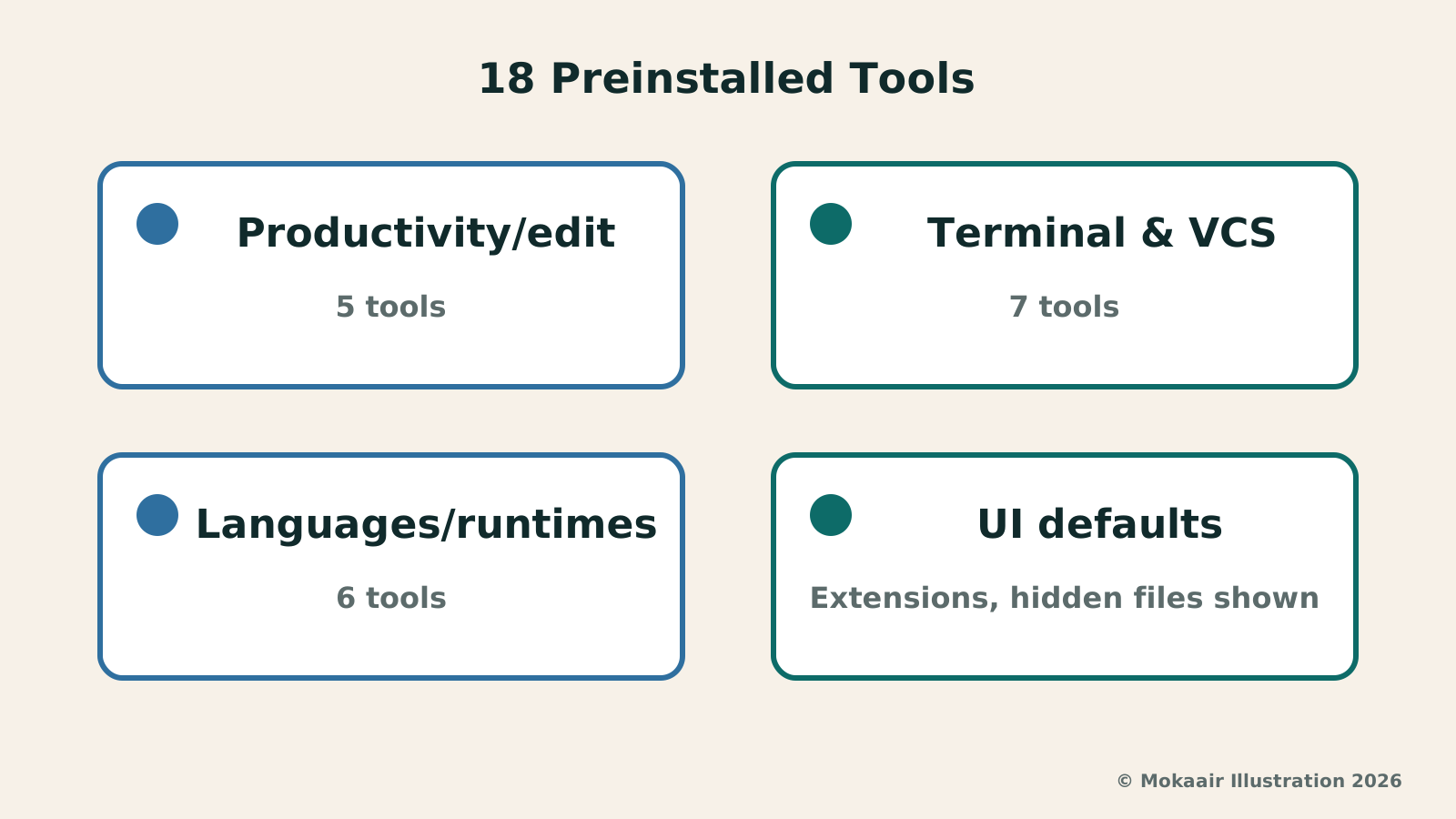
The announcement's body text names only the two tools pinned to the Taskbar by default — Windows Terminal and Visual Studio Code. The full list appears only in an embedded chart; this site counted 18 items in it. The three columns are: Productivity & edit tools, 5 items (Visual Studio Code, GitHub Copilot, PowerToys, WinAppCLI, Windows Dev Skills); Terminal & source control, 7 items (Intelligent Terminal, PowerShell 7, Git, GitHub CLI, Azure CLI, Core Utils, Oh My Posh); and Languages & runtimes, 6 items (Python 3.14+, uv, NVM, Node 24+, WSL 2+ Ubuntu, .NET 10). Only 5 of the 18 carry a version number: the four items in the languages column other than uv and NVM, plus PowerShell 7.
The first item in the chart's terminal column is Intelligent Terminal, yet the body text says the tool pinned to the Taskbar is Windows Terminal; Microsoft does not say whether the two are the same. Microsoft's June 2 Build 2026 post described Intelligent Terminal as an interface built on the existing Windows Terminal experience with agentic integration added, with its status at the time being "experimental preview"; that same post marked the similarly named Coreutils for Windows and Windows Development Skills as generally available. The September 4 announcement does not restate these statuses, so this article cites only what the June post said.
Microsoft also lists interface defaults applied ahead of time: File Explorer shows file extensions, hidden files, the full path in the title bar, and the details pane, with long-path support enabled, while the recent-files list and sync-provider prompts are turned off; Search and the Start menu have Command Palette turned on, with Start menu tips and account notifications turned off. Microsoft stresses this is not about prescribing a single workflow — developers can still configure, extend, or customize their setup; the announcement frames it as starting from a better baseline.
First With AMD's Ryzen AI Halo; Other Partners Not Yet Named
The September 4 announcement does not name any other OEM or silicon maker, referring only to "our OEM and silicon partners"; the September 14 IFA report lists computers from partners such as Acer, Dell, and Lenovo, but does not tie any specific model to Zenith. That same article relays AMD's statement that Ryzen AI Halo systems will support Zenith out of the box, citing Visual Studio Code, WSL, GitHub Copilot CLI, and PowerShell — the original wording is "includes," not a complete list, and not the chart's 18 items.
AMD's blog post from May 20, 2026 — three and a half months before the Zenith announcement — never mentions Project Zenith. AMD states that Ryzen AI Halo is its first compact AI developer platform, built on the Ryzen AI Max+ 395 processor, with up to 128GB of unified memory and capable of running models of up to 200 billion parameters; pre-orders began in June 2026, available exclusively through Micro Center, with no region named and no bandwidth figure given.
The same AMD post previews a next-generation Ryzen AI Max PRO 400 series of processors due in the third quarter of 2026, with up to 192GB of unified memory and 160GB of dedicated graphics memory, and states that these are the world's first x86 client processors capable of running 300 billion-parameter models locally — though that holds only with 4-bit quantization, per a footnote dated May 11, 2026; OEM partners include HP and Lenovo, launching in the third quarter — partners for this chip series, not for Zenith.
What Microsoft Hasn't Said: Price, Timeline, Region, and How to Try It Yourself
As checked through September 17, 2026, neither announcement gives a price, a ship date, a preview date, or a general-availability date for Zenith; the only future timing in the September 4 announcement, "in the coming months," refers to later devices, not the first one. Neither announcement mentions Taiwan, and neither says which countries or markets Zenith will launch in; nor do they explain whether it is, technically, a factory image, a Windows edition, a downloadable configuration package, or simply a marketing name, or whether an existing machine could get the same setup after the fact.
Microsoft's June 2 Build 2026 post described two ways to get a similar setup without buying new hardware: the WinGet configuration file dev-config.winget, which applies a setup including WSL, PowerShell 7, Git, GitHub CLI, Visual Studio Code, and more with a single command on any Windows 11 device; and Windows 365 with Developer configuration, a cloud PC pre-configured with the same setup, which was in public preview as of June 2. Neither of these is Project Zenith itself.
That same June post also mentioned a Microsoft-made device, the Surface RTX Spark Dev Box, with 128GB of unified memory; at the time it said the device would be sold later this year, exclusively through Microsoft.com in the U.S., and noted that it was a pre-release product whose actual sale and delivery would depend on regulatory certification/approval and compliance with applicable requirements. None of the four sources read for this article equates this device with Zenith.
Frequently asked questions
Is Project Zenith available to buy yet?
Neither of the two Microsoft announcements checked for this article gives a price, a launch timeline, or a region. Microsoft only says Zenith will first become available with AMD's Ryzen AI Halo, with devices from other OEM and silicon partners following "in the coming months" — without naming those makers or giving a date. AMD's own blog says pre-orders for Ryzen AI Halo began in June 2026 through Micro Center exclusively, and AMD does not mention any region; that is pre-order information for an AMD product, not launch information for Project Zenith itself.
My current computer doesn't have 64GB of unified memory — can I still get a similar development environment?
At its Build developer conference in June 2026, Microsoft described two approaches: the WinGet configuration file dev-config.winget, which Microsoft says can be applied on any Windows 11 device by running a single command; and Windows 365 with Developer configuration, a cloud PC pre-configured with the same developer setup, which Microsoft says can be accessed from any device and was in public preview as of June 2, 2026. Neither one is Project Zenith itself, and Microsoft has not said how either relates to Zenith's hardware requirements; both statuses are still only what Microsoft said in June.
What do unified memory and memory bandwidth mean?
Unified memory means the CPU and GPU share the same pool of memory instead of each reserving its own, which in theory allows larger models to fit; memory bandwidth is the speed at which data moves in and out of that memory — the higher the number, the less likely a model is to stall waiting for data while running. Microsoft defines a "developer-class device" as having 64GB or more of unified memory and 250GB/s or more of bandwidth, using memory specifications rather than processor specifications as the bar, and the announcement ties these two numbers to running models locally. Microsoft does not say these two numbers amount to a certification or a mandatory standard, nor does it say what happens on a machine below them.
Does this have anything to do with Taiwan?
Based on the sources checked for this article through September 17, 2026, neither Microsoft announcement mentions Taiwan, and neither says which countries or markets Project Zenith will launch in; the AMD blog post only says Ryzen AI Halo's channel is limited to Micro Center and does not mention any region anywhere in the text. None of this article's sources contain any information about whether this has launched in Taiwan, and readers should not conclude from this article that it is already available or has already been rolled out in Taiwan.
What exactly is Project Zenith — a chip, a Windows edition, or just a configuration?
Microsoft doesn't spell it out. The announcement describes it as a preconfigured Windows development environment together with a curated set of tools chosen to get developers up and running fastest, and mentions that there will be a choice of devices and performance tiers across OEM partners, but it does not say whether it is a factory image, a Windows edition, a downloadable installer, or simply a marketing name, nor does it say whether an older machine that meets the hardware bar could get it after the fact.
Microsoft says it's possible to run 30B-plus-parameter models locally — is that based on actual testing?
No. Microsoft states that on Project Zenith devices, developers can run 30B+ parameter models locally, and that this is "unmetered" — Microsoft contrasts this with metered cloud tokens, saying it helps lower token costs; that is not the same as saying Microsoft is separately providing a free service. The announcement does not name which model, and provides no figures for running speed, benchmark scores, or performance tests. This site likewise has not tested any Project Zenith device itself; this is Microsoft's own official statement, not a measurement made by any party.
2026 Tech News Roundup: Key Points on Hardware, Platforms, Telecom, and Regulation2026 Tech News Roundup: Key Points on Hardware, Platforms, Telecom, and RegulationThis site's 2026 tech-news explainers in five groups — hardware, platforms, computing infrastructure, Taiwan policy, EU regulation: iPhone Duo and September hardware, M6/M5 Ultra, Snapdragon 8 Elite Gen 6, Project Zenith, Pixel Drop, App Store subscriptions, WordPress and Synology patches, NVIDIA, 6G, the Taiwan–Matsu cables, the sovereign AI corpus, the Cyber Resilience Act, the KIDS Act and Apple's EU terms. No purchase advice; vendor claims attributed; official sources and check dates.Read the full article
Google's September Pixel Drop: Model, Region, Language, and Pixel Watch 5 ConditionsGoogle's September Pixel Drop: Model, Region, Language, and Pixel Watch 5 ConditionsOn September 15, 2026, Google published its September Pixel Drop on the official blog, linking to forum posts on device and region conditions and to the Pixel Watch 5 update notes. This article covers the device, region, and language conditions for Scam Detection, the expiry dates for the Harry Potter pack and the Audible trial, the table that leaves Pixel Tablet unchecked, and the features that require pairing a Pixel Watch 5 with a Pixel 11. Checked September 17, 2026.Read the full article
Lifestyle
Google's September Pixel Drop: Model, Region, Language, and Pixel Watch 5 Conditions
On September 15, 2026, Google published its September Pixel Drop on the official blog, linking to forum posts on device and region conditions and to the Pixel Watch 5 update notes. This article covers the device, region, and language conditions for Scam Detection, the expiry dates for the Harry Potter pack and the Audible trial, the table that leaves Pixel Tablet unchecked, and the features that require pairing a Pixel Watch 5 with a Pixel 11. Checked September 17, 2026.
Lifestyle
Cloudflare launches Traces in public beta: site operators can follow every step a request takes through the platform on one timeline
On October 2, 2026, Cloudflare announced the public beta of Cloudflare Traces. Website operators and developers using Cloudflare can see a request pass through security rules, caching, routing and the origin server on a single timeline, making it easier to find why a request was blocked or slowed. New pricing takes effect on December 1, 2026. Information comes from the official Cloudflare blog.
Lifestyle
Cloudflare launches Web Search API via AI Gateway, requiring search partners to follow its crawler rules
On October 2, 2026, Cloudflare announced a Web Search API that lets AI agents query live web information through AI Gateway. The first partners are Ceramic.ai, Exa and Linkup. Cloudflare says these partners' crawlers must meet its Verified bots requirements and cite sources. This matters both to developers building AI applications and to website owners whose content may be crawled.
Lifestyle
Cloudflare open-sources Streamline: a demo of using its cloud services to add graphics to live streams and burn subtitles into videos
On October 2, 2026, Cloudflare launched and open-sourced Streamline, a developer playground showing how developers can combine Stream, Workers, Containers and Durable Objects to build their own video processing pipelines, such as adding graphics to live streams in real time or adding subtitles to videos. This article explains what it is, how it works, its limitations, and what it means for viewers and developers.
Articles that cite this one
Latest travel guides

GuideTokyo
Where to Stay in Tokyo: Comparing Shinjuku, Ueno, Tokyo Station, Shibuya, Asakusa, Ikebukuro, and Ginza, Plus Airport Access, Accommodation Tax, and Luggage Delivery
Where should you stay in Tokyo? Compare Shinjuku, Ueno, Tokyo Station, Shibuya, Asakusa, Ikebukuro, and Ginza by the same criteria: access from Narita and Haneda, transit routes, nearby attractions, neighborhood character, and who each area suits. Includes a comparison table, a Yamanote Line diagram, Tokyo’s accommodation tax as verified in 2026/9 (changing to 3% in 2027/4), and Airport TA-Q-BIN luggage shipping rules.
- Budget
- Hotels

GuideTokyo
How to Choose Tokyo Transit Passes: Are Suica, Welcome Suica, the Tokyo Subway Ticket, and the JR Pass Worth It?
On a first Tokyo trip, start with an IC card and pay per ride (Welcome Suica has no deposit and is valid for 28 days). If you take four or more subway rides in a day, add a 72-hour Tokyo Subway Ticket for 2,000 yen; a JR Pass is never worthwhile if you stay in Tokyo and do not go to Kansai. See what TOURIST PASMO, Suica on iPhone, and the Tokyo Metro day pass do and do not cover, with a decision chart. Prices verified in September 2026.
- Transport
- Budget

GuideTokyo
Tokyo Disneyland and DisneySea Guide: Ticket Prices, Fantasy Springs, Disney Premier Access (DPA), Standby Pass, and Which Park to Choose for Your First Visit
Tokyo Disney one-day Passport prices vary: most weekdays in 9/2026 cost ¥9,900 and weekends ¥10,900. At 14:00 daily, tickets go on sale for the same date two months later. Free Priority Pass is no longer on the official service list; only paid Disney Premier Access (¥1,000–3,500 per person per use) shortens waits. Covers hours, the 25th anniversary, Standby Pass, Entry Request, Fantasy Springs access and first-visit park choice; checked on the official site in 9/2026.
- Itineraries
- Family
Sources
- Announcing Project Zenith: The ready-to-code Windows experience on developer-class devices · Checked:
- More choice and possibility with Windows PCs at IFA · Checked:
- Build 2026: Furthering Windows as the trusted platform for development · Checked:
- AMD Powers Next-Generation Agent Computers with New Ryzen AI Halo Developer Platform and Ryzen AI Max PRO 400 Series Processors · Checked: