Lifestyle
European Commission Adopts KIDS Act Proposal: No Social Accounts Under 13, Own Account at 15
On September 17, 2026, the European Commission adopted the EU KIDS Act proposal, barring social platforms from letting children under 13 hold accounts and setting 15 as the minimum age to open one. This article uses the Commission's press release, FAQ and proposal summary to lay out the age tiers, design duties, age-verification methods and penalty thresholds, and notes this is still a proposal before the European Parliament and Council, with no stated date of entry into force.
About 14 min read
On September 17, 2026, the European Commission adopted a legislative proposal called the EU KIDS Act (EU Keeping Internet Digital Spaces Accountable and Trustworthy). In the Commission's own words, it has adopted the EU KIDS Act to enhance the online safety of children throughout the Union. The proposal's core age rules come in three tiers: children under 13 may not hold an account on a social media platform; a minor must be 15 before opening an account of their own; and between 13 and under 15, a guardian opens and keeps control of the account, which the Commission calls a gradual approach.
This article was checked on September 18, 2026, against the European Commission's EU KIDS Act press release page, the full press release (reference IP/26/1890), the proposal's FAQ page, and the proposal summary page. This site has not tested any age-verification tool itself and offers no advice on setting up accounts for parents or minors; every sentence below marks this as proposal content, and where the official pages give no date, the article says so directly.
What the Commission Adopted: A Proposal, Not Yet a New Rule
The proposal's formal title, printed on the summary page, is EU KIDS Act - 'EU Keeping Internet Digital Spaces Accountable and Trustworthy,' under press release reference IP/26/1890, datelined Strasbourg, 17 September 2026. The Commission organizes the proposal around four pillars: delaying social media, safety by design, privacy-preserving age assurance, and what the press release calls effective enforcement.
Adopting a proposal is not the same as it taking effect. The press release's next-steps section states that the legislative proposal has been submitted to the European Parliament and Council; none of the four official pages checked for this article states a date of entry into force or a date of application. Wherever this article mentions a deadline, it is a relative formula, such as within six months of the rules applying, rather than a calendar date, and it stays that way below.
The press release's background section says the proposal builds on the report and recommendations of the Special Panel on Child Safety Online, convened by Commission President von der Leyen. Its co-chairs are Dr Maria Melchior and Prof. Dr. Jorg M Fegert; the panel had more than 60 experts, first convened in March 2026, and met three times before delivering its report in July 2026. The press release also cites a figure from the 2026 Special Eurobarometer on the Digital Decade: the Commission says 92% of Europeans consider the need to further strengthen children and young people's protection online a top policy priority, a figure the Commission is citing from that survey, which this article did not separately verify.
The Age Tiers: Three Gates From Age 3 to 15
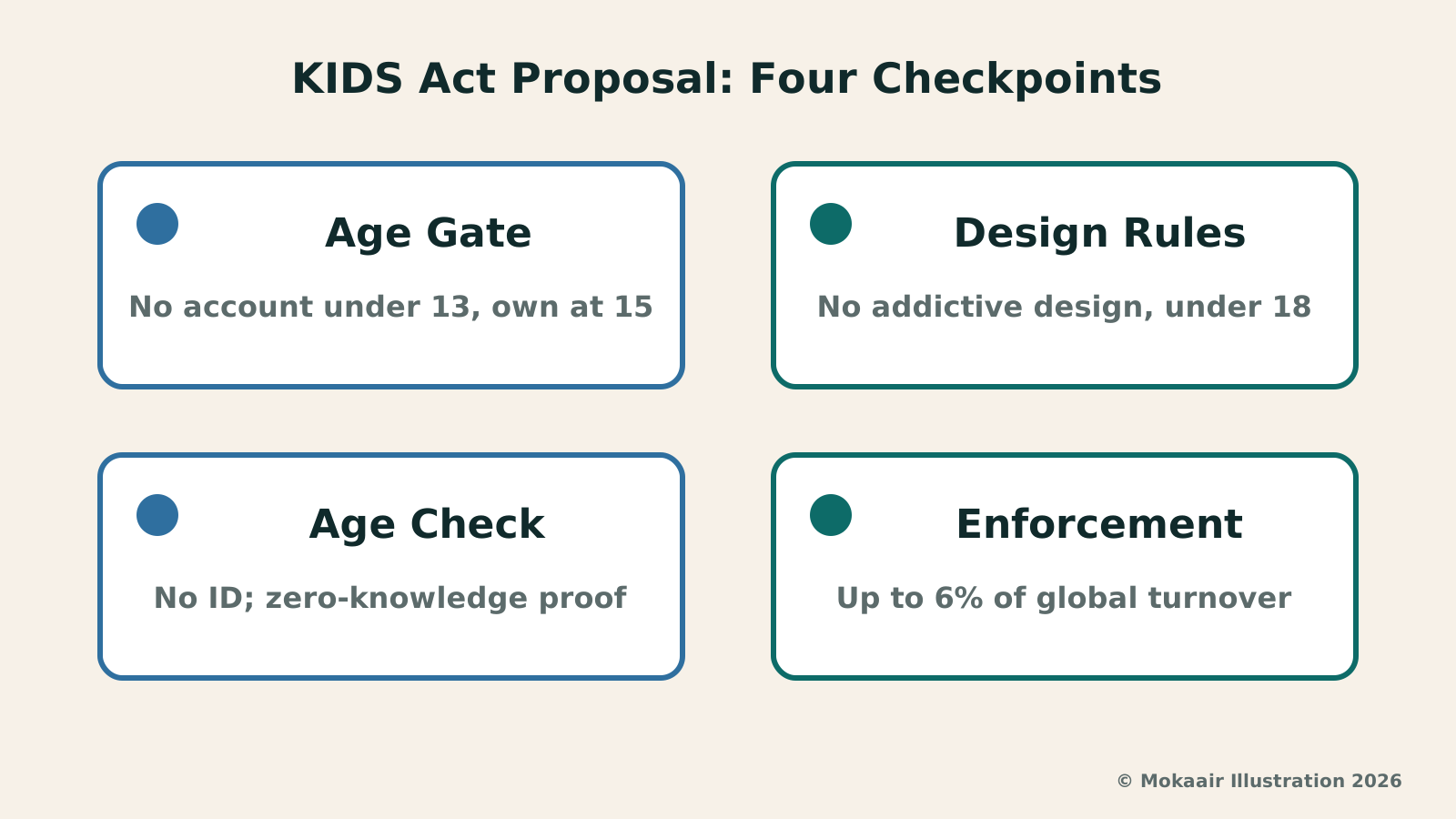
The proposal's age rules are not a single threshold. The press release states that the proposal prohibits social media platforms from accessing children under the age of 13 and sets an EU-wide minimum age for minors to open an account of their own at the age of 15, which the Commission calls a gradual approach. The FAQ page adds a scope limit: these age rules apply to social networking and video-sharing services with proven risky features.
Between 13 and under 15, the proposal requires platforms to offer parental controls, letting a guardian set up a mini account through which the child accesses the service. The press release's examples include limited social contacts and limited screen time of up to one hour per day; the FAQ page describes the same tier as parental tools always on, a daily time cap, and contacts that need a guardian's approval.
Between 3 and under 13, children cannot use social media, but they can reach specially designed child-facing video-sharing services through an account their guardian manages; platforms must also give parents an easy-to-use tool to limit an adult device's access to those services once it is handed to a child, capping the child's use at up to one hour a day. The FAQ page spells this tier out further: the child has no account of their own, personalized recommendations and search are off, the parent can stop access at any time, and the arrangement ends once the child turns 13.
| Age band | Can they have an account | Who controls it | Official limits stated |
|---|---|---|---|
| 3 to under 13 | No social media account; reaches children's video services through a guardian's account | Guardian | Up to 1 hour a day |
| 13 to under 15 | Guardian-opened mini account | Guardian keeps control | Limited social contacts; up to 1 hour a day |
| 15 and older | Can open an account of their own | The user | Still subject to safety-by-design duties for under-18s |
| Existing accounts | Checked within 6 months of the rules applying | Platform | Under-15 or unconfirmed-age accounts are disabled |
How the Design Has to Change: Which Services the Safety-by-Design Duties Cover
The press release lists safety by design as the second pillar, covering social media services, video sharing, online video games, and AI companions and chatbots, for users below the age of 18.
The press release names several practices to be banned for minors: addictive features and profiling-based recommender feeds that can draw minors into harmful content, infinite scroll without stopping points, reward tricks, push notifications during sleeping hours, and unsolicited contact from strangers. AI companions and chatbots must be turned off by default and may not simulate interpersonal relationships in ways that create emotional dependency.
On defaults: minors' profiles must be private by default, with geolocation, camera and microphone access turned off. Online services must also offer easy-to-use blocking and muting tools, effective time-management tools, and recommender systems minors can control, adjust and reset.
The FAQ page itself raises the question a reader might ask first: isn't this just banning children from social media? The official answer is no; the age rules are the most visible part, but most of the law is about how the services themselves are built, and the Commission says what matters more is that they are safe by design.
How Age Is Checked: Verification Without Showing ID
The FAQ page states plainly that platforms will not check identity documents and will not learn who the user is; age is verified through certified solutions independent of the platforms, one of which is the free EU age verification app, which the press release describes as not retaining identity documents or biometric data. The proposal requires zero-knowledge-proof technology that can only answer a yes-or-no question about whether the user meets the age, and cannot be used to identify, locate, track or profile anyone. The Commission also requires every Member State to offer at least one free way to prove age, including for people without a digital ID, with the European Digital Identity Wallet joining in time; the FAQ page gives no timetable for that.
When opening a new account, social media and video-sharing platforms will be required to carry out age verification; for existing accounts, they must instead estimate age from reasonable proxies, which the Commission gives as examples such as account creation date and credit card details, an illustration rather than a complete list. App stores carry their own obligations: every app, games included, must be age-rated with a published methodology, must not let children access or buy apps that are not appropriate for their age, and must carry the EU age verification app.
The FAQ page turns the reversed burden of proof into a concrete threshold: platforms with 45 million or more active monthly users in the EU cannot simply declare themselves safe. Before coming into contact with children under the new rules, they must put forward a detailed plan showing how they intend to meet every obligation of the law, to be checked by independent auditors. The Commission states specifically that this audit is paid for by the platforms, not by taxpayers.
Penalties, Who Enforces What, and What Is Still Undecided
The press release calls its fourth pillar effective enforcement, built on reversing the burden of proof: service providers must show their own services are age-appropriate and safe by design, rather than a regulator first having to prove they are not. This enforcement framework builds on the structures already in place under the Digital Services Act and the AI Act; the sources for this article say only that it builds on those structures, not that either law is amended or replaced. The FAQ page breaks the supervision down further: the Commission directly supervises the online platforms and AI chatbots most widely used in the EU; Digital Services Coordinators and national market surveillance authorities remain responsible for the other services and AI systems; and national authorities designated by Member States supervise video games that are not online platforms.
For services the Commission supervises directly, the FAQ page sets out an expedited procedure: preliminary findings within 30 days, and a final decision targeted within 90 days, the Commission's own language being that there is no time to spare. The fine figure appears only on the FAQ page, not in the press release itself: fines can reach 6% of total worldwide annual turnover. The transition rule is also on the FAQ page: within six months of the rules applying, platforms must check whether existing account holders are under 15, and disable the accounts of those who are, or whose age cannot be established; where a platform can already tell with high confidence that a user is an adult, no new check is needed.
A good deal is still undecided. None of the four official pages checked for this article states an entry-into-force date or an application date, and none gives an article number or legal-base citation to cite; this article rests on the Commission's own press release and FAQ summaries, not on the text of the proposal itself. None of the four pages mentions Taiwan either; this article does not speculate on whether Taiwan will follow, and does not compare this proposal with any Taiwanese rule. Readers can see the second link at the end of this article for what a similar category of service already has to do under an EU rule that is in force.
Frequently asked questions
Has the KIDS Act taken effect yet?
Not yet. This is a legislative proposal the European Commission adopted on September 17, 2026 and submitted to the European Parliament and Council. None of the four official pages checked for this article, current as of September 18, 2026, states a date of entry into force or application. The deadlines that do appear are relative formulas, for example existing accounts are checked within 6 months of the rules applying, preliminary findings for cases the Commission supervises directly come within 30 days, and a final decision is targeted within 90 days, not calendar dates.
At what age can someone open their own social media account?
15. The proposal sets 15 as the EU-wide minimum age for a minor to open an account of their own. Between 13 and under 15, the account must be a mini account opened by a guardian, who the child accesses the service through, with limited social contacts and a daily screen-time cap of at most one hour. Under 13, a child may not hold a social media account at all. The FAQ page adds that these age rules apply to social networking and video-sharing services with proven risky features.
What happens to a teenager's existing account once the rules formally apply?
The FAQ page states that within six months of the rules applying, platforms must check whether existing account holders are under 15 and disable the accounts of those who are, or whose age cannot be established. If a platform can already tell with high confidence that a user is an adult, no new check is needed.
Do you have to show ID to prove your age?
The official answer is no. The FAQ page states that platforms will not check identity documents and will not learn who the user is; age is verified through solutions certified independently of the platform, such as the free EU age verification app, which the press release describes as not retaining identity documents or biometric data. The technology required is zero-knowledge proof, which can only answer a yes-or-no question and cannot be used to identify, locate, track or profile anyone. Every Member State must offer at least one free way to prove age, including for people without a digital ID.
How large can the fine be for breaking the rules?
The FAQ page states a ceiling of 6% of total worldwide annual turnover; the press release itself does not give this figure. Services the Commission supervises directly are also subject to an expedited procedure: preliminary findings within 30 days and a final decision targeted within 90 days. Other services are the responsibility of each country's Digital Services Coordinators and market surveillance authorities, and video games that are not online platforms are supervised by the authority each Member State designates.
Does this proposal affect users in Taiwan?
None of the four official pages checked for this article mention Taiwan. This is an EU legislative proposal setting EU-wide age and design rules; this article does not speculate on whether Taiwan will follow, and does not compare it with any current Taiwanese rule. Readers who want to know what a similar category of service already has to do under an EU rule that is in force can see the second link at the end of this article.
2026 Tech News Roundup: Key Points on Hardware, Platforms, Telecom, and Regulation2026 Tech News Roundup: Key Points on Hardware, Platforms, Telecom, and RegulationThis site's 2026 tech-news explainers in five groups — hardware, platforms, computing infrastructure, Taiwan policy, EU regulation: iPhone Duo and September hardware, M6/M5 Ultra, Snapdragon 8 Elite Gen 6, Project Zenith, Pixel Drop, App Store subscriptions, WordPress and Synology patches, NVIDIA, 6G, the Taiwan–Matsu cables, the sovereign AI corpus, the Cyber Resilience Act, the KIDS Act and Apple's EU terms. No purchase advice; vendor claims attributed; official sources and check dates.Read the full article
EU Cyber Resilience Act Reporting Obligations Begin September 11: Who Must Report, How FastEU Cyber Resilience Act Reporting Obligations Begin September 11: Who Must Report, How FastOn September 11, 2026, the reporting obligations under Article 14 of the EU's Cyber Resilience Act took effect, and ENISA launched its Single Reporting Platform. Based on the European Commission's reporting page, ENISA's press release and FAQ, and the Regulation's text in the Official Journal, this article explains how fast manufacturers must report, where reports go, which obligations already apply, which wait until December 2027, and the fine ceiling in Article 64.Read the full article
Lifestyle
EU Cyber Resilience Act Reporting Obligations Begin September 11: Who Must Report, How Fast
On September 11, 2026, the reporting obligations under Article 14 of the EU's Cyber Resilience Act took effect, and ENISA launched its Single Reporting Platform. Based on the European Commission's reporting page, ENISA's press release and FAQ, and the Regulation's text in the Official Journal, this article explains how fast manufacturers must report, where reports go, which obligations already apply, which wait until December 2027, and the fine ceiling in Article 64.
Lifestyle
Apple Adjusts EU App Tracking Transparency Prompt: Five Countries Get the New Version, a Renamed Setting, Yearly Reprompts
On September 16, 2026, Apple announced that the EU's App Tracking Transparency prompt will get an alternative version: from iOS 27.2 and iPadOS 27.2, Germany, France, Italy, Poland, and Romania can only use it, and the EU device setting has been renamed. Developers can now ask again a year after a user's last response. Based on Apple's announcement and support page, this article covers what changed, what did not, and what the announcement does not mention, including Taiwan.
Lifestyle
Apple Announces New EU App Business Terms: A 5% Core Technology Commission, and Alternative Payments Alongside Apple In-App Purchase
On August 18, 2026, Apple announced new EU App Store business terms: the Core Technology Fee becomes a 5% Core Technology Commission, commissions run 26%/20%/15% by payment method, and apps may offer Apple In-App Purchase alongside alternative payments. Primary updates take effect October 1, 2026, for EU storefronts only. Checked against Apple's own announcements and support pages on September 17, 2026.
Lifestyle
Cloudflare launches Traces in public beta: site operators can follow every step a request takes through the platform on one timeline
On October 2, 2026, Cloudflare announced the public beta of Cloudflare Traces. Website operators and developers using Cloudflare can see a request pass through security rules, caching, routing and the origin server on a single timeline, making it easier to find why a request was blocked or slowed. New pricing takes effect on December 1, 2026. Information comes from the official Cloudflare blog.
Articles that cite this one
Latest travel guides

GuideTokyo
Where to Stay in Tokyo: Comparing Shinjuku, Ueno, Tokyo Station, Shibuya, Asakusa, Ikebukuro, and Ginza, Plus Airport Access, Accommodation Tax, and Luggage Delivery
Where should you stay in Tokyo? Compare Shinjuku, Ueno, Tokyo Station, Shibuya, Asakusa, Ikebukuro, and Ginza by the same criteria: access from Narita and Haneda, transit routes, nearby attractions, neighborhood character, and who each area suits. Includes a comparison table, a Yamanote Line diagram, Tokyo’s accommodation tax as verified in 2026/9 (changing to 3% in 2027/4), and Airport TA-Q-BIN luggage shipping rules.
- Budget
- Hotels

GuideTokyo
How to Choose Tokyo Transit Passes: Are Suica, Welcome Suica, the Tokyo Subway Ticket, and the JR Pass Worth It?
On a first Tokyo trip, start with an IC card and pay per ride (Welcome Suica has no deposit and is valid for 28 days). If you take four or more subway rides in a day, add a 72-hour Tokyo Subway Ticket for 2,000 yen; a JR Pass is never worthwhile if you stay in Tokyo and do not go to Kansai. See what TOURIST PASMO, Suica on iPhone, and the Tokyo Metro day pass do and do not cover, with a decision chart. Prices verified in September 2026.
- Transport
- Budget

GuideTokyo
Tokyo Disneyland and DisneySea Guide: Ticket Prices, Fantasy Springs, Disney Premier Access (DPA), Standby Pass, and Which Park to Choose for Your First Visit
Tokyo Disney one-day Passport prices vary: most weekdays in 9/2026 cost ¥9,900 and weekends ¥10,900. At 14:00 daily, tickets go on sale for the same date two months later. Free Priority Pass is no longer on the official service list; only paid Disney Premier Access (¥1,000–3,500 per person per use) shortens waits. Covers hours, the 25th anniversary, Standby Pass, Entry Request, Fantasy Springs access and first-visit park choice; checked on the official site in 9/2026.
- Itineraries
- Family
Sources
- European Commission: EU KIDS Act to restrict social media platforms' access to children in the EU (news page) · Checked:
- Press release IP/26/1890 (full text, PDF print edition): EU KIDS Act to restrict social media platforms' access to children in the EU · Checked:
- European Commission: The KIDS Act explained (FAQ) · Checked:
- European Commission: Proposal for EU KIDS Act - 'EU Keeping Internet Digital Spaces Accountable and Trustworthy' (summary page) · Checked: