Lifestyle
Chunghwa Telecom Announces Completion of the Taiwan–Matsu Fourth Cable: Nearly NT$1.4 Billion, Triple-Route Backup, and 1.9 Tbps
On September 18, 2026, Chunghwa Telecom announced the nearly 300 km Taiwan–Matsu Fourth Cable has completed construction, landing, and testing; cables to Matsu rise from two to three, capacity reaching about 1.9 Tbps. Using Chunghwa Telecom and moda announcements, this article compares June's preannouncement with September's, adds moda's same-day 5G showcase in Matsu, and notes what goes unstated: the commercial-service date and single-cable capacity. No on-site tests, no carrier advice.
Updated: About 15 min read
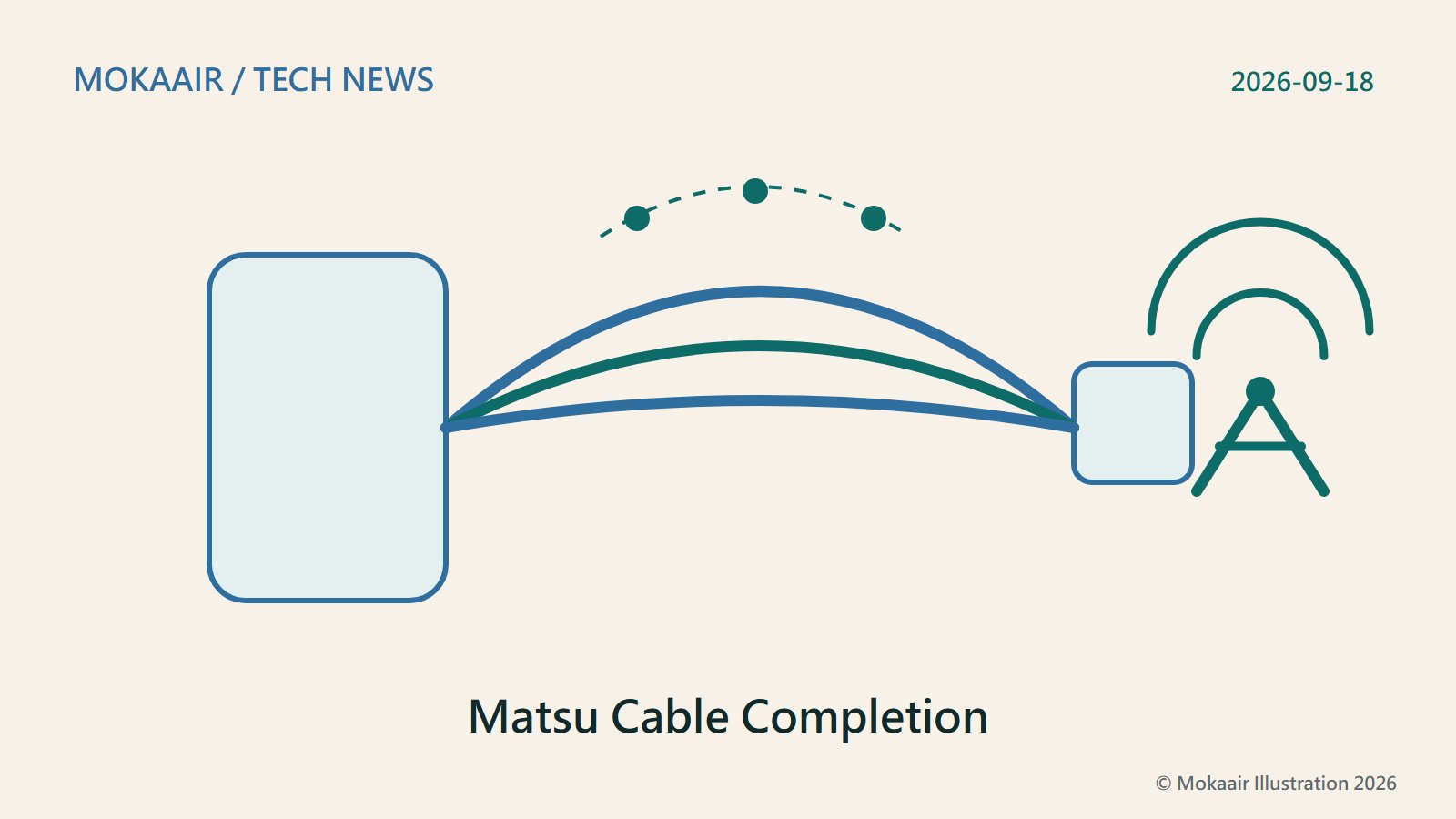
On September 18, 2026, Chunghwa Telecom announced that the “Taiwan–Matsu Fourth Cable,” nearly 300 kilometers long, has successfully completed cable-laying, landing, and testing, and has formally joined Matsu's outbound communications system. Chunghwa Telecom explained that with the Fourth Cable's laying complete, it will form “three mutually backing-up routes” together with the existing Taiwan–Matsu Second and Third Cables, combined with microwave and multi-orbit satellite communications — “three routes” is Chunghwa Telecom's own term. In the same announcement, Chunghwa Telecom also stated that the project cost nearly NT$1.4 billion, linking communications from the main island to Matsu's Dongyin, Nangan, and Xiju.
This article was first fact-checked on September 18, 2026, and updated on October 5, 2026: we re-read the full text of this Chunghwa Telecom announcement, moda's “Latest Submarine Cable Status” page, and the ministry's press release of June 23, 2026, and added the ministry's press release on the 5G applications event it held in Matsu on September 18. This site has not conducted any on-site testing, and offers no advice on whether to travel to Matsu or which telecom carrier to choose. This site previously covered moda's June preannouncement that the project was “coming to completion soon” and the outages and backups of the first half of the year; this article covers only the new facts and differences brought by September's completion announcement, and does not repeat that background.
What Chunghwa Telecom Announced on September 18
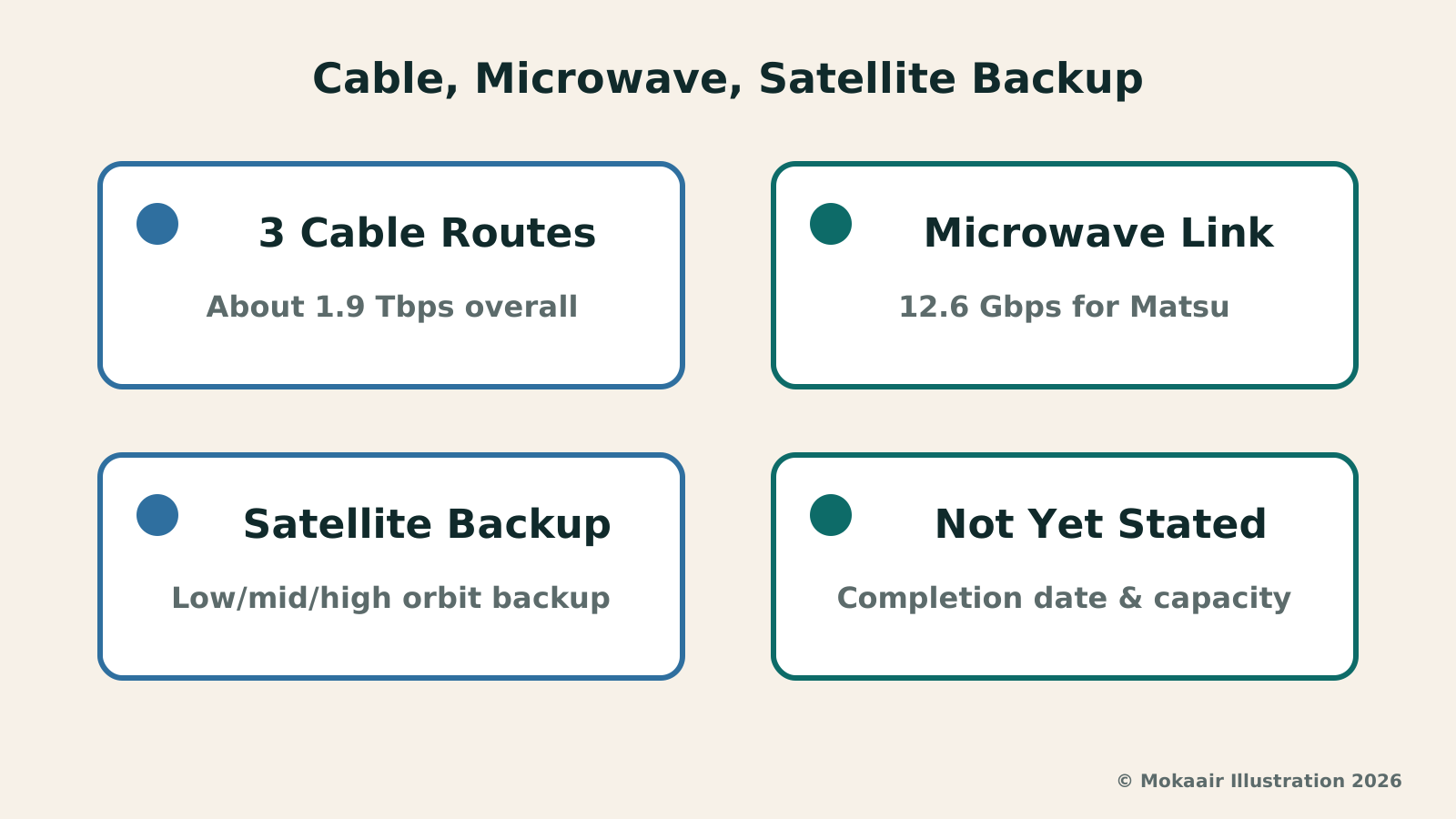
What Chunghwa Telecom calls “three mutually backing-up routes” refers to the newly completed Fourth Cable together with the existing Second and Third Cables; the announcement's wording is that the submarine cables linking Taiwan and Matsu are “expanded from two to three, with overall transmission capacity substantially increased to about 1.9 Tbps” — this figure is attached to the submarine cables linking Taiwan and Matsu as a whole, not to any single cable's own capacity. The announcement does not break down each cable's capacity, and this article does not break it down or estimate it either.
Besides the three-route submarine cable setup, Chunghwa Telecom states it has already deployed a 12.6 Gbps Taiwan–Matsu microwave backbone and integrated diverse low-, medium-, and high-orbit satellites, forming what Chunghwa Telecom calls a heterogeneous backup network of “submarine cable, microwave, and satellite”; later in the announcement it also describes the whole setup using the phrase “sea, land, satellite, sky.”
Chunghwa Telecom describes the difficulty of the construction: Matsu is an outlying island with scattered settlements, and sea conditions and construction conditions are complex, with outbound cables having repeatedly suffered external damage in the past — this is Chunghwa Telecom's own account, and the announcement does not list specific incidents, their number, or their cause. Chunghwa Telecom also states that the project will substantially improve Matsu residents' day-to-day communications quality and safeguard the stable operation of the military, police, government, firefighting, medical, education, and public services; these are all Chunghwa Telecom's own claims, and this site has not made any measurements.
From June's “Coming to Completion Soon” to September's “Successfully Completed”: Comparing the Two Official Announcements
A separate article on this site has covered moda's press release of June 23, 2026: the Taiwan–Matsu No. 4 Cable was “coming to completion soon,” without giving a specific date; that press release also forecast that once activated, there would be 3 cables between Taiwan and Matsu, and that Beigan, Nangan, Dongyin, and Juguang Township would each have at least 2 microwave systems for outside communication. Nearly three months later, it was Chunghwa Telecom's turn to issue a completion announcement on September 18, with the wording shifting from “coming soon” to “successfully completed” — but this completion announcement likewise gives no specific commercial-service date or activation date.
Placed side by side, what the two announcements agree on is the number of cables: June's preannouncement said “there will be 3 cables,” and September's says “expanded from two to three.” As for at least 2 microwave systems per township, that appears only in the June press release; September's completion announcement does not restate the number of microwave systems. The four figures — nearly 300 kilometers, nearly NT$1.4 billion, about 1.9 Tbps, and 12.6 Gbps — are ones the June press release did not give and that appear only in September's announcement. The funding source is also stated differently in each: June's moda release says it was built “with Chunghwa Telecom subsidized through the Forward-looking Infrastructure budget,” while September's Chunghwa Telecom announcement itself says “Chunghwa Telecom… invested nearly NT$1.4 billion.” Neither announcement states what share of the total cost the subsidy covers, and this article does not calculate that share either.
| Item | moda's June 23 Statement | Chunghwa Telecom's September 18 Statement | Note |
|---|---|---|---|
| Number of cables | 3 cables once activated | Expanded from two to three, about 1.9 Tbps overall | Cable count matches |
| Microwave systems | At least 2 microwave systems per township | 12.6 Gbps microwave backbone deployed | June gives no bandwidth, September gives no unit count |
| Completion timeline | Coming to completion soon | Announced completed construction, landing, and testing on the 18th | Neither gives an exact completion date |
| Funding | Forward-looking Infrastructure subsidy for construction | Chunghwa Telecom states nearly NT$1.4 billion | Subsidy share not stated |
How the Backups Stack Up: Three Layers of Cable, Microwave, and Satellite
On how the three routes back each other up, the announcement states, “even if a single route is damaged by a future natural disaster or sudden incident, the other systems can provide immediate support, effectively preventing the risk of an outbound communications interruption” — read in context, “the other systems” includes the submarine cables, microwave, and satellite; the announcement does not state how much traffic the other two cables could each take on if a single route were interrupted. This is Chunghwa Telecom's own claim, not a guarantee, and this site has not tested how it would actually perform after an interruption.
Beyond the three cable routes, there are two more layers of backup: the 12.6 Gbps Taiwan–Matsu microwave backbone, and multi-orbit satellite communications integrating low, medium, and high orbits. Converting 1.9 Tbps and 12.6 Gbps to the same unit and dividing, the former is about 150 times the latter — this is a conversion this article calculated itself; the announcement states the two figures separately, for the cable system and the microwave system, without making this comparison, and it does not state how much traffic microwave or satellite could actually carry if the cables were interrupted.
Here is an example designed by the editors: a reader working in Nangan, Matsu, might want to know, “If a cable breaks again, will communications be affected?” Based on the wording of the announcement as of the fact-check date, the only official statement that can be cited is the earlier sentence, “the other systems can provide immediate support” — Chunghwa Telecom does not specifically state the duration of an outage or its scope. This site has covered, in a separate article, the outages and backups that actually occurred on the Taiwan–Matsu cables in the first half of 2026; the details can be found via the link at the end of this article.
moda's Cable List: Taiwan–Matsu No. 1 Through No. 4, and What It Still Doesn't Say
Chunghwa Telecom's “three routes” refers to the Second, Third, and Fourth Cables; this announcement does not mention the Taiwan–Matsu No. 1 Cable. moda's “Latest Submarine Cable Status” page separately maintains an official cable list; when this article checked it on October 5, 2026, the page stated, “Taiwan currently has 16 international communication cables and 11 domestic communication cables.” The domestic cable list is numbered in order, and entries 2 through 5 are the Taiwan–Matsu No. 1 Cable (TM1-D), Taiwan–Matsu No. 2 Cable (TDM2), Taiwan–Matsu No. 3 Cable (TM3), and Taiwan–Matsu No. 4 Cable (TM4) — all four are on the list. This list is live data that changes as cables are added or removed; checking on a different date, the count and contents of the list could differ.
This list has only three fields — entry number, full Chinese name, and English abbreviation — and no field states which cable is currently in service; Chunghwa Telecom's announcement likewise does not mention the status of the No. 1 Cable. As seen on the fact-check date, the two official documents' statements about “three routes” and “four cables” do not contradict each other, nor do they explain each other. Readers should not infer from this that the No. 1 Cable has been decommissioned or retired, and this article does not make that judgment either.
It is also worth noting that officials themselves use two different names for this cable: searching the full text of the September 18, 2026 announcement, Chunghwa Telecom uses “Taiwan–Matsu Fourth Cable,” and “Taiwan–Matsu No. 4” or “TM4” does not appear; moda's cable list, on the other hand, calls it the “Taiwan–Matsu No. 4 Cable,” abbreviated TM4 — the two refer to the same cable. The landing locations are not written identically either: Chunghwa Telecom's September announcement says “Dongyin, Nangan, Xiju,” while moda's June press release, discussing the microwave system, says “Dongyin, Beigan, Nangan, and Juguang Township” — the two documents are discussing the cable and the microwave system respectively, and the place names themselves are not entirely the same. This article quotes each side's original wording separately, without merging them into a single list.
Chunghwa Telecom's completion announcement itself also leaves plenty of gaps: it only states that it “announced” on September 18 that construction, landing, and testing were complete, without giving an exact completion date, commercial-service date, or activation date; 1.9 Tbps is the “overall transmission capacity,” and the capacity of any single cable, the cable specifications, the number of fiber pairs, the landing-station names, the contractor, and the cable-laying ship are not stated; as for the 12.6 Gbps microwave backbone, it only says it “has also been deployed,” without giving a date. Nor does the announcement give any of latency, availability, actual download speed, or recovery time should a cable break; “substantially improving Matsu residents' day-to-day communications quality” is Chunghwa Telecom's own claim. Whether rates, plans, or application methods for residents will change is not stated in the announcement either.
The Same Day in Matsu: moda and Taiwan's Three Major Carriers Show 5G Applications
On the afternoon of September 18, 2026, moda held a “5G vertical-domain application experience event” in Lienchiang County, where Taiwan's three major telecom carriers each showed a different application scenario. According to moda's press release, Chunghwa Telecom's theme was “AI digital culture technology applications,” combining Matsu's local culture and tourism features; FarEasTone showed “五官鏡” (literally, “five-senses scope”), a 5G smart-healthcare application that captures medical images with devices such as high-resolution otoscopes and laryngoscopes and transmits them in real time over the 5G network so that medical staff can read the images and consult remotely; and Taiwan Mobile, under the theme “Smart Campus智慧校園大可能,” showed smart-campus and interactive-teaching applications.
Minister Yi-Jing Lin (林宜敬) said in the press release that the real value of 5G is bringing convenient digital services into daily life through high bandwidth and low latency combined with AI. The press release also says “as the Taiwan–Matsu No. 4 Cable is completed and activated and 5G and other digital applications gradually take root,” describing the cable as “completed and activated” but giving no date. The three applications were demonstrations on the day of the event; the press release does not say whether, or on what terms, they will be offered to residents afterward, and this site did not attend or try them.
Frequently asked questions
Are the Taiwan–Matsu Fourth Cable and the Taiwan–Matsu No. 4 Cable the same cable?
Yes, they are the same cable. Searching the full text of the September 18, 2026 announcement, Chunghwa Telecom uses “Taiwan–Matsu Fourth Cable,” and “Taiwan–Matsu No. 4” or “TM4” does not appear; moda's official cable list calls it the “Taiwan–Matsu No. 4 Cable,” abbreviated TM4. The two names refer to the same project, and this article quotes each side's official original wording separately.
How many submarine cables currently link Taiwan and Matsu?
Chunghwa Telecom states that with the Fourth Cable added, the submarine cables linking Taiwan and Matsu expand from two to three; moda's official cable list, meanwhile, lists four cables, Taiwan–Matsu No. 1 through No. 4, and the list itself has no field stating which one is currently in service. As seen by this article as fact-checked on October 5, 2026, the two official documents do not contradict each other, nor do they explain each other, and this article does not make a judgment on the current status of the No. 1 Cable.
How much did this project cost?
Chunghwa Telecom's announcement states it “invested nearly NT$1.4 billion to advance the Taiwan–Matsu Fourth Cable project”; moda's June press release states it was built “with Chunghwa Telecom subsidized through the Forward-looking Infrastructure budget.” Neither official document states what share of the total cost the subsidy covers; this article quotes each side's original wording separately and does not calculate that share itself.
If a cable breaks, what backup is there?
Chunghwa Telecom's announcement describes three systems: the cables' own three routes (the Second, Third, and Fourth Cables backing each other up), the 12.6 Gbps Taiwan–Matsu microwave backbone, and multi-orbit satellite communications integrating low, medium, and high orbits. Chunghwa Telecom states that “even if a single route is damaged by a future natural disaster or sudden incident, the other systems can provide immediate support,” but this is Chunghwa Telecom's own claim; the announcement does not state how long service could actually be maintained after an outage or which services would be restored first.
Has Chunghwa Telecom given a commercial-service date for the Taiwan–Matsu Fourth Cable?
Chunghwa Telecom's September 18 announcement only says that construction, landing, and testing are complete and that the cable has formally joined Matsu's outbound communications system, without giving a specific commercial-service date or activation date; moda's press release on its 5G applications event the same day describes the cable as “the Taiwan–Matsu No. 4 Cable completed and activated,” likewise without a date. Compared with moda's June statement that it was “coming to completion soon,” neither of these two September documents separately gives a commercial-service date.
Are 1.9 Tbps and 12.6 Gbps the same thing?
No. 1.9 Tbps is the overall transmission capacity of the Taiwan–Matsu submarine cables, as stated by Chunghwa Telecom; 12.6 Gbps is attached to the separately deployed Taiwan–Matsu microwave backbone, and the two belong to different systems. Converted to the same unit and divided, the former is about 150 times the latter — this is a conversion this article calculated itself; the announcement states the two figures on their two separate systems without making this comparison, and it does not state how much traffic microwave could carry if the cables were interrupted.
2026 Tech News Roundup: Key Points on Hardware, Platforms, Telecom, and Regulation2026 Tech News Roundup: Key Points on Hardware, Platforms, Telecom, and RegulationThis site's 2026 tech-news explainers in five groups — hardware, platforms, computing infrastructure, Taiwan policy, EU regulation: iPhone Duo and September hardware, M6/M5 Ultra, Snapdragon 8 Elite Gen 6, Project Zenith, Pixel Drop, App Store subscriptions, WordPress and Synology patches, NVIDIA, 6G, the Taiwan–Matsu cables, the sovereign AI corpus, the Cyber Resilience Act, the KIDS Act and Apple's EU terms. No purchase advice; vendor claims attributed; official sources and check dates.Read the full article
Taiwan–Matsu No. 4 Submarine Cable and Matsu’s Microwave Stations: moda Says Completion Is Coming Soon, and the State of Matsu’s Communications BackupsTaiwan–Matsu No. 4 Submarine Cable and Matsu’s Microwave Stations: moda Says Completion Is Coming Soon, and the State of Matsu’s Communications BackupsOn June 23, 2026, moda said the Taiwan–Matsu No. 4 cable and microwave stations in Matsu’s four townships, built with Forward-looking Infrastructure subsidies, are due to be completed soon; once active, there will be 3 cables and at least 2 microwave systems per township. This article traces the cable outages and backups of the first half of 2026 from official notices, plus the official cable list as of September 17, 2026. This site did no on-site testing and gives no travel or carrier advice.Read the full article
Lifestyle
Taiwan–Matsu No. 4 Submarine Cable and Matsu’s Microwave Stations: moda Says Completion Is Coming Soon, and the State of Matsu’s Communications Backups
On June 23, 2026, moda said the Taiwan–Matsu No. 4 cable and microwave stations in Matsu’s four townships, built with Forward-looking Infrastructure subsidies, are due to be completed soon; once active, there will be 3 cables and at least 2 microwave systems per township. This article traces the cable outages and backups of the first half of 2026 from official notices, plus the official cable list as of September 17, 2026. This site did no on-site testing and gives no travel or carrier advice.
Lifestyle
Cloudflare launches Traces in public beta: site operators can follow every step a request takes through the platform on one timeline
On October 2, 2026, Cloudflare announced the public beta of Cloudflare Traces. Website operators and developers using Cloudflare can see a request pass through security rules, caching, routing and the origin server on a single timeline, making it easier to find why a request was blocked or slowed. New pricing takes effect on December 1, 2026. Information comes from the official Cloudflare blog.
Lifestyle
Cloudflare launches Web Search API via AI Gateway, requiring search partners to follow its crawler rules
On October 2, 2026, Cloudflare announced a Web Search API that lets AI agents query live web information through AI Gateway. The first partners are Ceramic.ai, Exa and Linkup. Cloudflare says these partners' crawlers must meet its Verified bots requirements and cite sources. This matters both to developers building AI applications and to website owners whose content may be crawled.
Lifestyle
Cloudflare open-sources Streamline: a demo of using its cloud services to add graphics to live streams and burn subtitles into videos
On October 2, 2026, Cloudflare launched and open-sourced Streamline, a developer playground showing how developers can combine Stream, Workers, Containers and Durable Objects to build their own video processing pipelines, such as adding graphics to live streams in real time or adding subtitles to videos. This article explains what it is, how it works, its limitations, and what it means for viewers and developers.
Articles that cite this one
Latest travel guides

GuideTokyo
Where to Stay in Tokyo: Comparing Shinjuku, Ueno, Tokyo Station, Shibuya, Asakusa, Ikebukuro, and Ginza, Plus Airport Access, Accommodation Tax, and Luggage Delivery
Where should you stay in Tokyo? Compare Shinjuku, Ueno, Tokyo Station, Shibuya, Asakusa, Ikebukuro, and Ginza by the same criteria: access from Narita and Haneda, transit routes, nearby attractions, neighborhood character, and who each area suits. Includes a comparison table, a Yamanote Line diagram, Tokyo’s accommodation tax as verified in 2026/9 (changing to 3% in 2027/4), and Airport TA-Q-BIN luggage shipping rules.
- Budget
- Hotels
GuideTokyo
How to Choose Tokyo Transit Passes: Are Suica, Welcome Suica, the Tokyo Subway Ticket, and the JR Pass Worth It?
On a first Tokyo trip, start with an IC card and pay per ride (Welcome Suica has no deposit and is valid for 28 days). If you take four or more subway rides in a day, add a 72-hour Tokyo Subway Ticket for 2,000 yen; a JR Pass is never worthwhile if you stay in Tokyo and do not go to Kansai. See what TOURIST PASMO, Suica on iPhone, and the Tokyo Metro day pass do and do not cover, with a decision chart. Prices verified in September 2026.
- Transport
- Budget

GuideTokyo
Tokyo Disneyland and DisneySea Guide: Ticket Prices, Fantasy Springs, Disney Premier Access (DPA), Standby Pass, and Which Park to Choose for Your First Visit
Tokyo Disney one-day Passport prices vary: most weekdays in 9/2026 cost ¥9,900 and weekends ¥10,900. At 14:00 daily, tickets go on sale for the same date two months later. Free Priority Pass is no longer on the official service list; only paid Disney Premier Access (¥1,000–3,500 per person per use) shortens waits. Covers hours, the 25th anniversary, Standby Pass, Entry Request, Fantasy Springs access and first-visit park choice; checked on the official site in 9/2026.
- Itineraries
- Family
Sources
- Chunghwa Telecom Completes Construction of the ‘Taiwan–Matsu Fourth Cable,’ Building Three-Route Backup to Comprehensively Strengthen Matsu's Communications Resilience · Checked:
- Latest Submarine Cable Status · Checked:
- moda Actively Advances Construction of the Taiwan–Matsu No. 4 Cable and Microwave Stations in Matsu's Four Townships to Strengthen Outlying-Island Communications Resilience · Checked:
- 5G Applications Arrive in Matsu: moda and the Three Major Carriers Show New Smart-Island Scenarios · Checked: