Lifestyle
How Websites Build Trust: Authors, Sources and High-Risk Topics
Website trust rests on verifiable author backgrounds, sources, methods and correction accountability. This article explains E-E-A-T and YMYL's uses and limits, using original scenarios for everyday posts, software tutorials and high-risk information to outline author, editor and expert reviewer roles. A checklist covers source applicability, partnership disclosures, dates and corrections, so author boxes, institution names and search rankings are not taken as proof of accuracy.
About 8 min read
Contents
- 1. Understand E-E-A-T and high-risk topics correctly
- 2. Match author backgrounds to what they can actually take responsibility for
- 3. Check whether sources sufficiently support readers' decisions
- 4. Disclose partnerships and the website's purpose
- 5. Set clearer editorial checkpoints for high-risk content
- 6. Maintain long-term trust through correction and traceability
Putting an author's photo and the words “expert reviewed” on a website does not automatically answer readers' most pressing questions: who is responsible for this information, what supports it, and whether errors can be corrected when discovered. Trustworthiness requires verifiable content and actual processes to support it.
Everyday personal posts can clearly describe individual experiences, but when an article may affect health, safety, finances or important rights and interests, the cost of errors is different. Websites should arrange verification and review according to the content's impact, rather than applying the same professional-looking template to every article.
Understand E-E-A-T and high-risk topics correctly
Google uses E-E-A-T to discuss experience, expertise, authoritativeness and trustworthiness, with trustworthiness being the most important. It is not a single ranking score that can be bought or obtained simply by adding markup. Google also explains that quality raters assess search systems and do not directly control individual pages' rankings.
YMYL refers to topics that may significantly affect areas such as health, financial stability, safety and societal well-being. What matters is the content's impact, not just its category. A post about arranging a planner and one claiming that a method can treat a disease cannot have the same verification requirements, even if both are labeled lifestyle articles.
First list the actions readers might take based on the article, then ask what could happen if the information is wrong. If it merely influences the choice of a folder color, the impact is limited. If it might lead someone to stop taking medication, transfer a large sum of money or miss an application deadline, stricter sourcing, clearer boundaries and appropriate expert review are needed. This is an editorial risk assessment, not a diagnosis of individual readers.
Match author backgrounds to what they can actually take responsibility for
Author bios should explain experience and work relevant to the article, rather than pile up unverifiable titles. Someone writing software instructions can describe their setup and how they compiled the information; someone writing about travel experiences can state when they visited and the scope of their observations. Things they have never done should not be filled in with seemingly authentic photos or accounts of experience.
Distinguish between writers, research editors and expert reviewers. Someone checking wording has not necessarily verified medical or legal judgments. If a professional reviews only one paragraph, the entire article should not appear to carry the same endorsement. Review records should specify the scope, date and work actually completed.
If a website uses a team byline, it can still publicly explain how content is produced, who handles corrections and when external review is needed. When using AIWhat Is Artificial Intelligence?AI covers many technologies and uses; it is not synonymous with chatbots and need not generate text. Starting with the OECD system definition, this article uses photo classification and community resource recommendations to link inputs, inference, outputs and human goals, and explains AI's relationship to machine learning, deep learning and generative AI. Learn to ask concrete questions about what an AI feature does and distinguish capability, autonomy and trustworthiness.Read the full article to help organize information, explain its role and how people verify its output. Do not present fictional people as experts or treat passing automated checks as agreement from a professional.
Check whether sources sufficiently support readers' decisions
Start by choosing sources suited to the question. For product features, consult vendor documentation; for administrative rules, consult the relevant authority; for research claims, examine the study's methods and limitations. Linking to a well-known website's homepage does not tell readers which statement it supports. The closer a citation is to a specific claim, the easier it is to verify.
Also check the region, time period and intended population. Another country's system cannot simply be treated as Taiwan's current rules, and research on adults cannot automatically be applied to all ages. If an article only explains how to look up information, keep it clearly within that scope rather than extending it into conclusions about what applies to individual readers.
NIH's guidance on evaluating health information reminds readers that personal testimonials are not research evidence that directly proves effectiveness, and that sources and expert review need to be clearly identified. Websites can retain valuable personal experiences, but readers should be able to distinguish personal accounts from research-supported statements and recognize which matters still require professional judgment based on individual circumstances.
Disclose partnerships and the website's purpose
If an article involves samples, payments or affiliate commissions, clearly disclose the relationships relevant to its content so readers understand the author's potential interests. This does not mean sponsored content is necessarily unreliable; it allows readers to factor those circumstances into their judgment. Do not blend advertising copy into neutral test findings or present paid placement as an independent recommendation.
NIH's guide to reliable health information recommends checking who operates and funds a website, along with the backgrounds of its authors and reviewers. These principles can also inform disclosure practices for websites in general: the About page, contact information and editorial policies should be consistent. Readers should be able to find a way to raise questions, rather than seeing only a row of unverifiable badges.
Citing an institution's information does not mean that institution recommends your website. Participating in events or earning certification for a tool should not be inflated into credentials establishing authority on every topic. Before using external titles and logos, confirm the actual relationship and permitted scope of use. A credibility page should provide verifiable information, not create an impression of authority beyond the facts.
Set clearer editorial checkpoints for high-risk content
Before production, define how far the article's answers can go: general concepts, ways to find official information, or professional judgments requiring review by qualified personnel. If the team's current capabilities extend only to compiling official information, limit the content to what can be supported. Do not write personalized conclusions first and then try to remedy them with a disclaimer at the bottom of the page.
When submitting content for review, include a list matching claims to sources, the applicable region, unresolved questions and important figures so reviewers know what to check. After making corrections, recheck the title, summary and illustrations to ensure that excessive promises do not remain elsewhere after the body text has become more cautious. Mark unfinished reviews as pending; do not apply a reviewed label in advance.
For example, an article teaching readers how to look up official application requirements can explain which fields to examine and how to confirm the applicable year and which groups the rules cover. Directly deciding whether a particular person is eligible goes beyond a general guide to looking up information. Separating these tasks helps a website provide useful information within its capabilities and direct matters requiring individual judgment to appropriate channels.
- List readers' possible actions and the consequences of errors to determine the level of verification needed.
- Assign authors, editors and reviewers, specifying each person's scope.
- Check sources, regions, dates and interests involved, and record unresolved questions.
- Apply the appropriate status only after actual review and corrections across all fields are complete.
Maintain long-term trust through correction and traceability
Manage publication dates, substantive update dates and verification dates separately. Readers need to know when content was created, when it changed and when its information was last checked. Rebuilding a website must not automatically make every article appear to have just undergone expert review. If the information has not changed but has actually been rechecked, you can also explain the scope of that verification.
Someone needs to handle the corrections channel. After receiving a specific error report, first preserve the issue and its sources, then assess whether an immediate correction or temporary removal of unreliable conclusions is needed. Correction notices should clearly explain what changed. Do not describe changes that affect interpretation merely as layout updates.
Periodically spot-check from a reader's perspective: can they find the author's background, do citations lead directly to evidence, are partnerships clearly disclosed, and does the review status reflect reality? Articles are not immune to errors because they rank highly, nor are attractive pages automatically trustworthy. Ongoing maintenance means making responsibility, sources and correction procedures understandable.
Read the full description
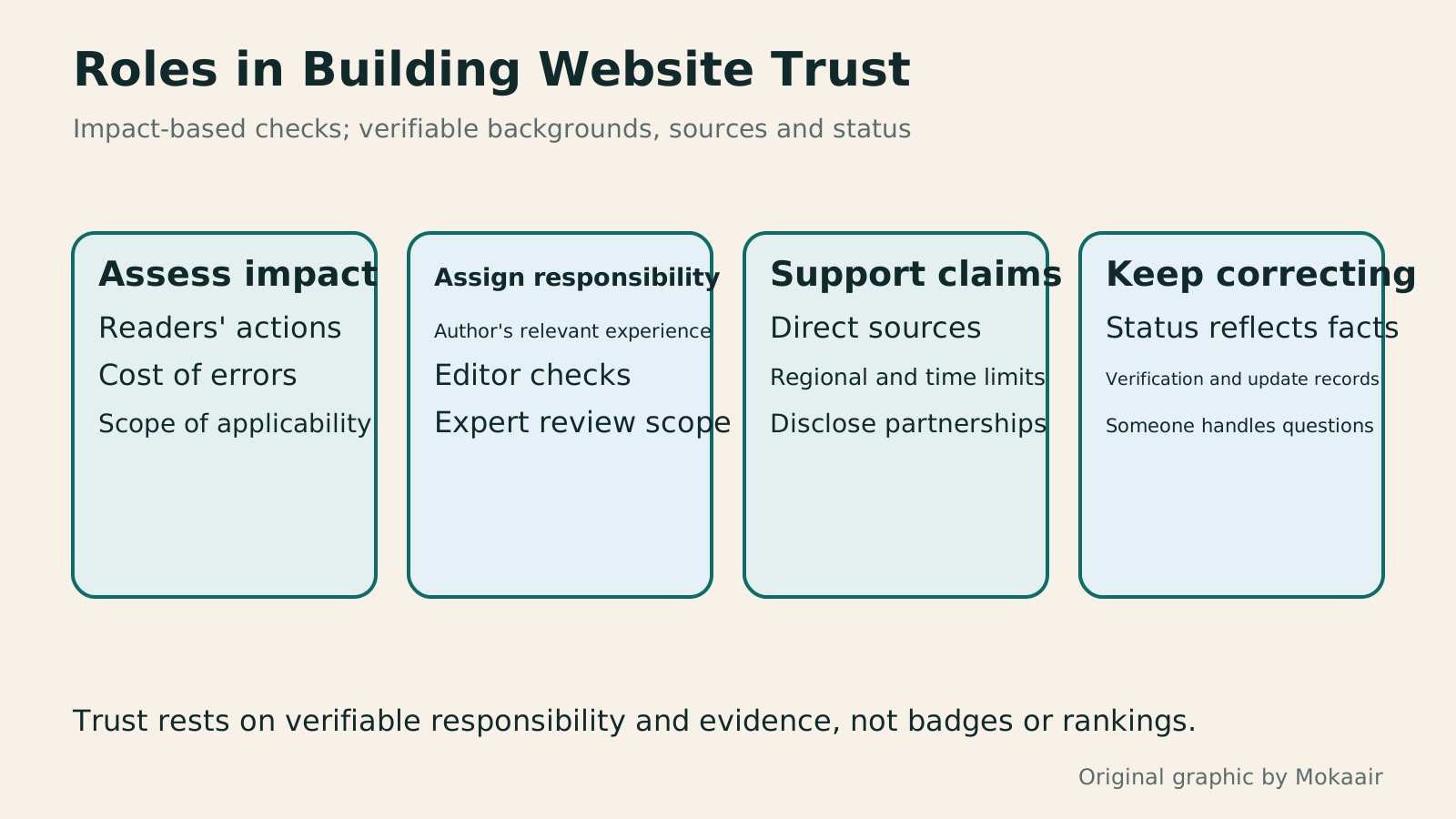
Four sections—assessing impact, assigning responsibility, supporting claims and ongoing corrections—explain how websites build trust.
| Aspect of trustworthiness | Evidence to provide | Potentially misleading practices |
|---|---|---|
| Relevant experience | Context, time period, methods and necessary records | Inventing experiences of use or visits |
| Scope of expertise | Verifiable background and review work actually performed | Using a single title to represent expertise in every field |
| Source applicability | Specific documents, regions, versions and limitations | Using an institution's name to endorse unrelated claims |
| Partnership disclosures | Sponsorships, samples or commission arrangements | Presenting paid arrangements as independent rankings |
| High-risk content review | Claim lists, review scope and completion dates | Labeling content expert-approved before review |
| Ongoing maintenance | Correction channels and verification records | Updating dates without checking information |
Establish an article sourcing and quality-checking processSEO Article Quality Checklist: Sources, Useful Detail and MaintenanceA content quality review checks whether evidence, interpretation, instructions and images agree. Using a comparison of digital note-taking tools, this guide shows how to map claims to sources, distinguish official features from hands-on tests, add the details readers need to compare options, and check image rights, titles, summaries and update ownership. An editorial checklist and correction workflow make ‘finished’ mean verifiable, readable and maintainable, not merely long enough.Read the full article
Avoid titles that promise more than the evidence supportsHow to write article titles: Show search readers the scope and purposeA useful title tells readers before they click what problem an article addresses, when it applies, and what information they will get. Using original rewrites of everyday tutorials, this guide checks the topic, purpose, limits, and evidence behind title promises. It explains why the page heading, HTML title, and Google search title may differ, then offers prepublication checks and post-change observation without stuffing keywords, claiming tests that never happened, or adding an unverified year.Read the full article
Found this guide helpful? Share it with someone who needs it
Lifestyle
Understanding website authority scores: Tool metrics vs. search performance
Website authority scores appear in SEO reports and partnership proposals, but tools calculate them differently. Using Ahrefs Domain Rating and Semrush Authority Score, this article explains differences between domains, pages, links, estimated traffic and actual outcomes, with steps for same-tool comparisons, anomaly checks and monthly reports. It helps small sites treat scores as research clues, not Google certification or ranking guarantees.
Lifestyle
How to Design a 404 Page: Explain the Problem and Help Readers Continue
404 pages need more than art and a home button: explain missing content and help readers finish their task. An original exhibition-site example covers clear copy, relevant categories and search, HTTP status codes, proper redirects and error tracking. Steps, a comparison table and original diagrams distinguish missing content, moved pages and service outages, avoiding attractive pages that return success or redirecting every old URL to an unrelated home page.
Lifestyle
Articles Competing for Rankings? Identify Overlapping Intent and Consolidate Content
Multiple articles from one site appearing for similar queries do not always hurt each other. This article shows how Search Console, article tasks and content differences reveal truly duplicate needs and guide retention, repositioning or merging. It explains the distinct roles of permanent redirects, canonical and noindex, plus pre-merge backups, URL mapping, internal link updates and performance tracking, to avoid deleting articles based only on keywords or short-term rankings.
Lifestyle
How to Plan a Sitemap: Which URLs to Include, How to Submit It, and How to Maintain It
A sitemap is a URL list for search engines. Choosing the wrong content or leaving it outdated means successful submission still cannot solve indexing problems. This article covers selecting public canonical URLs, WordPress sitemap locations, XML formatting and file limits, and Search Console submission and maintenance. A URL-type comparison table and an original synchronization diagram help small websites in Taiwan build a sustainably managed Sitemap.
Articles that cite this one
Sources
- Google: E-E-A-T and People-First ContentChecked:
- NIH ODS: Evaluating Online Health InformationChecked:
- NIH NIA: Finding Reliable Health InformationChecked:
- Google: Guidance on Using Generative AI ContentChecked:
Compiled from the references and verification dates listed above; fares, schedules, product features, and terms can change, so please confirm the latest details on the relevant official website before travelling, booking, or purchasing.