Lifestyle
Understanding website authority scores: Tool metrics vs. search performance
Website authority scores appear in SEO reports and partnership proposals, but tools calculate them differently. Using Ahrefs Domain Rating and Semrush Authority Score, this article explains differences between domains, pages, links, estimated traffic and actual outcomes, with steps for same-tool comparisons, anomaly checks and monthly reports. It helps small sites treat scores as research clues, not Google certification or ranking guarantees.
About 8 min read
Contents
- 1. First, identify whose metric it is and what scope it assesses
- 2. There is no conversion table between tool scores and Google rankings
- 3. Choose comparable sites within the same tool
- 4. When scores change, check the data and model before judging website problems
- 5. Divide monthly reports into tool clues, search performance and user outcomes
- 6. Avoid making a higher score your only work objective
Different authority scores for the same website in two tools do not mean one tool must be wrong. The tools may use different data, scopes and formulas. If you have not even recorded the metric's name and simply say the website rose from forty to fifty, that growth is difficult to interpret correctly.
For most website managers, understanding what a score describes is more useful than pursuing an impressive threshold. It can help identify sites to research and investigate changes, but it cannot replace specific pages' search performance, whether readers found answers, or actual inquiry and purchase outcomes.
First, identify whose metric it is and what scope it assesses
“Website authority” is a common term, but it is not a single scale shared by all tools. A report should at least list the provider, full metric name, domain or URL queried, data date and scope of use. Providing only a number or abbreviation can even mix up sitewide and individual-page scores.
Ahrefs officially defines Domain Rating, abbreviated DR, as the relative strength of a domain's backlink profile within its database, on a scale from zero to one hundred. URL Rating assesses individual pages. Although both concern links, a domain's DR cannot directly establish the strength of every page within it.
Semrush's Authority Score combines link power, estimated organic traffic and spam signals in the link profile. Its data sources and the way it combines them differ from DR. A DR of fifty and an Authority Score of fifty therefore do not represent the same result, nor can they be added and averaged into another meaningful website score.
There is no conversion table between tool scores and Google rankings
Google's official explanation says its ranking systems work primarily at the page level while also using sitewide signals and classifiers. Certain positive signals on a website do not mean every page will rank well. A tool's aggregate number cannot replace search systems' assessment of actual questions and content.
A report labeling a score as authority or trust does not make it Google-issued certification. Ahrefs also states that there is no evidence search engines use DR or similar tool scores as ranking factors. This does not mean links are entirely unimportant; it means a tool's external model and the search system itself need to be understood separately.
Suppose a large website specializes in photography and a small website explains how to take buses in a particular area. Sitewide scores alone cannot determine which is necessarily better suited to answer that transport question. Page relevance, the usefulness of the information and its freshness all require separate checks. This example illustrates the limits of comparison, not a prediction of actual rankings.
Choose comparable sites within the same tool
First, define the market and readers you want to research—for example, websites in Taiwan offering similar services and similar types of content—then examine them using the same tool and date range. If a small studio offering courses compares its sitewide score only with global media sites, it can easily find a large numerical gap without identifying any content or maintenance actions it can take.
Query scopes must also match: an entire domain, a subdomain, a single path and an individual page may cover different data. Record the settings in a spreadsheet and retain source URLs and access dates. If a tool does not offer the scope you need, note that limitation rather than silently treating substitute data as the item you originally intended to compare.
The purpose of comparison here is to find differences worth understanding in depth. For example, if a course website has a clear materials list that relevant communities regularly cite, you can study how that information is used and presented. A higher score does not mean you should copy its wording, buy its links or abandon questions you were already capable of answering.
When scores change, check the data and model before judging website problems
DR is a relative metric. Ahrefs explains that even without losing backlinks, your score may fall as other websites gain links. After noticing a change, first confirm that you are using the same tool and scope, then review the tool's recent data updates and available methodology explanations. Do not immediately conclude that the website has received a search penalty.
Next, spot-check new or lost link sources, whether important destination pages are broken, and whether the website has recently been redesigned or its URLs moved. Record “the tool just discovered a link” separately from “the link first appeared today.” The time data was discovered does not necessarily match when an event occurred, and a single snapshot cannot reconstruct the full history.
If the score falls but key pages' impressions, clicks and service inquiries show no abnormalities, preserve the evidence and continue monitoring. If both decline together, you still need to check seasonality, content changes, technical problems and tracking settings. Simultaneous changes are only a starting point for investigation, not proof that the score caused the traffic decline.
- Save the before-and-after values, tool, scope and dates, and confirm that comparison conditions match.
- Read the provider's methodology and update notes to identify relative metrics or estimated data.
- Spot-check important links and destination pages against the website's change history.
- Then examine search and business data, recording evidence for and against each possible cause.
Divide monthly reports into tool clues, search performance and user outcomes
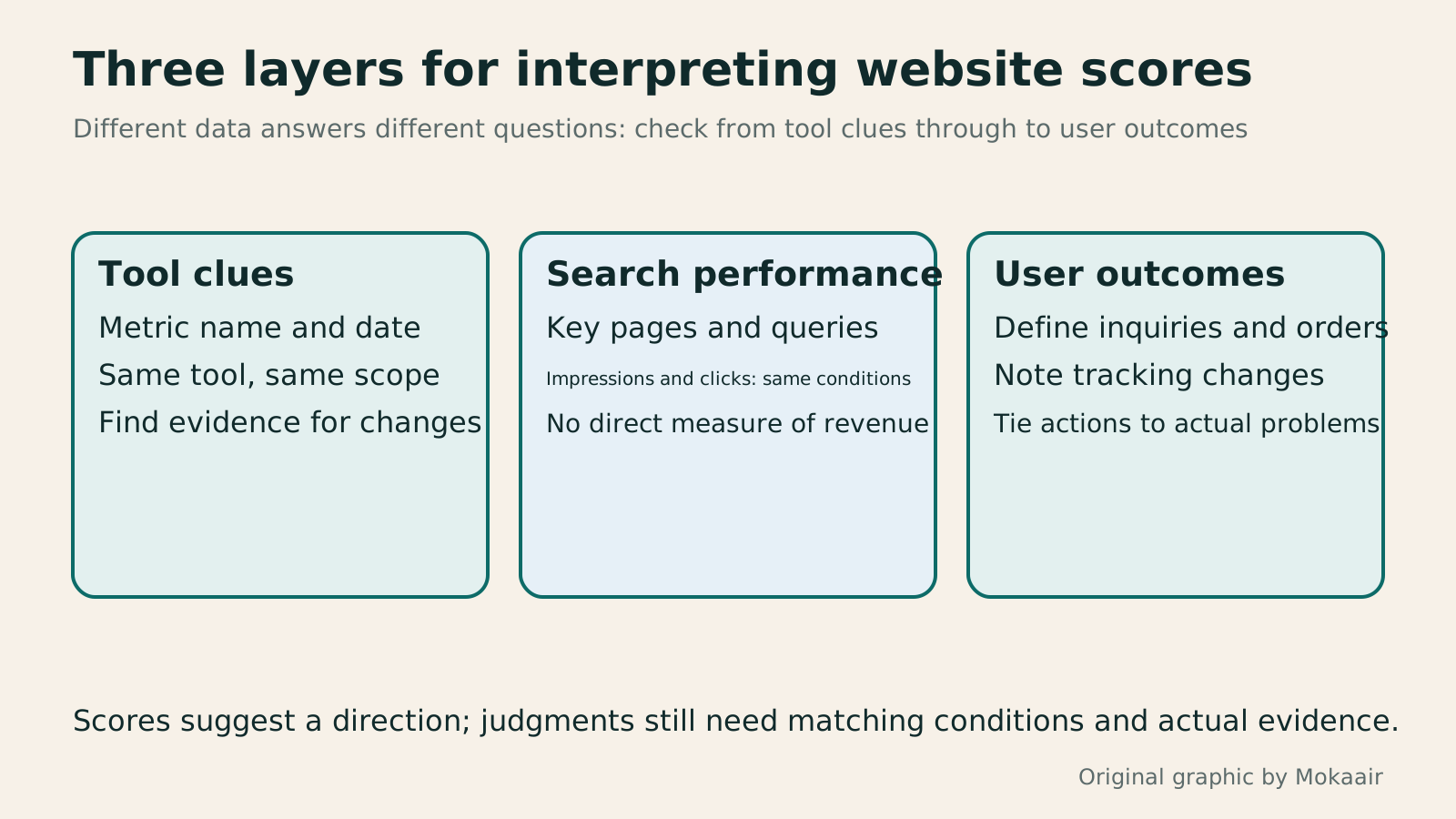
A monthly report can have three layers. The first records third-party metrics and changes requiring investigation. The second uses Search Console to examine search performance for important pages and queries. The third compiles inquiry or order data that you are authorized to access and that uses consistent tracking definitions. State the scope and limitations of each layer rather than treating them as substitutes for one another.
Semrush's organic traffic field is an estimate based on its data and models, not a direct reading of every website's actual visitor records. When using it to research peers, you can describe only the estimates and their trends. You cannot claim how many customers a competitor actually gained last month, much less calculate revenue directly from estimated traffic.
A useful conclusion should lead to action. For example, if an important download page is broken, fix it first and check where links citing it lead. If only the score has changed and other evidence is lacking, record it for monitoring. Do not switch to another tool that gives higher scores or select only the most flattering dates just to make monthly reports appear to show progress.
Avoid making a higher score your only work objective
When you receive a proposal guaranteeing higher authority, ask the provider to explain what content it will change, how it will acquire links, and which metrics and dates will be used to verify delivery. Even reaching a particular tool score does not automatically mean organic search has grown or business goals have been met. Fees should correspond to work that can be checked, not a number with no practical use.
If the method relies on buying and selling links to manipulate rankings, excessive link exchanges or automated link creation at scale, Google's spam policies still apply. A rising third-party score provides no exemption for these practices. Conversely, a low score alone cannot prove that a new website is spam or that a potential partner is unreliable.
Improvement priorities can return to the website's actual gaps: ensuring important content can be read, information addresses readers' questions, pages are easy to navigate between, and original resources worth citing remain maintained. Keep tool scores as metrics to monitor. Your work has a clear direction when you can explain whom each change helped and how to verify its completion.
Read the full description
Three sections present third-party tools, search performance and first-party business data in sequence, explaining their uses, limitations and possible actions.
| Data | Scope described | Cannot directly establish |
|---|---|---|
| Ahrefs DR | Relative strength of a domain's links within its database | Each page's rankings or actual orders |
| Ahrefs UR | Link assessment for an individual page | Performance of every page across the website |
| Semrush Authority Score | A combined model of links, estimated traffic and spam signals | Google certification or actual traffic |
| Search Console search performance | Search impressions, clicks and other metrics under selected conditions | All visitor sources and total revenue |
| First-party service records | Inquiry or order outcomes using consistent definitions | That a single SEO change caused all growth |
Examine the citation context of backlinks
Connect keyword research to readers' needsA keyword research workflow: Reader needs, long-tail queries, and topic prioritiesKeyword research should produce a schedulable content list, not hundreds of unused terms. Using a small baking tutorial site, this guide collects clues from reader questions, Search Console, Google Keyword Planner, and Google Trends. It separates search-volume estimates, ad competition, and relative interest, then groups specific needs, checks existing pages, and prioritizes topics by value and production capacity.Read the full article
Found this guide helpful? Share it with someone who needs it
Lifestyle
How Websites Build Trust: Authors, Sources and High-Risk Topics
Website trust rests on verifiable author backgrounds, sources, methods and correction accountability. This article explains E-E-A-T and YMYL's uses and limits, using original scenarios for everyday posts, software tutorials and high-risk information to outline author, editor and expert reviewer roles. A checklist covers source applicability, partnership disclosures, dates and corrections, so author boxes, institution names and search rankings are not taken as proof of accuracy.
Lifestyle
How to Design a 404 Page: Explain the Problem and Help Readers Continue
404 pages need more than art and a home button: explain missing content and help readers finish their task. An original exhibition-site example covers clear copy, relevant categories and search, HTTP status codes, proper redirects and error tracking. Steps, a comparison table and original diagrams distinguish missing content, moved pages and service outages, avoiding attractive pages that return success or redirecting every old URL to an unrelated home page.
Lifestyle
Articles Competing for Rankings? Identify Overlapping Intent and Consolidate Content
Multiple articles from one site appearing for similar queries do not always hurt each other. This article shows how Search Console, article tasks and content differences reveal truly duplicate needs and guide retention, repositioning or merging. It explains the distinct roles of permanent redirects, canonical and noindex, plus pre-merge backups, URL mapping, internal link updates and performance tracking, to avoid deleting articles based only on keywords or short-term rankings.
Lifestyle
How to Plan a Sitemap: Which URLs to Include, How to Submit It, and How to Maintain It
A sitemap is a URL list for search engines. Choosing the wrong content or leaving it outdated means successful submission still cannot solve indexing problems. This article covers selecting public canonical URLs, WordPress sitemap locations, XML formatting and file limits, and Search Console submission and maintenance. A URL-type comparison table and an original synchronization diagram help small websites in Taiwan build a sustainably managed Sitemap.
Sources
- Ahrefs Domain Rating definitionChecked:
- Ahrefs explanation of tool scores and rankingsChecked:
- Semrush Authority Score methodologyChecked:
- Google Search ranking systemsChecked:
- Google spam policiesChecked:
Compiled from the references and verification dates listed above; fares, schedules, product features, and terms can change, so please confirm the latest details on the relevant official website before travelling, booking, or purchasing.