Lifestyle
Practicing Design Thinking: From Interviews to Small, Testable Prototypes
Design thinking helps frame everyday and service problems without making every exercise a sticky-note-filled workshop. An original community umbrella-lending scenario explains interview preparation, observation versus conjecture, scoped problem definitions, idea comparison and small prototypes. Steps, a method comparison table and original diagrams help beginners turn discussion into decisions they can check, without mistaking a few opinions for everyone's needs.
About 8 min read
Contents
- 1. Treat design thinking as an iterative way to explore
- 2. Ask about real experiences without putting answers into the questions
- 3. Turn the data into an actionable problem
- 4. Propose different approaches, then compare them against criteria
- 5. Build only a small prototype sufficient to test the key assumption
- 6. Let feedback shape the next decision, not just reflections
A community wants to improve its rainy-day umbrella-lending service. Someone proposes an app, someone suggests adding umbrella stands, and someone else thinks a deposit system would help. These are all possible solutions. But without knowing why residents do not borrow umbrellas or why they fail to return them, voting directly on features may simply mean choosing the answers everyone knows best.
The following original community umbrella-lending exercise demonstrates methods for moving from understanding a situation to testing ideas. The concepts draw on Stanford d.school, Design Council, IDEO.org and GOV.UK resources accessed on 2026-9-14. All resident reactions are treated as scenarios awaiting confirmation, not presented as real interviews, implementation results or case studies from the source websites.
Treat design thinking as an iterative way to explore
Stanford d.school's introductory tools organize methods into modes such as empathize, define, ideate, prototype and test, and explain that you can start wherever it makes sense. Design Council's Double Diamond emphasizes exploring and defining the problem before developing and testing solutions. These frameworks help teams see where to focus their work; they need not be treated as fixed checkpoints passed through only once.
The community umbrella-lending exercise can begin with a list of things to understand: who might need to borrow an umbrella, where borrowing currently takes place, what restrictions apply to returns and how much effort staff spend managing the service. Do not start by making increased app usage the goal, because whether an app needs to exist is precisely one of the unanswered questions.
If testing reveals that the problem lies in return locations rather than the borrowing process, you can revisit the problem definition. Having already drawn the screens does not mean development must continue. The value of the exercise is for each step to produce new understanding that guides what to do next, rather than merely completing a polished set of deliverables.
Ask about real experiences without putting answers into the questions
First list the situations you need to understand, then prepare an interview guide. Instead of asking whether participants find the umbrella-lending system troublesome, invite them to describe what they did the last time they encountered rain while out. Follow up by asking what information they saw, how they decided and what they ultimately did. Open, neutral questions are more likely to reveal factors you had not considered.
Participants should include different roles relevant to the topic, such as residents who might borrow umbrellas, people who have used the service and those responsible for organizing the umbrella stands. An introductory exercise does not require a fixed participant count supposedly suitable for every study. Start by explaining which situations you have selected, whose perspectives are missing and how these limitations might affect your understanding.
Before research begins, explain its purpose, process, whether audio will be recorded, how data will be used and how to withdraw, and obtain the appropriate consent. In your notes, distinguish participants' actual words, the behavior you observe and your own interpretations. If you are only rehearsing questions with classmates, label it as a practice interview; do not treat answers from classmates role-playing residents as real needs.
Turn the data into an actionable problem
After the interviews, organize specific incidents before comparing whether they point to similar difficulties. Not knowing whether an umbrella can be returned to another building, being unable to find an umbrella stand when heading out and finding no usable umbrellas at a stand may require different responses. Do not lump them together as a poor user experience simply because they all involve borrowing umbrellas.
For this original exercise, a provisional question could be: How might we help residents who move between buildings know where they can return an umbrella before borrowing one? This wording leaves room for paper signs, explanations at the desk or digital prompts, and makes the scope easier to define than asking how to create the most user-friendly umbrella-lending app. Without supporting research, still mark the question as an assumption.
IDEO.org's approach to framing a design challenge reminds us that a problem's scope should consider the people involved, context, constraints and intended impact while allowing different solutions. You can also add constraints to the exercise, such as no additional on-duty staff or information that must be easy to update. These conditions must have a basis; they cannot be invented on the spot to favor a preferred solution.
Propose different approaches, then compare them against criteria
For return information, initial ideas might include umbrella-handle labels, umbrella-stand maps, verbal reminders when borrowing or a simple web page. During ideation, first clarify each approach, including who will see it, when they will see it and how it will be maintained. If several ideas merely change colors within the same app, you have not yet explored genuinely different solutions.
Once the ideas are organized, compare how well they meet needs, their implementation burden and their key assumptions. An umbrella-handle label might travel with the umbrella but would need to withstand wear. A web page is easy to update, but you must check whether residents will open the link. These are original lines of reasoning, not test findings. List what needs verification instead of immediately assigning each solution a precise score.
When choosing a solution, record your reasons and any criteria set aside. If the community is short-staffed, you might first test whether labels and fixed notices can communicate the rules before considering digitization. Voting can support discussion, but the most votes only reflect the choices of those participating at that moment. They cannot replace understanding users or prove that a solution already works.
Build only a small prototype sufficient to test the key assumption
A prototype does not have to be a launch-ready website. To find out whether residents understand return locations, you can start with paper labels and a simplified map. To check the sequence from borrowing to receiving a reminder, you can use role-play or clickable screens. Write down what you want to learn before deciding how much time to spend making it.
Set a concrete task: for example, ask participants to explain where they would return an umbrella after starting from Building A and ending an activity near Building B. Observe how they find information, then ask about their reasoning. Do not rush to point them toward the answer. If an explanation is necessary for them to continue, record where you intervened so that prompted completion is not counted as unassisted success.
Label the prototype as an exercise, use fictional building names and test data, and tell participants that no umbrellas will actually be lent out and no rules will change. Address an important uncertainty at a time. After testing, summarize which assumptions were supported, which were challenged and which single aspect to change in the next version.
- Define the everyday situation and list the roles and questions to understand, along with existing information.
- Prepare a neutral interview guide, obtain consent, then record events while keeping interpretations separate.
- Write a clearly scoped problem, propose different solutions and explain the comparison criteria.
- Build a small prototype that tests a key assumption, then revise the problem or approach based on feedback.
Let feedback shape the next decision, not just reflections
After testing, you can organize your notes into three columns: what happened, possible causes and next steps. Suppose a participant mistakenly believes umbrellas can be returned to any building. Keep the version and instructions they saw in the record, then consider whether the wording, map or service rules need adjustment. When the cause is still unconfirmed, do not write it up as a definitive research insight.
A small qualitative exercise can help uncover problems, but it cannot directly establish proportions across all residents. Decisions about formal investment or changes to the system require data suited to the decision, confirmation from management and further validation. Success in the exercise can mean identifying something worth changing; there is no need to claim that umbrella borrowing has already increased.
To close, record the decision, who is responsible, how the next check will be conducted and the data retention arrangements. Keep versions so that later changes can be traced. You can also choose to stop pursuing a solution: if it increases the management burden or requires resources you do not currently have, document the reasons clearly. Design thinking should help teams make better-grounded decisions.
Read the full description
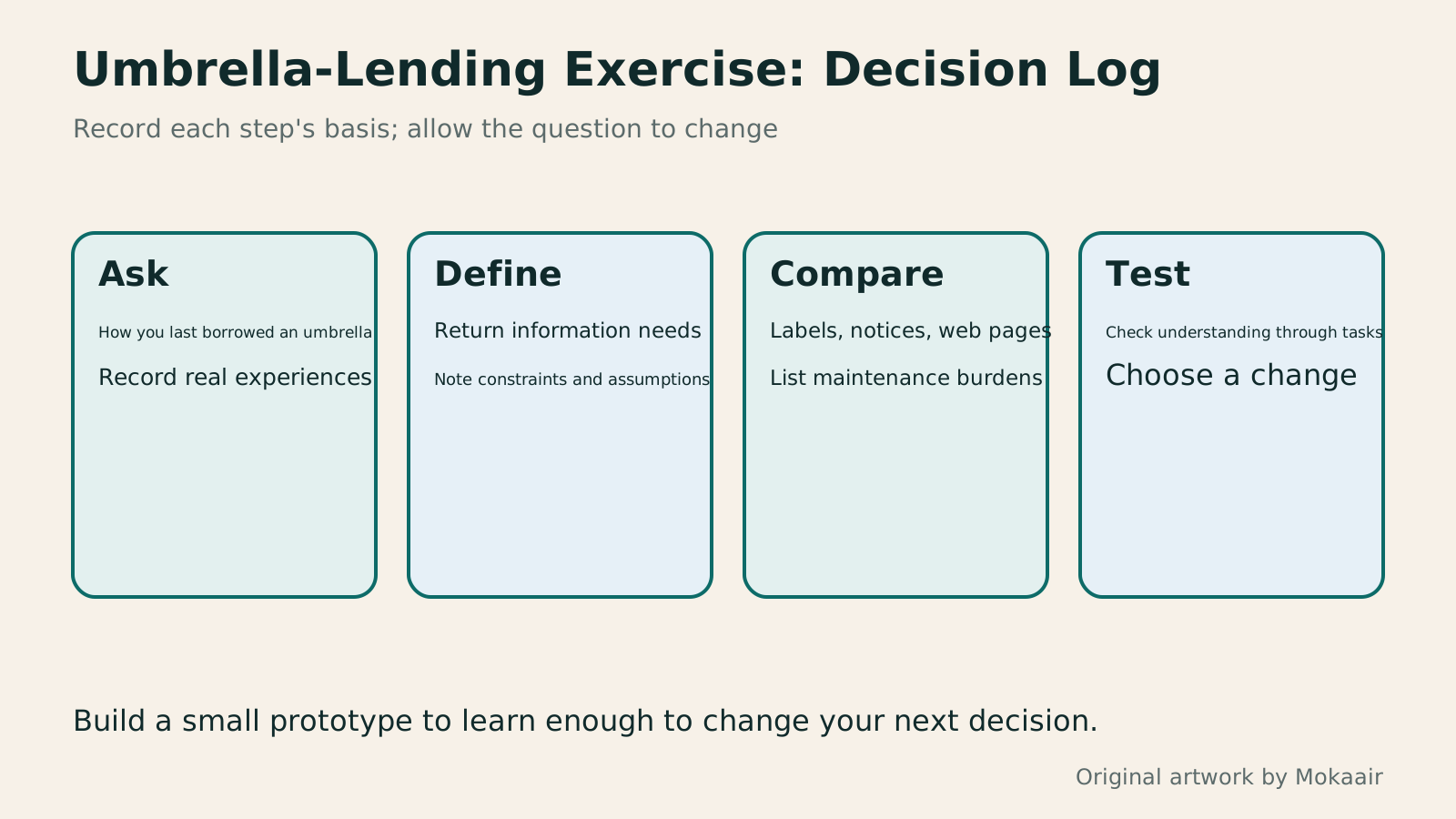
Four original cards document questions, definitions, comparisons and testing for umbrella lending; they do not reproduce the Double Diamond or teaching cards.
| Current problem | Possible exercise | What you cannot directly infer |
|---|---|---|
| The borrowing context is unclear | Interview people about their most recent experience of being caught in the rain | Every resident has the same needs |
| The problem is too broad | Clarify the people involved, constraints and goals | A one-sentence problem definition will always be correct |
| There is only one approach | Compare labels, notices and web pages | The option with the most votes is the most effective |
| It is unclear whether the rules are understandable | Use paper labels and task-based testing | Understanding guarantees that umbrellas will be returned |
| A decision on committing resources is needed | Organize the evidence and implementation conditions | A small exercise has proven operational effectiveness |
Distinguish the scope of UI, UX and researchUI and UX for Beginners: Interfaces, Tasks and User ResearchUI and UX often share a job title, but learners need to distinguish the problems addressed by interfaces, tasks and research. Using an original clothing alterations shop pickup example, this article explains visual and interaction design, the full service experience and user research, with beginner exercises, an outcomes comparison table and original diagrams. It helps beginners in Taiwan build a learning path to explain design decisions and check courses for practice and feedback.Read the full article
Map user journeys and touchpointsCustomer Journeys and Marketing Funnels: Find Where Readers Drop OffCustomer journeys explain touchpoints and needs; marketing funnels count people at each step using consistent criteria. Using an original bicycle repair booking example, this article explains how to map online and offline contacts, define completion events, calculate step conversion rates, and set up GA4 open or closed funnels. A calculation table, practical steps, and original diagrams help identify improvement hypotheses to test without mistaking data gaps for causes of customer drop-off.Read the full article
Turn the exercise process into a credible case studyHow to Organize a Portfolio Website: Show Problems and Outcomes Through Case StudiesA portfolio site should show what you did, your role, and why you made those design choices. Using an original rainy-day commute information page exercise, this article covers project selection, case structure, outcome evidence, platforms, and contact details, plus public, link-only, and password-protected access. Steps, a comparison table, and original diagrams help designers, researchers, and freelancers turn work into readable, verifiable case studies suited to sharing.Read the full article
Found this guide helpful? Share it with someone who needs it
Lifestyle
How to Read the BCG Matrix: Uses and Limits of Product Portfolio Analysis
The BCG matrix maps product portfolios by market growth and relative share; stars, cash cows, question marks and dogs do not establish actual profit. An original home goods store example shows how to define markets, check comparison periods and denominators, understand model assumptions, and allocate resources using costs, turnover and customer needs. Includes a four-category table, practical steps, original diagrams and options when reliable market data is lacking.
Lifestyle
How to Use the Ansoff Matrix: Four Options for Expanding Products and Markets
The Ansoff matrix maps four growth paths using existing or new products and markets: market penetration, market development, product development and diversification. An original canvas goods studio example shows how to define the current business and compare the capabilities and evidence each path needs. A comparison table, steps and original diagrams turn growth ideas into small, testable plans, without treating the model as a success-rate table.
Lifestyle
How to Write Marketing Copy: Clarify Value, Conditions, and Next Steps
Marketing copy should explain who it suits, its value, conditions, and what happens next. Using an original journal-binding workshop example, this article revises information hierarchy, features and benefits, evidence for claims, and action buttons step by step. A before-and-after table and original diagrams show how to retain appeal without overstating promises, and check that prices, limits, images, and links align before publication.
Lifestyle
Customer Journeys and Marketing Funnels: Find Where Readers Drop Off
Customer journeys explain touchpoints and needs; marketing funnels count people at each step using consistent criteria. Using an original bicycle repair booking example, this article explains how to map online and offline contacts, define completion events, calculate step conversion rates, and set up GA4 open or closed funnels. A calculation table, practical steps, and original diagrams help identify improvement hypotheses to test without mistaking data gaps for causes of customer drop-off.
Articles that cite this one
Sources
- Stanford d.school: Design Thinking Modes and Tool UseChecked:
- Design Council: The Double Diamond and Iterative ExplorationChecked:
- IDEO.org: Framing a Design ChallengeChecked:
- GOV.UK: In-Depth Interviews and Neutral QuestionsChecked:
- GOV.UK: Informed Consent for ResearchChecked:
Compiled from the references and verification dates listed above; fares, schedules, product features, and terms can change, so please confirm the latest details on the relevant official website before travelling, booking, or purchasing.