Lifestyle
Microsoft Research Introduces Quine, a Research-Only AI System for Studying Biology
On September 29, 2026, Microsoft Research introduced Quine, an AI system meant to help scientists decide which biology experiments to run. Microsoft says it tested the system in pancreatic cancer cell experiments with the Broad Institute. Quine is for research only, not for patients or clinical use, and access is limited for now to selected scientists.
About 6 min read

What is Quine?
According to Microsoft Research, Quine is a research program with two goals. The first is to build a multimodal "world model" of biology, meaning one that learns from many kinds of biological data at once. The second is to pair it with an interactive "harness": software that links the model to scientific tools, published literature and the researchers using it. The announcement was written by Nicolo Fusi, VP and Distinguished Scientist, and Jonathan M. Carlson, Vice President.
By world model, Microsoft Research means a system that can do three things. It can represent the current state of a biological system, predict how that state will change after an intervention such as adding a drug, and reason about the consequences several steps ahead. Microsoft says plainly that such systems will not replace experiments. Instead, they use computation to explore, propose and rank possible directions before scarce lab resources are committed. Microsoft also says a world model will never perfectly model biology; it only needs to usefully inform how experiments are designed.
Read the full description
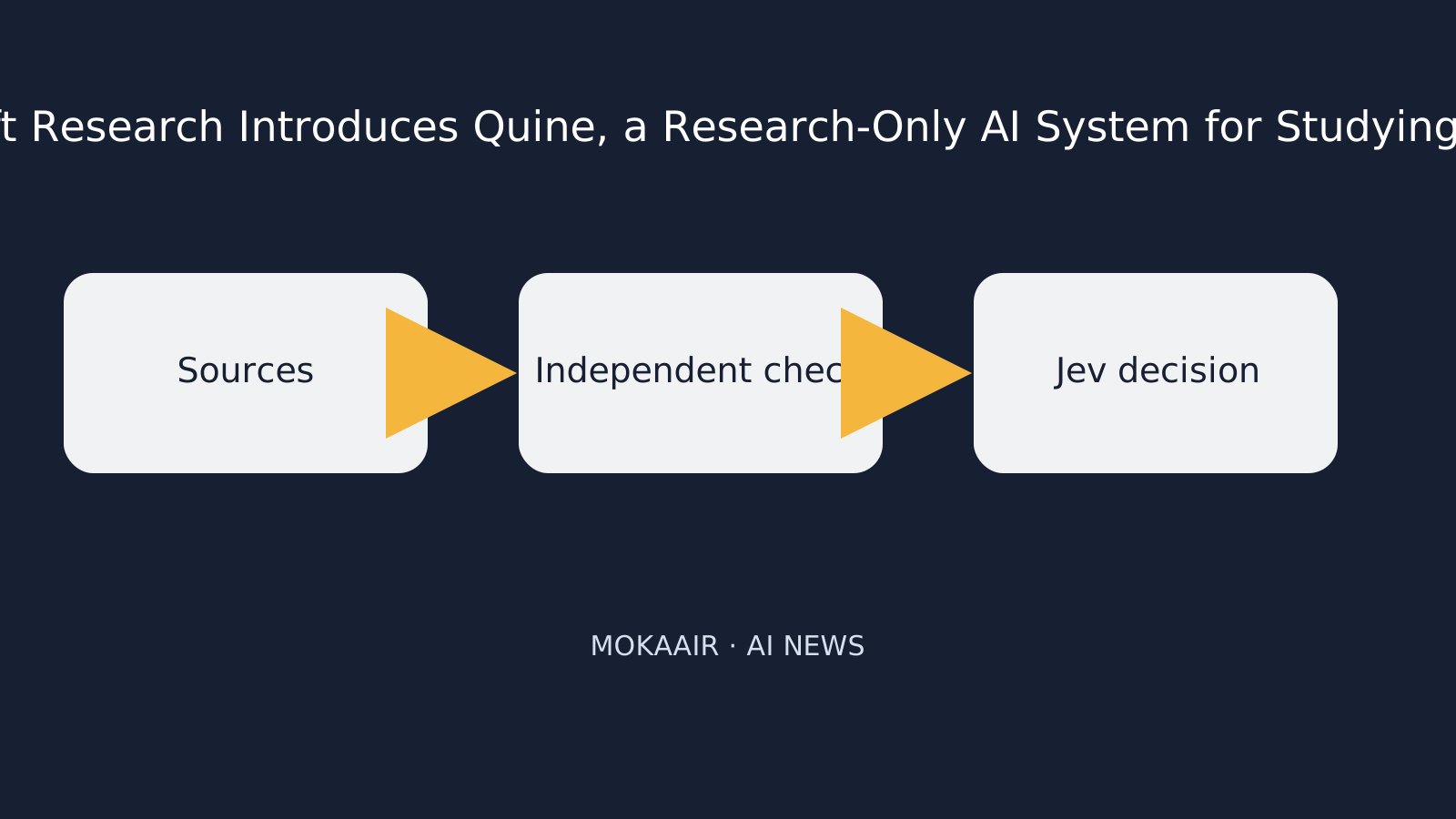
Sources are collected, independently checked, then reviewed by Jev.
Two core components
| Component | Function as described by Microsoft |
|---|---|
| Biology world model | Learns from several kinds of data together: sequences, structures, function, cell state and imaging. This lets evidence from one kind of data inform predictions about another. |
| Interactive tool harness | Connects the model to orchestration and reasoning models, scientific tools, literature and the teams of scientists using the system |
The pancreatic cancer case: what results did Microsoft report?
Microsoft Research used pancreatic ductal adenocarcinoma (PDAC) as its example. Microsoft describes PDAC as the most common form of pancreatic cancer and one of the most challenging to treat. PDAC tumor cells can be in different "states", two of which are called classical and basal. Microsoft says these states are associated with how the cells respond to treatment. Working with Broad Institute researchers, Microsoft used Quine to predict and rank thousands of compounds by their potential to shift tumor cells between these states.
The predictions were then checked in wet-lab experiments. These are tests on real cells in a laboratory, as opposed to computer simulations, and they used several different lab tests, known as assays.
| Experimental direction | Result as described by Microsoft Research |
|---|---|
| Classical to basal cell state | Quine's top-ranked compounds produced the largest intended shifts across multiple assays |
| Basal back to classical (reverse) | The shift was harder to achieve, consistent with Quine's prediction that available compounds would have weaker effects |
| A third phenotype (a distinct set of observable cell characteristics) | Quine predicted several compounds would consistently push cells toward a distinct third phenotype, and lab observations bore this out |
Microsoft says the whole process took just one weekend, from narrowing the compound search space to picking a handful of candidates for lab validation. It says this could potentially save months of experimental work and significant research costs. Microsoft also notes that some of the strongest effects came from compounds with unexpected mechanisms of action. It sees this as early evidence that AI could help with drug repurposing (finding new uses for existing compounds) and with discovering new drugs.
Who can use it? Access and future plans
According to Microsoft Research, access to Quine is being opened in careful, phased steps. At first it is limited to the Quine Fellows program and select research collaborations. Microsoft says oversight will come from ongoing internal review and safeguards built into the system. Applications for the first group of Quine Fellows are open now. Microsoft says it expects to broaden access through products such as Microsoft Discovery as the technology matures.
Microsoft also says Quine has been used in its own research on cancer biology, protein engineering, genomics and bioimaging. Its next steps are to add new RNA datasets, strengthen its predictions of how cells change state, and provide calibrated confidence estimates. These are scores showing how much trust each prediction deserves, so scientists can decide which ideas to test first.
What it means for general readers
- No direct effect on doctor visits or medication in the near term: Microsoft states explicitly that Quine is not for clinical or medical use.
- The change worth watching is in how research is done. If Microsoft's account holds, AI could first help scientists screen large numbers of candidate compounds, so labs can spend their time on the most promising directions.
- Treat the results with caution: they currently come from a single source, Microsoft, and still await more independent research and peer review.
Frequently asked questions
Can the general public use Quine now?
No. According to Microsoft Research, Quine is initially available only to the Quine Fellows program and select research collaborations. Microsoft says it expects to broaden access through products such as Microsoft Discovery in the future, but it has not announced a timeline.
Has Quine found a new drug for pancreatic cancer?
No such claim has been made. Microsoft says it used Quine to rank compounds and saw the intended cell-state shifts in laboratory experiments on cells. Microsoft stresses that Quine is for research only and not for clinical or medical use.
Will Quine replace lab experiments?
Microsoft Research says no. Quine's role is to use computation to explore, propose and rank directions before lab resources are committed. The experimental results are then fed back to improve the model.
Have these results been independently verified?
Not so far. The results are described only in Microsoft Research's own announcement, so they should be read as Microsoft's account rather than as independently confirmed findings.
Browse the latest news in this topic
Lifestyle
NVIDIA launches DGX Spark 64GB: on sale October 23 from $4,999, two units can be linked into 128GB
On October 2, 2026, NVIDIA announced a more affordable 64GB memory version of its DGX Spark personal AI computer, available from October 23 through six makers including Acer and ASUS. It is aimed mainly at developers and researchers who want to run AI models on their own machines. Below we summarize the specs NVIDIA published, its claims about linking two units, and what it means for general readers.
Lifestyle
Google Cloud Launches Spanner Queues: Putting Message Queues Inside Database Transactions to Make AI Agents More Reliable
Google Cloud has announced the general availability of Spanner queues, which make message creation part of a database transaction. The aim is to stop AI agents' "state" and "actions" from falling out of sync. This article covers Google Cloud's claims, the main features, and what it means for general readers.
Lifestyle
GPT-6.1 Sol Launches: New Sol Version in the API, Codex and ChatGPT Work, Not in Chat
OpenAI launched GPT-6.1 Sol on September 29, 2026, with the API name gpt-6.1-sol. The launch rollout covers Codex and ChatGPT Work on Plus, Pro, Business, Enterprise and Edu (Enterprise and Edu need an administrator to enable it); Free and Go are not included at launch, and it is not in Chat (checked September 2026).
Lifestyle
Claude Sonnet 5.5 Launches: Same List Price as Sonnet 5, Available in the API, on Cloud Platforms and in Claude.ai
Anthropic launched Claude Sonnet 5.5 on September 28, 2026. API list prices are the same as Sonnet 5 ($2 per million input tokens, $10 per million output tokens). It is available in Claude.ai, the API and several cloud platforms, and higher-risk cybersecurity requests fall back to Sonnet 5 (checked September 2026).
Latest travel guides

GuideTokyo
Where to Stay in Tokyo: Comparing Shinjuku, Ueno, Tokyo Station, Shibuya, Asakusa, Ikebukuro, and Ginza, Plus Airport Access, Accommodation Tax, and Luggage Delivery
Where should you stay in Tokyo? Compare Shinjuku, Ueno, Tokyo Station, Shibuya, Asakusa, Ikebukuro, and Ginza by the same criteria: access from Narita and Haneda, transit routes, nearby attractions, neighborhood character, and who each area suits. Includes a comparison table, a Yamanote Line diagram, Tokyo’s accommodation tax as verified in 2026/9 (changing to 3% in 2027/4), and Airport TA-Q-BIN luggage shipping rules.
- Budget
- Hotels

GuideTokyo
How to Choose Tokyo Transit Passes: Are Suica, Welcome Suica, the Tokyo Subway Ticket, and the JR Pass Worth It?
On a first Tokyo trip, start with an IC card and pay per ride (Welcome Suica has no deposit and is valid for 28 days). If you take four or more subway rides in a day, add a 72-hour Tokyo Subway Ticket for 2,000 yen; a JR Pass is never worthwhile if you stay in Tokyo and do not go to Kansai. See what TOURIST PASMO, Suica on iPhone, and the Tokyo Metro day pass do and do not cover, with a decision chart. Prices verified in September 2026.
- Transport
- Budget

GuideTokyo
Tokyo Disneyland and DisneySea Guide: Ticket Prices, Fantasy Springs, Disney Premier Access (DPA), Standby Pass, and Which Park to Choose for Your First Visit
Tokyo Disney one-day Passport prices vary: most weekdays in 9/2026 cost ¥9,900 and weekends ¥10,900. At 14:00 daily, tickets go on sale for the same date two months later. Free Priority Pass is no longer on the official service list; only paid Disney Premier Access (¥1,000–3,500 per person per use) shortens waits. Covers hours, the 25th anniversary, Standby Pass, Entry Request, Fantasy Springs access and first-visit park choice; checked on the official site in 9/2026.
- Itineraries
- Family