GuideSeoul
Seoul Subway and T-money Complete Guide: Where to Buy, How to Top Up, and Whether the Climate Card Is Worth It
Seoul subway adult base fare is 1,550 won; transfers within 30 minutes are discounted. Count separately charged trips when comparing Climate Card short-term passes, and add 3,000 won for a new physical card. You cannot board at Incheon Airport with the pass, but a covered AREX all-stop trip from Seoul can end at T1 or T2. How to buy, top up, and refund T-money; covered routes and pass choices. Verified with official sources in 2026/9.
About 14 min read
We may earn a commission through these links, at no extra cost to you.
First-time visitors to Seoul usually have three transit-card questions: where to buy T-money, how much to load without complicating a refund, and whether a Climate Card (기후동행카드) short-term pass fits their itinerary. Short-term passes are for short-term visitors, including Korean residents and foreign travelers; they are not exclusively for foreigners. This guide compares fares and rules found on the websites of Seoul Metro, the Seoul Metropolitan Government, and the Korea Tourism Organization in 2026/9. It begins with the 1,550-won basic subway fare and the transfer discount within 30 minutes, then covers buying, topping up, and refunding T-money. Finally, it compares Climate Card passes lasting 1 to 7 days based on trips actually charged separately. A new physical Climate Card costs another 3,000 won; a discounted transfer with no additional basic fare is not another separately paid trip; a higher fare difference or distance surcharge can still apply. Discover Seoul Pass, map apps, and priority-seat etiquette are also covered.
At a glance: comparing three ways to pay
| Method | Price | Best for | Keep in mind |
|---|---|---|---|
| Pay per ride with T-money | Blank card about 2,500 to 5,000 won (depending on design); subway base fare 1,550 won, city bus 1,500 won; a qualifying transfer within 30 minutes receives a discount, but a higher base fare difference or distance surcharge may still apply | Those who already have T-money, have few separately charged trips, or need to travel from Incheon Airport into the city or use excluded routes. | Balances over 50,000 won can only be refunded at Tmoney Town in Seoul Station; top up enough for two or three days at a time |
| Climate Card short-term pass | New physical card: another 3,000 won. Passes: 1 day 5,000; 2 days 8,000; 3 days 10,000; 5 days 15,000; 7 days 20,000 won. Covers eligible subway sections and Seoul-registered buses. | Those whose separately charged rides during the pass period meet the break-even threshold and stay within the city's official coverage; include the cost of a new card. | Starts on top-up day. New Line 1–8 machines take overseas credit/debit cards for short-term passes; elsewhere cash may be needed. No airport boarding with the pass, but exit is allowed on covered all-stop rides from Seoul. Express trains, airport buses and Shinbundang are excluded. |
| Single-use transit card | Costs 100 won more than paying by card (base fare 1,650), plus a 500-won deposit refunded at a deposit refund machine after exit | Travelers taking only one or two rides who do not want to buy a card | You must queue for a ticket on every trip; it cannot be used on buses and offers no transfer discount |
Read the full description
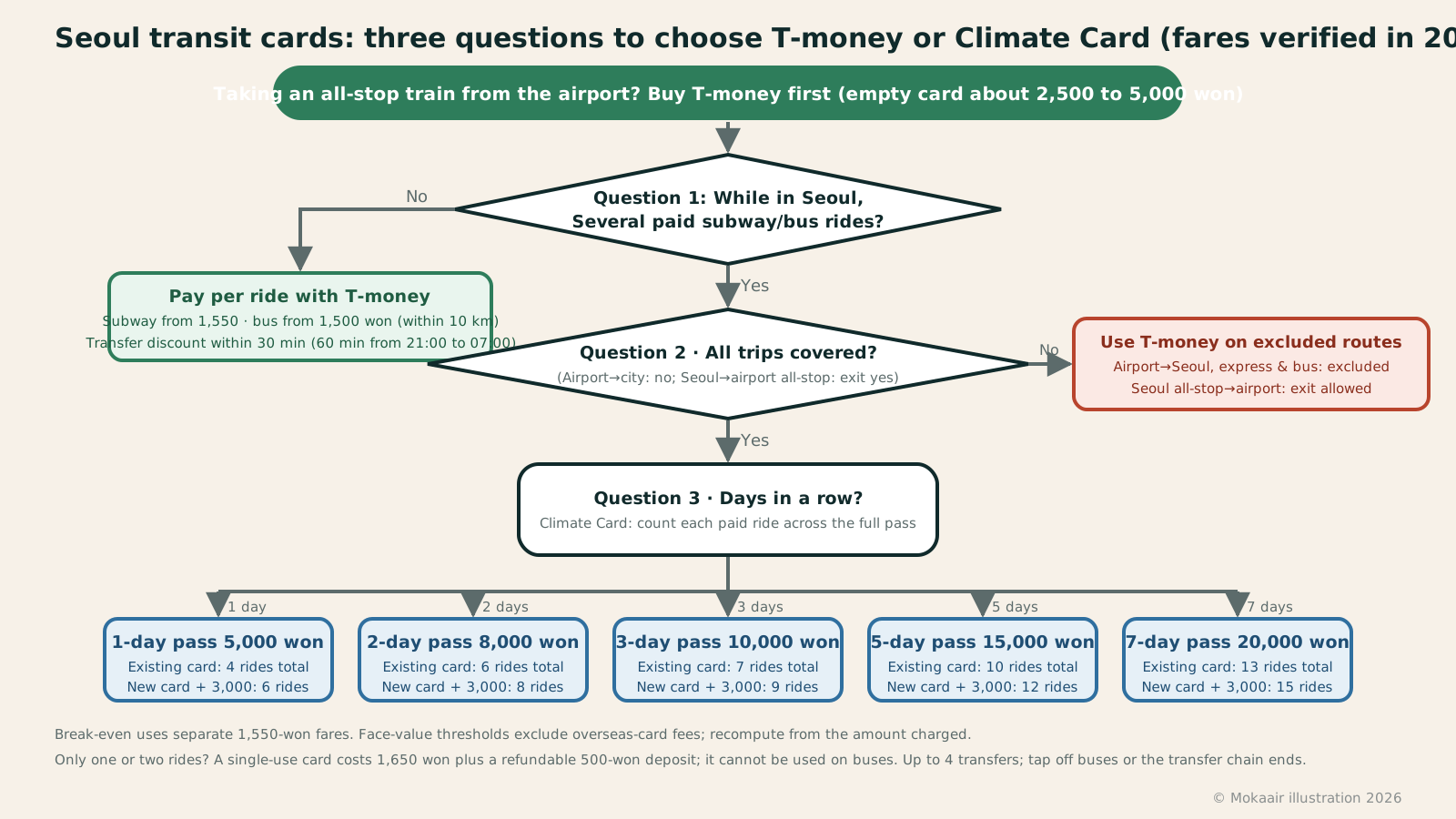
At Incheon Airport you cannot enter with Climate Card. For AREX all-stop, buy T-money; an empty card costs 2,500–5,000 won. First: Several separately paid subway/bus rides? A discounted transfer with no additional basic fare does not count. Otherwise use T-money: subway from 1,550 won, bus from 1,500 won, with a transfer discount within 30 minutes of getting off. Second: Are all rides covered? Use T-money for excluded trips such as Incheon Airport to the city, Sinbundang Line, Suwon, or Nami Island. But you can exit at Incheon Airport T1/T2 after taking an AREX all-stop train from an eligible Seoul station; you cannot enter at the airport in the reverse direction. Third: How many consecutive days? If each ride incurs a separate basic fare of 1,550 won and no transfer discounts apply during the pass period, holders of a physical Climate Card need at least 4/6/7/10/13 rides to break even on the 1/2/3/5/7-day passes, respectively. A new physical card adds 3,000 won and raises those thresholds, in the same order, to 6/8/9/12/15 rides. These are face-value thresholds excluding any overseas-card service fee; recompute the break-even ride count from the amount actually charged. Short-term passes start on the top-up day. Designated new machines on subway Lines 1–8 accept overseas credit/debit cards for short-term passes; some channels still require cash. For just one or two rides, a single-use transit card is another option: a basic fare of 1,650 won plus a 500-won deposit.
Seoul subway fares and transfer rules (verified in 2026/9)
Seoul's subway uses a unified distance-based fare across the capital region: the adult transit-card base fare of 1,550 won covers 10 kilometers. From 10 to 50 kilometers, add 100 won per 5 kilometers; beyond 50 kilometers, add 100 won per 8 kilometers. Base fares are 900 won for teenagers and 550 won for children. Buy a single-use transit card (1회용 교통카드) by choosing your destination at a ticket machine. It costs 100 won more than paying by transit card, plus a 500-won deposit; put it in a deposit refund machine after exiting to get the deposit back. Entering with a transit card between the first train and 06:30 earns a 20% early-bird discount on the base fare, but entry during a transfer does not qualify. Bus fares here are all transit-card prices: blue trunk buses (간선) and green branch buses (지선) cost 1,500 won; yellow circular buses cost 1,400 won; small green neighborhood buses (마을버스) cost 1,200 won; and red metropolitan buses cost 3,000 won. Tap once when boarding and again when getting off. Night buses with route numbers beginning with N have separate fares; check the Seoul City website.
- A transfer to the next mode of transport within 30 minutes of getting off qualifies for the transfer discount; from 21:00 to 07:00 the next day, the window extends to 60 minutes.
- You can transfer up to 4 times, for 5 consecutive rides in all.
- Always tap your card again when getting off a bus. If you do not, the transfer chain ends at that leg and you will pay the full fare on the next ride.
- Reboarding the same route or the same vehicle does not count as a transfer. If one card pays for several bus passengers, a bus-to-bus transfer can receive the discount only when the same group continues the same journey and tells each driver the passenger count at every boarding so the driver sets the fare. This group-card arrangement does not qualify for a discounted transfer to metropolitan rail.
- Fares are combined across transfers: within 10 kilometers, you pay only the higher applicable base fare; beyond that, add 100 won per 5 kilometers. Subway-to-bus and bus-to-subway transfers both count as one journey.
T-money: where to buy, how to top up, and how to get a refund
Where to buy
T-money is a rechargeable transit card accepted throughout South Korea on subways, buses, regular Airport Railroad trains, most taxis, and at convenience stores. Convenience stores bearing the Tmoney logo, including GS25, CU, and 7-ELEVEN at Incheon Airport and in the city, sell it; so do station offices (customer service centers) on Seoul Subway Lines 1 to 8. A blank card costs about 2,500 to 5,000 won depending on its design, and the purchase price is not refundable. Top it up when you buy it at the airport on arrival: you can then tap straight into an AREX regular train instead of queueing for a single-use ticket. The transit-card fare from Incheon Airport T1 is 4,650 won to Hongik University Station and 4,750 won to Seoul Station.
Get T-money and your airport transport ticket ready, then tap in after landing
How to top up
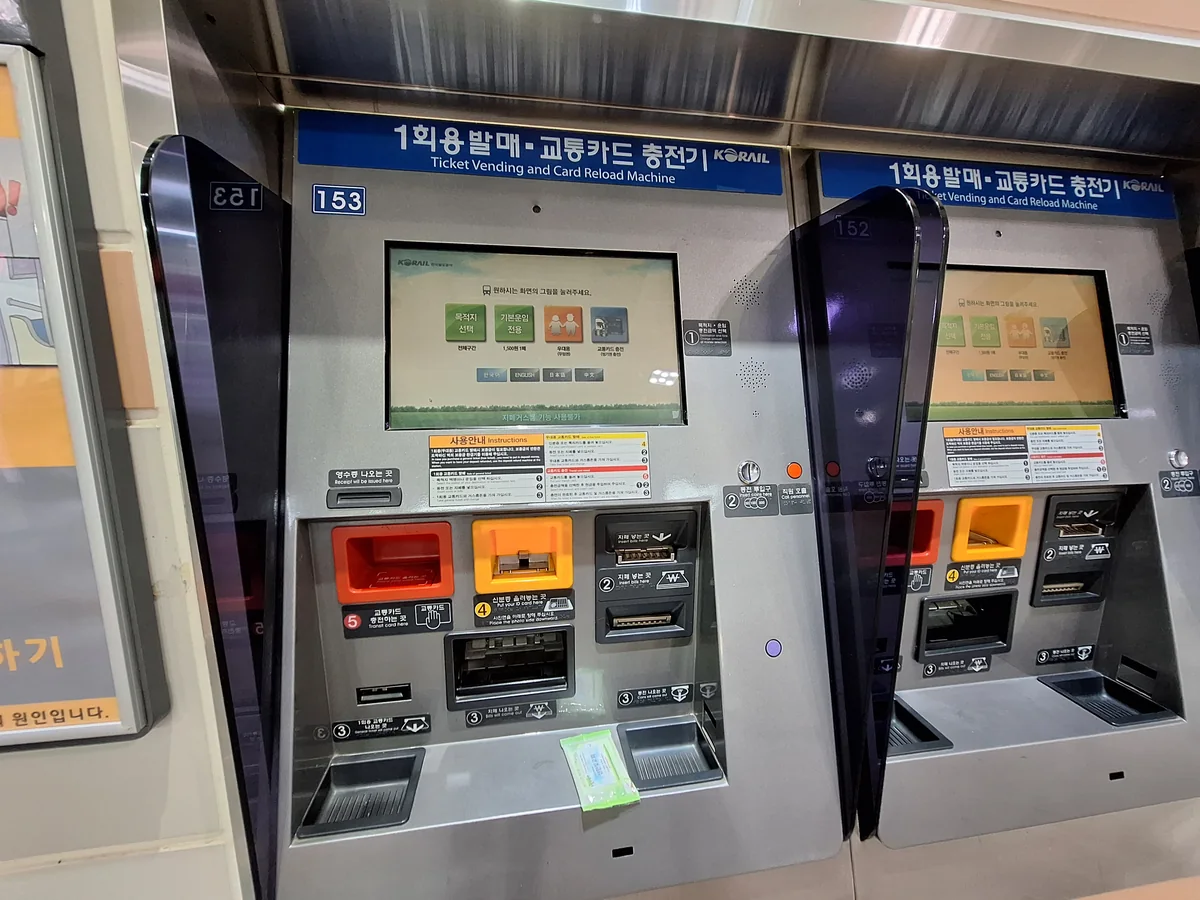
You can add value at the ticket and top-up machines in every subway station. Switch the machine to its Chinese interface, insert cash, and choose an amount. The Korea Tourism Organization website says a single card can hold up to 500,000 won. You can also top up at convenience store counters, again mainly with cash, so keep some won banknotes on hand. In practice, you need much less: subway rides start at 1,550 won and bus rides cost 1,500 won, so four rides a day cost about 6,000 to 7,000 won. Loading 20,000 won at a time covers two or three days; add more when needed so you do not leave with a large unused balance. You can see your balance on the entry gate screen and at top-up machines.
Refund rules
Refunds are where travelers most often run into trouble. Refunding the remaining balance costs a 500-won fee, and the card purchase price is not refunded. Small balances can be refunded at convenience stores bearing the Tmoney logo or at subway station offices; each outlet has its own limit, so follow the notice at the counter. Balances over 50,000 won can only be refunded at Tmoney Town in Seoul Station. The Korea Tourism Organization website also warns directly that refunds over 50,000 won are slow and troublesome. The easiest approach is to spend the balance at a convenience store on your last day or keep the card for your next visit; T-money does not expire.
Climate Card short-term passes: how foreign visitors can use them
Climate Card (기후동행카드) is Seoul's flat-rate transit card. Top-ups for prepaid 30-day passes (originally starting at 62,000 won) ended on 2026/8/31; existing top-ups could be used through 9/29 at the latest. Postpaid 30-day passes end on 9/30. Short-term passes for 1, 2, 3, 5, or 7 days, introduced on 2024/7/1, remain available at 5,000, 8,000, 10,000, 15,000, and 20,000 won respectively. They cover designated subway sections published by Seoul, city buses and neighborhood buses registered in Seoul, and offer other benefits such as half-price admission to Seoul Science Center and Seoul Grand Park. A new physical card costs another 3,000 won. You can buy one at designated new ticket machines in subway stations on Lines 1–8 or at designated retailers. Since 2026/3/17, new machines at 273 of these stations have accepted overseas credit/debit cards or mobile payments for buying cards and topping up short-term passes. Overseas cards incur an average 3.7% service fee; other machines or sales channels may still require cash. This Climate Card short-term pass differs from the separately sold prepaid Climate Pass, which accepts only cash top-ups. A short-term pass starts on its top-up day and cannot be topped up in advance, so buy it on the day you intend to use it. You can request a refund while it is valid, but not after expiry. Foreigners without a Korean bank account must visit Tmoney headquarters for a cash refund.
- Check short-term-pass coverage station by station. Seoul City's general Climate Card route page lists some extensions outside the city, but its 2026 short-term-pass continuation FAQs say the short-term pass is usable only in Seoul. Those official descriptions conflict, so this guide cannot guarantee that a short-term pass covers any outer-city extension. Before travel, compare Seoul City's latest short-term-pass guidance and service-area search results for each boarding and exit station; ask station staff if needed. On an AREX all-stop train, you may exit at Incheon Airport T1/T2 after boarding at an eligible station, but you cannot enter with the card at the airport. Use T-money for any route you have not confirmed.
- Valid on: blue trunk buses, green branch buses, and neighborhood buses registered in Seoul.
- Excluded: Sinbundang Line, GTX, suburban subway sections outside official coverage, AREX express trains, red metropolitan buses, airport buses, and buses registered outside Seoul. You cannot enter at Incheon Airport T1/T2 with a Climate Card.
- Normally, entering within the covered area and exiting outside it incurs an additional fare. The exception is a ride boarded at an eligible Seoul station that exits at Incheon Airport T1/T2; entry at the airport stations remains unavailable. Check official coverage before riding.
Incheon Airport to central Seoul transport guide: AREX express and regular trains, airport buses, and what to do after a late-night arrivalIncheon Airport to Central Seoul: AREX Express and All-Stop Trains, Airport Buses, and Late-Night ArrivalsAREX Express reaches Seoul Station from Incheon Airport in 43 minutes from T1 or 51 from T2 (13,000 won). For Hongdae, the All-Stop Train costs 4,650 won from T1 with T-money. Buses 6001/6015/6002 cost 17,000 won to Myeongdong, Seoul Station, or Hongdae. Compare four options, N6000 night buses, taxis, neighbourhood choices, and Seoul Station City Airport Terminal; official sites checked 2026/9.Read the full article
For break-even calculations, compare rides actually charged separately, not the number of gate entries or boardings: a qualifying transfer within 30 minutes may incur no second basic fare, though a higher fare difference or distance surcharge can still apply. The thresholds below assume the traveler has already bought T-money for the trip into the city, every ride is charged a separate basic fare of 1,550 won, and there is no applicable transfer discount. If you have not bought T-money, include its roughly 2,500 to 5,000-won purchase price in the pay-per-ride option. If you already have a physical Climate Card, the 1-day pass at 5,000 won breaks even at 4 or more paid rides over its validity period; the 2-day pass at 8,000 needs 6 rides; the 3-day pass at 10,000 needs 7; the 5-day pass at 15,000 needs 10; and the 7-day pass at 20,000 needs 13. A new physical Climate Card adds 3,000 won and raises those thresholds, respectively, to 6, 8, 9, 12, and 15 rides. These full-period thresholds use pass face value plus the 3,000-won new-card cost, and exclude the average 3.7% service fee for overseas credit/debit-card purchases or top-ups. If paying that way, divide the actual total charged for the pass and any newly purchased card by the fare each alternative ride would incur, then round up. These are thresholds for the full pass period; you need not ride the same amount each day. If your actual fare exceeds 1,550 won, recalculate using what you would pay. Trips from Incheon Airport to Seoul, on Sinbundang Line, or on uncovered suburban sections do not count. An AREX all-stop trip from an eligible Seoul station to Incheon Airport does count as a covered ride.
When do you need the Discover Seoul Pass?
The Discover Seoul Pass is Seoul City's sightseeing pass. Its official website says it covers more than 70 attractions and experiences and includes eSIM and T-money functions. Several versions are sold by the hour; check the current official listing for prices and inclusions. It saves on admission, not transit fares, and may pay off only if you visit more than three paid attractions in a day. If you only want to save on transport, T-money plus a Climate Card is enough. The pass's built-in T-money function still needs a separate top-up, and the same refund rules as regular T-money apply.
Map apps and riding etiquette
Google Maps offers incomplete walking and public transport directions in South Korea. Install Naver Map or Kakao Map before you leave. Both can switch to an English interface and show which line and platform to use, which exit to take, walking time for transfers, and last trains. Seoul subway station names are displayed in Korean, English, and Chinese characters. Station numbers (for example, Myeongdong Station is 424) match between the apps and station signs, making numbers the easiest way to find the right station.
For how to find routes in both map apps, hail a taxi without a Korean phone number, and pay, see Korea map and taxi app guide: routes in Naver Map and Kakao Map, choosing and paying with k.ride or Kakao T, Seoul taxi fares, and late-night surchargesMaps and taxi apps in Korea: Naver Map and Kakao Map routes, k.ride versus Kakao T, payments, Seoul fares and late-night surchargesWhich apps should you install for Korea, and can you book a taxi without a Korean phone number? Learn route searches in Naver Map and Kakao Map; registration, interface languages and payments for k.ride, Kakao T, TADA and TABA; and Seoul’s KRW 4,800 starting fare and late-night surcharges. Checked in September 2026 against the App Store, Kakao Mobility, Korea Tourism Organization, Seoul government and Incheon Airport websites.Read the full article.
- Priority seats (노약자석) are at both ends of each carriage. Leave them for older people and passengers with limited mobility, even when the carriage is crowded; do not sit in them even if they are empty.
- Pink seats are priority seats for pregnant passengers (임산부 배려석); other passengers should leave these empty too.
- Follow the queue lines on the floor in front of platform doors, and let passengers off before boarding. Stand on the right of escalators and leave the left side for walking.
- Do not eat on the train; speak quietly on the phone and wear your backpack in front.
- Board buses through the front door and exit through the rear. Tap your card both times, and press the stop button before getting off.
Seoul city page: attractions, accommodation, and airport transport in one place
Seoul food directory: local restaurants in Myeongdong, Hongdae, and Gangnam
Guide
Where to Stay in Tokyo: Comparing Shinjuku, Ueno, Tokyo Station, Shibuya, Asakusa, Ikebukuro, and Ginza, Plus Airport Access, Accommodation Tax, and Luggage Delivery
Where should you stay in Tokyo? Compare Shinjuku, Ueno, Tokyo Station, Shibuya, Asakusa, Ikebukuro, and Ginza by the same criteria: access from Narita and Haneda, transit routes, nearby attractions, neighborhood character, and who each area suits. Includes a comparison table, a Yamanote Line diagram, Tokyo’s accommodation tax as verified in 2026/9 (changing to 3% in 2027/4), and Airport TA-Q-BIN luggage shipping rules.
Guide
How to Choose Tokyo Transit Passes: Are Suica, Welcome Suica, the Tokyo Subway Ticket, and the JR Pass Worth It?
On a first Tokyo trip, start with an IC card and pay per ride (Welcome Suica has no deposit and is valid for 28 days). If you take four or more subway rides in a day, add a 72-hour Tokyo Subway Ticket for 2,000 yen; a JR Pass is never worthwhile if you stay in Tokyo and do not go to Kansai. See what TOURIST PASMO, Suica on iPhone, and the Tokyo Metro day pass do and do not cover, with a decision chart. Prices verified in September 2026.
Guide
Narita and Haneda Airports to Central Tokyo: How to Choose Skyliner, N'EX, Keikyu, or the Airport Limousine Bus
From Narita to Tokyo: take Keisei Skyliner to Ueno in 36–41 minutes for ¥2,580; for Shinjuku or Tokyo Station, JR N'EX reaches Tokyo in as little as 53 minutes for ¥3,140; choose the TYO-NRT bus for ¥1,500 when budget comes first. From Haneda, Keikyu reaches Shinagawa in 11–14 minutes for ¥330. Includes fares and times for Access Express, Airport Limousine and Tokyo Monorail, plus a stay-area route guide; checked on official sites in 9/2026.
Guide
Taoyuan Airport Departure Guide: A1/A3 In-Town Check-in, Baggage, Liquids and Power Banks at Security, e-Gate Registration, and When to Leave (2026)
Departure-day guide from Taipei or New Taipei: check in online and confirm the terminal; use in-town check-in at A1 (06:00–21:30) or A3 (09:00–16:00), with a three-hour cutoff and different airlines; follow the 100 mL/one-liter liquids rule, the two-power-bank carry-on limit and lighter rules; check e-Gate rules for ROC nationals with household registration in Taiwan using an ROC passport, from age 10 and 120 cm; then calculate when to leave. Verified in September 2026 using Taiwan sources.
Articles that cite this one
Sources
- Seoul Metro fare guide (subway fares, early-bird discount, and transfer fare calculation) · Checked:
- Seoul Metro ticket guide (500-won deposit for single-use transit cards) · Checked:
- Seoul City transport fare guide (fare table effective 2025/6/28) · Checked:
- Seoul City integrated transfer discount system (30-minute and 60-minute transfers; up to 4 transfers) · Checked:
- Seoul City bus system and how to use it (bus fares) · Checked:
- Seoul City Climate Card overview (fares, valid routes, and 3,000-won physical card) · Checked:
- Seoul City launch of the Climate Card tourist pass (short-term passes and purchase locations) · Checked:
- VisitKorea (Korea Tourism Organization) Transportation Cards: T-money · Checked:
- VisitKorea (Korea Tourism Organization) Tmoney & Cashbee (500-won refund fee) · Checked:
- Airport Railroad regular train fares (transit-card fares from Incheon Airport) · Checked:
- Discover Seoul Pass official website · Checked:
- Seoul City: Until when can the Climate Card be used? (end of the 30-day pass and continuation of short-term passes) · Checked:
- Seoul Metropolitan Government: Buying and topping up Climate Card short-term passes with overseas credit cards at designated new machines · Checked:
- Seoul Metropolitan Government: Payment methods FAQ for Climate Card short-term passes and prepaid Climate Pass · Checked:
- Seoul Metropolitan Government: One-way exit rule at Incheon Airport T1/T2 on the Airport Railroad · Checked:
- Seoul Metropolitan Government: End of top-ups for prepaid Climate Card 30-day passes · Checked: