Guide
Planning Luggage Forwarding in Japan: Traveling Light Between Cities, Hotel Delivery, and Airport Pickup
Sending luggage is only half the job; make sure it can reach your next stop. From confirming hotel acceptance and filling in recipient details to handling airport forwarding separately from regular delivery, here is a practical approach to keeping luggage from dictating your itinerary.
About 7 min read

Sometimes the most tiring part of traveling between cities is dragging luggage around while looking for an elevator. Luggage forwarding suits travelers who have short stays along the way and are willing to spend the night with just a small backpack. If you change accommodation every day or fly the next day, keeping your large suitcase with you may be easier to manage. This article focuses on arranging domestic services within Japan. It does not assume same-day delivery or present illustrations as photographs of actual service counters.
Confirm someone can receive it before deciding where to send it from
Yamato (Black Cat) offers regular parcel delivery, airport forwarding, and some same-day delivery options as separate services. Its official regular-delivery website lets you look up options by shipping area, size, and other criteria, but actual acceptance also depends on the origin, destination, and item restrictions. After booking your hotels, ask the next one whether it accepts luggage before check-in, how early it may arrive, and how to write the reservation name. For accommodation with an unstaffed reception, apartments, self-check-in properties, or branches with similar addresses, you especially cannot assume that providing only the street address will ensure successful receipt.
Once the hotel replies, put its official Japanese name, postal code, address, phone number, your check-in date, and reservation name in a single note. If a travel companion made the booking, use the name the hotel can find in its system and add the names of the actual guests. These details help staff verify the delivery; there is no need to print payment information from your booking email, passport details, or your full itinerary on the outside of the parcel. Separately confirm whether the sending hotel helps complete the form, arranges courier pickup, and collects payment.
Read the full description
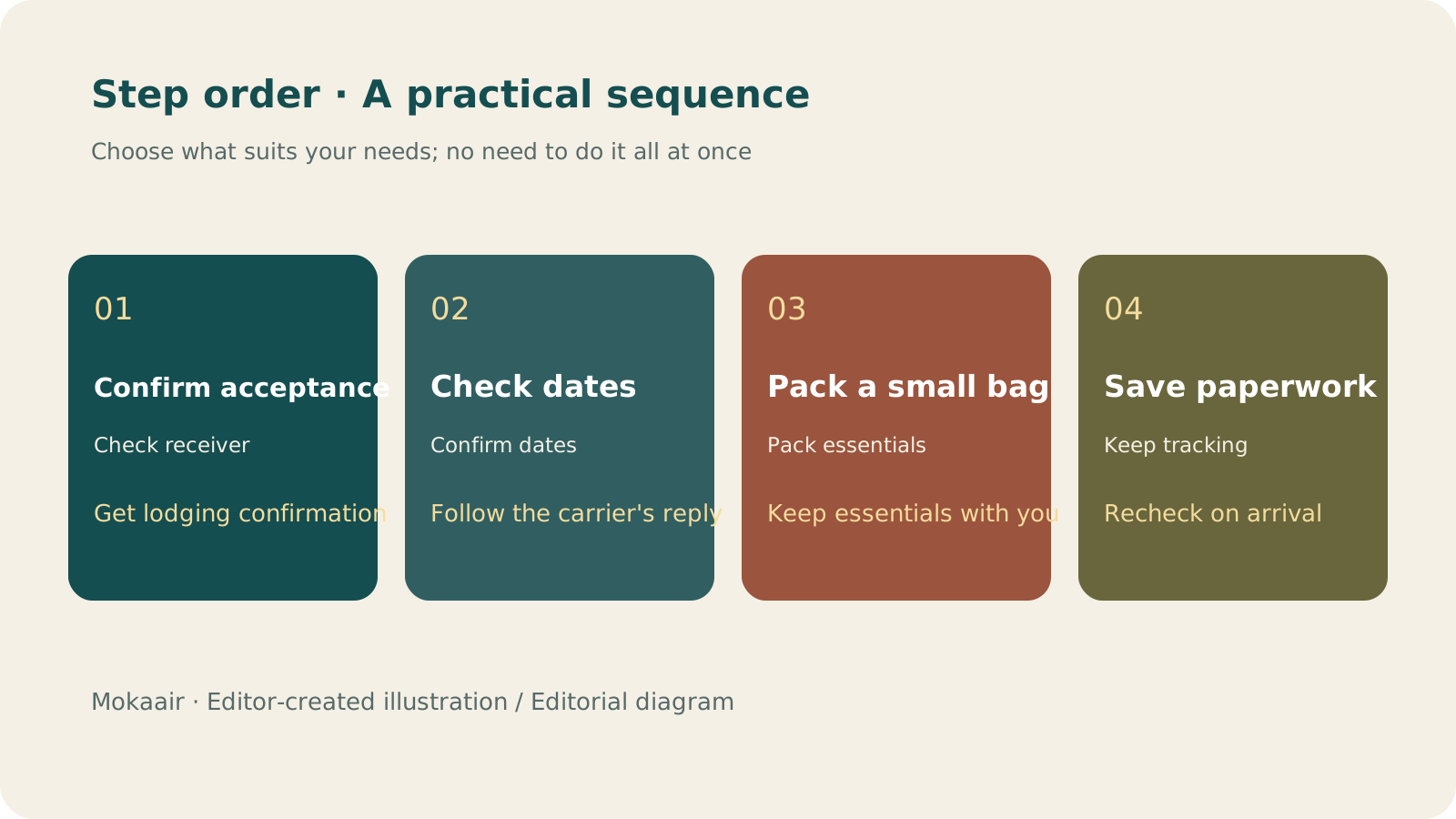
Check in order: confirm acceptance, verify dates, pack a small bag, and save the paperwork. Compiled by the editors; not a map or measured timing.
Split your intercity trip between a large suitcase and a small bag
Start by sketching out “current hotel—short stay en route—next accommodation base.” Having the large suitcase skip the short stay while carrying what you need for that part of the trip in a small bag is often simpler than forwarding luggage every night. Ask about the expected delivery date before handing it over, then decide how many changes of clothing to carry. For outlying islands, remote areas, or weather disruptions, do not rely on experience from a previous delivery between cities. Forwarding only truly reduces your burden if you can still complete that day's plans when your luggage arrives late.
| Arrangement | Best suited to | Check first |
|---|---|---|
| Send from one hotel to the next | Short stays en route with only a small bag | Whether the sending hotel handles dispatch and the receiving hotel accepts luggage |
| Send to an airport counter | Traveling light on the return journey | The airport-specific service, terminal, and shipping deadline |
| Carry it yourself throughout | Frequent accommodation changes or needing your luggage the next day | Station elevators and onboard luggage rules |
| Short-term storage | Returning to the same area that day | Pickup opening hours and location |
Work backward from your flight for airport pickup; “airport” alone is not enough
Before sending luggage to an airport, check Yamato's airport forwarding instructions and the counter for your terminal directly. Verify the flight date, terminal, pickup location, and latest shipping requirements together. “Ask when we get to the airport” is not a plan for fixing delivery to the wrong terminal. Airport forwarding and regular hotel delivery have different acceptance deadlines; the exact deadline is the one the shipping counter confirms for your route. Do not substitute someone else's claim that “sending it the day before was enough” for the requirements of your own flight.
In practice, save the counter location first, then add pickup to your airport arrival checklist, before airline check-in. The airline's baggage drop deadline and the delivery counter's opening hours are separate matters, and missing either can cause problems. If an early flight does not fit the counter's opening time, send your luggage to your final night's hotel or take it to the airport yourself. If your flight changes, reconfirm the receiving arrangements too; simply updating the departure time in your calendar is not enough.
Keep traceable records when handing over your luggage
First check the suitcase's exterior, zippers, and handles, and remove old baggage tags that could cause confusion. Take a clear photo of the shipping slip, check the delivery date, address, and number of bags, then save the tracking number. A tracking status of “delivered” does not mean the hotel has assigned the luggage to your room. On arrival, ask at reception using your name and shipping slip. If it has not arrived by the expected time, contact the carrier first to check its status, then ask the hotel for help. There is no need to place duplicate orders at different counters at the same time.
Use a two-night stopover to check whether you can split up your luggage
Suppose you stay in City A, spend two nights in the mountains, then return to City B for three consecutive nights. You could confirm that the hotel in City B accepts luggage, then ask the carrier whether it can deliver your suitcase directly there. This is only an example arrangement, not a guarantee that any route will take no more than two days. If the hotel cannot store luggage in advance, or the carrier's delivery date does not align with your check-in, carry it yourself or change the delivery destination. Do not hand it over before finding someone to receive it.
When packing your small bag, check items in the order you will actually use them during those two nights: clothes to change into after arrival, supplies for the next day's outing, charging equipment, and confirmation details for your next stay. Leave room in the large suitcase for shopping, since you only need that space on the return trip. If traveling with others, double-check who is keeping shared items so that everyone does not assume the adapter is in someone else's bag. Keep important items somewhere you can access yourself; do not put everything in one piece of luggage just because someone offers to help.
On the final night, also treat “the hotel has received the luggage” and “ready to leave for the airport” as separate checkpoints. Check the suitcases when you check in. If there is a problem with their exterior condition or the number of bags, keep a record and report it through the carrier's process; do not wait until after checkout to open them and inspect them. If they have not arrived that evening, first clarify the progress of the case and feasible pickup options, then decide on the next day's transport. Base any recovery arrangements on clear answers, and avoid adding a succession of steps that all depend on punctual connections.
The value of splitting up your luggage this way is less carrying, not guaranteed savings. When comparing options, consider the shipping fee, any small bag you may need, detours for pickup, and the uncertainty you are willing to accept. Travelers changing accommodation only once, with convenient elevators at both stations, may not need forwarding. Those who need to travel light for part of the journey are more likely to benefit in practice.
- Ask whether your next accommodation can receive luggage and obtain a clear reply.
- Verify the recipient details against the reservation name and check-in date.
- Pack what you need to carry based on the delivery date confirmed by the carrier.
- Save the shipping slip, tracking number, and pickup location.
Recheck your tickets and luggage arrangements before taking the Shinkansen
Guide
How to Choose Tokyo Transit Passes: Are Suica, Welcome Suica, the Tokyo Subway Ticket, and the JR Pass Worth It?
On a first Tokyo trip, start with an IC card and pay per ride (Welcome Suica has no deposit and is valid for 28 days). If you take four or more subway rides in a day, add a 72-hour Tokyo Subway Ticket for 2,000 yen; a JR Pass is never worthwhile if you stay in Tokyo and do not go to Kansai. See what TOURIST PASMO, Suica on iPhone, and the Tokyo Metro day pass do and do not cover, with a decision chart. Prices verified in September 2026.
Guide
Narita and Haneda Airports to Central Tokyo: How to Choose Skyliner, N'EX, Keikyu, or the Airport Limousine Bus
From Narita to Tokyo: take Keisei Skyliner to Ueno in 36–41 minutes for ¥2,580; for Shinjuku or Tokyo Station, JR N'EX reaches Tokyo in as little as 53 minutes for ¥3,140; choose the TYO-NRT bus for ¥1,500 when budget comes first. From Haneda, Keikyu reaches Shinagawa in 11–14 minutes for ¥330. Includes fares and times for Access Express, Airport Limousine and Tokyo Monorail, plus a stay-area route guide; checked on official sites in 9/2026.
Guide
How to Get Online in Thailand: Airport AIS and True Tourist SIMs, eSIM, Taiwan Carrier Roaming, and Pocket WiFi (2026)
Buy an AIS or True tourist SIM at Suvarnabhumi or Don Mueang Airport, install an eSIM before departure, or use Taiwan carrier roaming? Compare official September 2026 plans and prices from AIS, True, Chunghwa Telecom and Taiwan Mobile, plus NBTC passport-registration rules: up to 3 SIMs per carrier and tourist SIMs valid for at most 60 days. A comparison table and decision chart help you choose by trip length, group size and phone eSIM support.
Guide
Taoyuan Airport Departure Guide: A1/A3 In-Town Check-in, Baggage, Liquids and Power Banks at Security, e-Gate Registration, and When to Leave (2026)
Departure-day guide from Taipei or New Taipei: check in online and confirm the terminal; use in-town check-in at A1 (06:00–21:30) or A3 (09:00–16:00), with a three-hour cutoff and different airlines; follow the 100 mL/one-liter liquids rule, the two-power-bank carry-on limit and lighter rules; check e-Gate rules for ROC nationals with household registration in Taiwan using an ROC passport, from age 10 and 120 cm; then calculate when to leave. Verified in September 2026 using Taiwan sources.
Articles that cite this one
Sources
- Yamato: Regular TA-Q-BIN Service and Acceptance Conditions · Checked:
- Yamato: Airport TA-Q-BIN · Checked: