Intel
2026 Power Bank Flight Rules: 2 Per Person, No In-Flight Charging or Use—Taiwan, Korea and Japan Effective Dates and How to Calculate 100Wh and 160Wh
Power banks are carry-on only: up to 2 per person, each up to 160Wh. On board, do not charge them or use them to charge phones. Covers ICAO's 3/27, Taiwan's 4/8, Korea's 4/20 and Japan's 4/24 effective dates; Wh conversion, three capacity bands, spare-battery counts, overhead bins, penalties, WiFi routers and e-cigarettes. Verified in 2026/9 against announcements from ICAO, Taiwan CAA, Korea's MOLIT and Japan's MLIT.
About 6 min read
Contents
Power banks must go in carry-on baggage and cannot be checked in. Each person may carry up to 2, each up to 160Wh. On board, you must not charge them or use them to charge your phone. The rules are already in effect in Taiwan, Korea and Japan. This article was verified in 2026/9 against announcements from ICAO, Taiwan's Civil Aviation Administration under the Ministry of Transportation and Communications, Korea's Ministry of Land, Infrastructure and Transport, and Japan's Ministry of Land, Infrastructure, Transport and Tourism.
Where the new rules came from and when they took effect
The ICAO Council urgently amended its Technical Instructions for dangerous goods on 2026/3/27, effective that day. Taiwan's CAA said Taiwanese airlines already prohibited in-flight use and charging; the main addition is the quantity limit. Korea previously allowed 5 power banks up to 100Wh, now reduced to 2.
| Region | Effective date | Quantity | In-flight rules and overhead bins |
|---|---|---|---|
| ICAO | 2026/3/27 | 2 per person | No charging during flights |
| Taiwan Civil Aviation Administration | 2026/4/8 | 2 per person, carry-on only | No use or charging; the announcement does not mention overhead bins, so follow airline instructions |
| Korea Ministry of Land, Infrastructure and Transport | 2026/4/20 | 2 per person, each up to 160Wh | No charging power banks or using them to charge phones; no overhead-bin storage since 2025/3/1 |
| Japan Ministry of Land, Infrastructure, Transport and Tourism | 2026/4/24 | 2 per person, each up to 160Wh | No charging power banks or using them to charge other devices; no overhead-bin storage since 2025/7/8 |
Calculating Wh: check the label and the three capacity bands
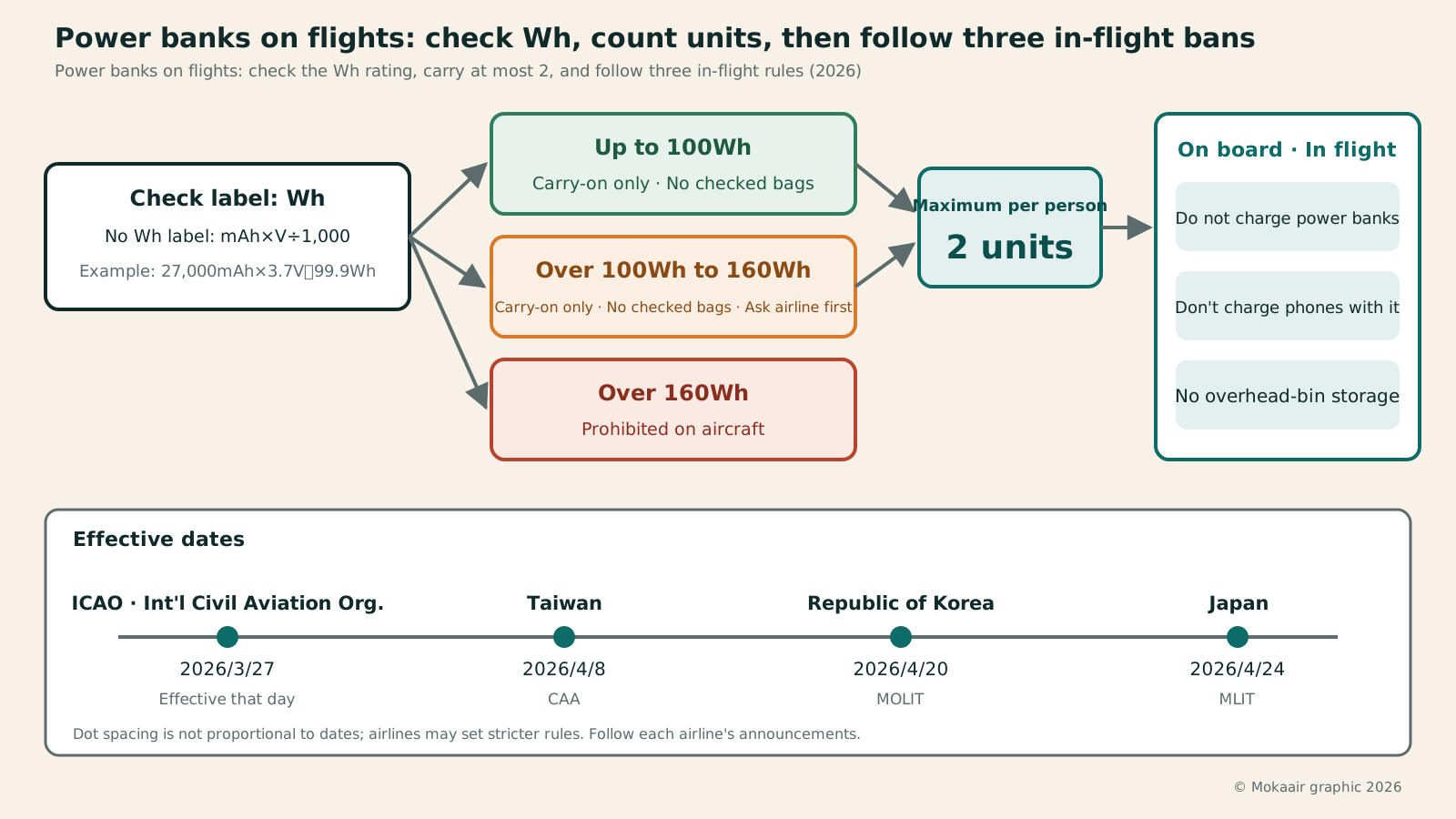
If the label does not show Wh, calculate it using Wh=mAh×V÷1,000. Japan's MLIT gives the example 27,000mAh×3.7V=99.9Wh; the Korean government converts 160Wh to approximately 43,000mAh. The voltage is not necessarily 3.7V, so check the label. Kaohsiung International Airport's announcement requires clear labeling and valid certification. Do not bring units with illegible labels or units that are damaged or swollen. Look for the BSMI mark when buying; the CAA's dangerous goods table also requires batteries to pass UN38.3 testing.
- Up to 100Wh: allowed in carry-on baggage, prohibited in checked baggage, and counted toward the limit of 2 per person.
- Over 100Wh and up to 160Wh: allowed in carry-on baggage, prohibited in checked baggage, and also counted toward the limit of 2. Both the CAA's dangerous goods table and Korean rules require airline approval; Japan's MLIT passenger guidance does not mention it. Ask your airline before bringing a power bank in this band.
- Over 160Wh: prohibited on aircraft.
Read the full description
Start by checking the Wh rating on the power bank's label. If Wh is not listed, multiply mAh by the voltage and divide by 1,000; for example, 27,000mAh multiplied by 3.7V equals 99.9Wh. There are three paths based on Wh: up to 100Wh is allowed in carry-on baggage but prohibited in checked baggage; over 100Wh and up to 160Wh is allowed in carry-on baggage but prohibited in checked baggage, and you should ask the airline first; over 160Wh is prohibited on aircraft. The first two paths lead to a maximum of 2 per person. Three rules apply on board: do not charge the power bank, do not use it to charge your phone, and do not store it in an overhead bin. The timeline at the bottom shows ICAO taking effect immediately on 2026/3/27, Taiwan CAA on 2026/4/8, Korea's Ministry of Land, Infrastructure and Transport on 2026/4/20, and Japan's Ministry of Land, Infrastructure, Transport and Tourism on 2026/4/24.
Spare batteries do not count as power banks
Spare camera and drone batteries do not count as power banks, but they are still carry-on only, with terminals insulated or each battery placed in a separate bag. Japan's MLIT sets no quantity limit for spare batteries up to 100Wh. Spare batteries rated 100–160Wh must be counted together with power banks: if you carry 2 power banks up to 100Wh, you may bring 2 additional spare batteries; if you carry 2 power banks rated 100–160Wh, you may bring no additional spare batteries; if you carry 1 power bank from each band, you may bring 1 additional spare battery. Taiwanese and Korean official guidance does not specify how to combine the counts; follow your airline's rules.
In-flight rules, penalties and what to do if you exceed the limits
Keep power banks on your person or in the seat-back pocket in front of you, not in overhead bins. Japan's 2025 rules previously allowed charging where the device remained visible, but these were superseded by the new rules on 2026/4/24. Charge your phone using the seat's power supply. Japan's MLIT explicitly states that checking in power banks, bringing units over 160Wh, failing to protect against short circuits, carrying more than 2, or charging a power bank on board may incur penalties under aviation law.
When sending luggage in Japan, whether batteries are accepted depends on the carrier's rules.
Arranging Luggage Delivery in Japan: Hotel Acceptance and Airport PickupPlanning Luggage Forwarding in Japan: Traveling Light Between Cities, Hotel Delivery, and Airport PickupSending luggage is only half the job; make sure it can reach your next stop. From confirming hotel acceptance and filling in recipient details to handling airport forwarding separately from regular delivery, here is a practical approach to keeping luggage from dictating your itinerary.Read the full article
The local new rules also apply when your return flight departs from Japan or Korea. For other countries, follow your airline's rules. For tobacco, alcohol and duty-free allowances when entering Taiwan on your return, see the Taiwan customs article.
Luggage Rules When Returning to Taiwan: Duty-Free Allowances, Tobacco, Alcohol and Declarations
WiFi routers, e-cigarettes and lighters
The CAA's dangerous goods table classifies WiFi routers as "portable electronic devices containing lithium batteries," listed separately from power banks. Carry-on is recommended. If checked in, they must be completely switched off—not in sleep or hibernation mode—and protected against accidental activation. If you rely on power banks to keep both your router and phone running, make sure you have no more than 2 power banks before departure.
Choosing Internet Access in Japan: eSIM, Physical SIM or WiFi Router
Choosing Internet Access in Korea: eSIM, Physical SIM or WiFi Router
Choosing Internet Access in Thailand: Tourist SIM, eSIM or WiFi RouterHow to Get Online in Thailand: Airport AIS and True Tourist SIMs, eSIM, Taiwan Carrier Roaming, and Pocket WiFi (2026)Buy an AIS or True tourist SIM at Suvarnabhumi or Don Mueang Airport, install an eSIM before departure, or use Taiwan carrier roaming? Compare official September 2026 plans and prices from AIS, True, Chunghwa Telecom and Taiwan Mobile, plus NBTC passport-registration rules: up to 3 SIMs per carrier and tourist SIMs valid for at most 60 days. A comparison table and decision chart help you choose by trip length, group size and phone eSIM support.Read the full article
Internet Access, Currency Exchange and Ride-Hailing in Vietnam: One Complete Guide
E-cigarettes cannot be checked in and must be carried on. Neither the devices nor their batteries may be charged on board (item 3 of the CAA's dangerous goods table). Permission to bring them on an aircraft does not mean permission to bring them into a country: Vietnam completely bans e-cigarettes and heated tobacco products, Hong Kong prohibits their import, and Singapore prohibits carrying and using e-cigarettes. See the entry guides for details.
Entering Vietnam in 2026: e-visa, Customs and E-Cigarette Rules
Entering Hong Kong in 2026: Pre-arrival Registration, E-Cigarettes and Duty-Free Allowances2026 Hong Kong Entry for Taiwan Travelers: Free Online Registration; 2 Entries in 2 Months, 30 Days Each; No E-cigarettes; Tobacco/Alcohol Allowances; Declare Cash over HK$12 × ten thousandTaiwan passport holders need no Hong Kong visa: use free GovHK pre-arrival registration for Taiwan residents or a Mainland Travel Permit for Taiwan Residents. From Hong Kong Immigration, Customs, Tobacco and Alcohol Control Office and Taiwan MOFA's Bureau of Consular Affairs: three routes' eligibility, landing slips, 18+ tobacco/alcohol allowances, e-cigarette/heated tobacco import and public possession bans, and airport red-channel cash declarations over HK$12 × ten thousand. Checked 2026/9.Read the full article
Entering Singapore in 2026: SG Arrival Card, Duty-Free Allowances and E-Cigarettes2026 Singapore Entry for Taiwan Travelers: Free SG Arrival Card Within 3 Days Before Arrival, No Cigarette Allowance, Vape Fines Up to SGD 10,000Taiwan passport holders get 30 visa-free tourist days in Singapore. Submit the free SG Arrival Card within 3 days before arrival (arrival day included). Based on ICA, Singapore Customs, gov.sg, HSA and Taiwan's Bureau of Consular Affairs: SGAC timing and paid agents, Changi automated lanes, five liquor allowances, GST relief, no cigarette allowance, cash over SGD 20,000, and vaping law effective 2026/5/1. Verified 2026/9.Read the full article
Each person may bring up to 1 cigarette lighter or 1 box of safety matches. They must be carried on your person and cannot be checked in (item 5 of the CAA's dangerous goods table).
5 checks before departure
- Check the label: confirm the Wh rating and ask your airline first if it exceeds 100Wh.
- Count the units: no more than 2 power banks per person.
- Protect the terminals: cover them with insulating tape or place each unit in a separate bag.
- Pack them in carry-on baggage: power banks must not go in checked baggage.
- On board: keep them on your person or in a seat-back pocket. Do not charge them or use them to charge your phone.
STARLUX, Tigerair Taiwan and other low-cost airlines may have stricter rules. Refer to each airline's official website.
Departing from Taoyuan Airport: Check-In, Bag Drop, Security and Automated Immigration ClearanceTaoyuan Airport Departure Guide: A1/A3 In-Town Check-in, Baggage, Liquids and Power Banks at Security, e-Gate Registration, and When to Leave (2026)Departure-day guide from Taipei or New Taipei: check in online and confirm the terminal; use in-town check-in at A1 (06:00–21:30) or A3 (09:00–16:00), with a three-hour cutoff and different airlines; follow the 100 mL/one-liter liquids rule, the two-power-bank carry-on limit and lighter rules; check e-Gate rules for ROC nationals with household registration in Taiwan using an ROC passport, from age 10 and 120 cm; then calculate when to leave. Verified in September 2026 using Taiwan sources.Read the full article
Tokyo City Page: Attractions, Accommodation and Transport
Seoul City Page: Attractions, Accommodation and Transport
Found this guide helpful? Share it with someone who needs it
Guide
How to Get Online in Thailand: Airport AIS and True Tourist SIMs, eSIM, Taiwan Carrier Roaming, and Pocket WiFi (2026)
Buy an AIS or True tourist SIM at Suvarnabhumi or Don Mueang Airport, install an eSIM before departure, or use Taiwan carrier roaming? Compare official September 2026 plans and prices from AIS, True, Chunghwa Telecom and Taiwan Mobile, plus NBTC passport-registration rules: up to 3 SIMs per carrier and tourist SIMs valid for at most 60 days. A comparison table and decision chart help you choose by trip length, group size and phone eSIM support.
Guide
Taoyuan Airport Departure Guide: A1/A3 In-Town Check-in, Baggage, Liquids and Power Banks at Security, e-Gate Registration, and When to Leave (2026)
Departure-day guide from Taipei or New Taipei: check in online and confirm the terminal; use in-town check-in at A1 (06:00–21:30) or A3 (09:00–16:00), with a three-hour cutoff and different airlines; follow the 100 mL/one-liter liquids rule, the two-power-bank carry-on limit and lighter rules; check e-Gate rules for ROC nationals with household registration in Taiwan using an ROC passport, from age 10 and 120 cm; then calculate when to leave. Verified in September 2026 using Taiwan sources.
Guide
Renting a car in Jeju: Taiwan-issued IDPs, airport shuttles, coverage, deposits, fuel and returns
Under the 2022 Taiwan–South Korea reciprocal IDP agreement, a traveler with a valid Taiwan-issued International Driving Permit, Taiwan licence and passport can rent a car in Jeju. This guide covers the minimum age of 21, airport Gate 2 desk and Gate 5 shuttle, CDW and full exemption, deposits, fuel, parking, fines, child seats, returns and alternatives without an IDP. Rules and figures were checked with Taiwan and South Korean authorities, Jeju Airport and LOTTE rent-a-car in September 2026.
Guide
Japan Station Locker Guide: Inside or Outside Ticket Gates, Access Credentials, and Luggage Retrieval
Storing luggage takes only minutes, but finding your locker again can take much longer. Record its location, collection hours, and unlocking method together so that traveling between areas that day does not mean retracing your route through the station for your bags.
Sources
- ICAO: New power bank restrictions will safeguard international aviation (effective 3/27; 2 per person; no charging during flights)Checked:
- Taiwan MOTC CAA: Passengers limited to 2 power banks from 4/8 (2026-04-02 press release)Checked:
- Kaohsiung International Airport: From 2026/4/8, limit of 2 power banks and no in-flight use (labeling and certification; voluntarily surrender excess units or arrange their return)Checked:
- Taiwan MOTC CAA: Carry power banks on board with protection; never check them in (2023-01-11 press release; 100Wh, 100–160Wh, BSMI)Checked:
- Taiwan MOTC CAA: Dangerous goods passengers and crew may carry on or check in (webpage, updated 2025-02-11)Checked:
- Taiwan MOTC CAA: Dangerous goods passengers and crew may carry on or check in—PDF table (item 1: lithium batteries; item 3: e-cigarettes; item 5: lighters)Checked:
- Korea Policy Briefing: From the 20th, 1 passenger may bring at most 2 power banks aboard aircraft (2026-04-08; safety infographic)Checked:
- Korea Policy Briefing: No overhead-bin storage of power banks from month 3 (2025-02-13; bins, terminal protection, airline approval for 100–160Wh)Checked:
- Japan MLIT: New rules for carrying power banks on board (2026-04-14; effective 4/24)Checked:
- Japan MLIT: Appendix 1 [For Passengers] Carrying Power Banks On Board—PDF (Wh formula, seven rules, penalties, combined spare-battery counts)Checked:
- Japan MLIT: Do not put power banks in overhead bins (2025-07-01; effective 7/8)Checked:
- Hong Kong Customs: Alternative Smoking Products (import of alternative smoking products prohibited)Checked:
- Singapore Health Sciences Authority HSA: Vaping enforcement (purchase, possession and use of e-cigarettes prohibited)Checked:
- Singapore Customs: Controlled and prohibited goods for imports (e-cigarettes listed as prohibited imports)Checked:
- Vietnam Government Portal: National Assembly Resolution No. 173/2024/QH15, banning e-cigarettes and heated tobacco products from 2025Checked:
Compiled from the references and verification dates listed above; fares, schedules, product features, and terms can change, so please confirm the latest details on the relevant official website before travelling, booking, or purchasing.