Lifestyle
GitHub and Yale survey: 80% of developers surveyed want energy-efficient coding tools but lack ways to measure impact
On September 23, 2026, GitHub published a survey of 1,039 US GitHub users run with the Yale Program on Climate Change Communication. Most respondents want tools to make software use less energy but lack ways to measure it. Here are the key figures, the sample's limits and what it means for everyday users and development teams.
About 6 min read

What happened
GitHub, the widely used platform where developers store and share code, published a research post on its official blog. The post was written by Paull Young, released on September 23, 2026 and updated on September 24. According to GitHub, the survey was run jointly by GitHub and the Yale Program on Climate Change Communication. It collected 1,039 responses from monthly active GitHub users in the US and asked about climate change, AI, software efficiency and the responsibilities of organizations across the tech industry.
GitHub's core conclusion is that developers know efficient software matters. However, many lack a clear way to find waste, measure an improvement and make the case for fixing it.
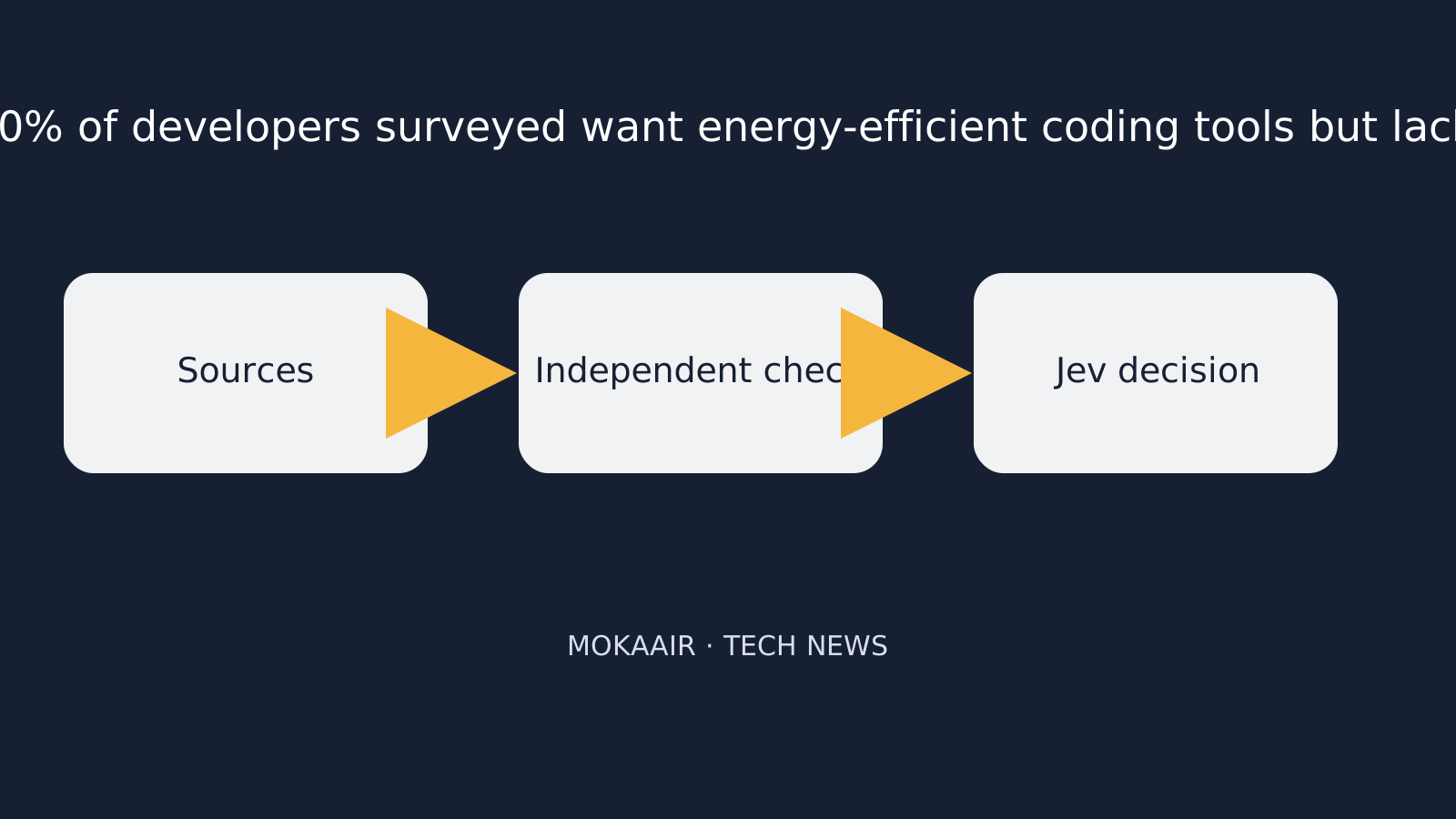
Read the full description
Sources are collected, independently checked, then reviewed by Jev.
Key survey figures
According to GitHub, 79% of respondents are worried about global warming. 71% are concerned about the environmental impact of AI systems, including their energy and water use and carbon emissions. 75% say it is important for their employer to actively reduce its environmental impact. When asked what they want, 80% are interested in energy-efficient coding tools and 78% want to learn best practices for reducing software's environmental footprint. 74% want to measure the environmental impact of their software or development process, and 70% are interested in contributing to open source projects focused on sustainability.
GitHub also compared some answers with results for US adults from "Climate Change in the American Mind", Yale's nationally representative survey. The GitHub users surveyed expressed more concern about climate change than US adults overall.
| Question | GitHub respondents | US adults |
|---|---|---|
| Think global warming is happening | 86% | 68% |
| Say it is at least somewhat important to them personally | 82% | 65% |
| Think it will harm them at least a moderate amount | 68% | 45% |
| Expect it to harm future generations at least a moderate amount | 82% | 68% |
| Worried about global warming | 79% | 66% |
Where the gap lies: willingness, but no practical path
According to GitHub, only 10% of respondents believe the way they write software does a lot to reduce their personal environmental impact. Another 28% say it has a moderate effect, and 63% say the effect is small. In their written comments, some respondents asked for ways to estimate the footprint of repositories (the storage space for a project's code) and CI/CD workflows (automated pipelines that build and test code). Others wanted to find unnecessary runs of GitHub Actions, GitHub's automation service, or to compare AI use with other sources of computing demand. Several respondents also warned against making environmental claims without evidence.
GitHub specifically notes that faster code can reduce resource use, but running time alone does not prove lower energy use or emissions. Hardware, workload, location, time and the source of electricity all affect the result.
GitHub's recommended approach and AI agent tools
GitHub recommends looking for measurable waste in four areas: - Code, such as repeated computation and inefficient algorithms. - Data, such as fetching more than needed and missing caching. - Network and I/O (input and output), such as duplicate requests and oversized payloads. - Front end, such as unnecessary rendering and loading off-screen assets too early. Execution time, CPU use, memory allocation and network transfer size can all serve as proxy metrics. These are indirect measures of how much computing a program needs. GitHub cautions that each has limits, so teams should state what they measured and what they did not.
GitHub also introduced its open source Daily Efficiency Improver workflow, part of GitHub Agentic Workflows. These workflows use an AI agent, an AI tool that carries out tasks on its own. According to GitHub, the workflow reviews a repository for efficiency opportunities and runs the repository's tests. It can then open draft pull requests, which are proposed code changes for people to review, with the evidence and trade-offs attached. It does not merge changes itself. Before enabling it, GitHub recommends reviewing its permissions, configuration, model use, run frequency and likely compute cost. GitHub also suggests starting in a test repository or running the workflow manually. GitHub says humans still decide whether the evidence is sound and whether a change is adopted.
What this means in practice
- For everyday users: the survey shows that some developers care about the energy use of software and AI. However, it is an opinion survey and does not mean any service has actually become more energy-efficient.
- For development teams: the core of GitHub's advice is "measure first, then claim". Back efficiency improvements with concrete data and reproducible tests rather than simply calling a change "greener".
- For teams considering AI agent tools: GitHub advises checking permissions and likely compute cost before enabling a scheduled workflow. It also advises treating every recommendation as a hypothesis until benchmarks and tests support it, with maintainers deciding what ships.
Frequently asked questions
Does this survey represent the views of all engineers?
No. According to GitHub, the respondents were US users who had agreed to receive GitHub marketing emails. They were not randomly selected, so the results describe only the respondents' views.
Does the survey prove that AI uses a lot of energy?
No. GitHub explicitly states that the survey did not measure the environmental footprint of AI or any software system. It only reflects respondents' level of concern.
Does faster code mean lower energy use?
Not necessarily. GitHub notes that running time alone cannot prove lower energy use or emissions, since hardware, workload, location, time and electricity source all affect the result.
Will Daily Efficiency Improver automatically change my code?
According to GitHub, it can open draft pull requests for maintainers to review, but it does not merge changes itself. People decide whether to adopt them.
Who produced these figures?
The figures come from a survey GitHub ran with the Yale Program on Climate Change Communication and published on the official GitHub Blog. They are reported here as GitHub published them.
Browse the latest news in this topic
Lifestyle
Cloudflare launches Traces in public beta: site operators can follow every step a request takes through the platform on one timeline
On October 2, 2026, Cloudflare announced the public beta of Cloudflare Traces. Website operators and developers using Cloudflare can see a request pass through security rules, caching, routing and the origin server on a single timeline, making it easier to find why a request was blocked or slowed. New pricing takes effect on December 1, 2026. Information comes from the official Cloudflare blog.
Lifestyle
Cloudflare launches Web Search API via AI Gateway, requiring search partners to follow its crawler rules
On October 2, 2026, Cloudflare announced a Web Search API that lets AI agents query live web information through AI Gateway. The first partners are Ceramic.ai, Exa and Linkup. Cloudflare says these partners' crawlers must meet its Verified bots requirements and cite sources. This matters both to developers building AI applications and to website owners whose content may be crawled.
Lifestyle
Cloudflare open-sources Streamline: a demo of using its cloud services to add graphics to live streams and burn subtitles into videos
On October 2, 2026, Cloudflare launched and open-sourced Streamline, a developer playground showing how developers can combine Stream, Workers, Containers and Durable Objects to build their own video processing pipelines, such as adding graphics to live streams in real time or adding subtitles to videos. This article explains what it is, how it works, its limitations, and what it means for viewers and developers.
Lifestyle
Google unveils Gemini 4 Argon: cyber defenders get it first, everyone else still has to wait
On September 30, 2026, Google announced Gemini 4 Argon, which it calls its new frontier (most advanced) AI model. For now it is available only to trusted cyber defenders through the Fairwind Program. Here is what Google says the model can do, what it will cost developers, how Google says it is managing the risks, and what it means for everyday users. All figures come from Google itself.
Latest travel guides

GuideTokyo
Where to Stay in Tokyo: Comparing Shinjuku, Ueno, Tokyo Station, Shibuya, Asakusa, Ikebukuro, and Ginza, Plus Airport Access, Accommodation Tax, and Luggage Delivery
Where should you stay in Tokyo? Compare Shinjuku, Ueno, Tokyo Station, Shibuya, Asakusa, Ikebukuro, and Ginza by the same criteria: access from Narita and Haneda, transit routes, nearby attractions, neighborhood character, and who each area suits. Includes a comparison table, a Yamanote Line diagram, Tokyo’s accommodation tax as verified in 2026/9 (changing to 3% in 2027/4), and Airport TA-Q-BIN luggage shipping rules.
- Budget
- Hotels

GuideTokyo
How to Choose Tokyo Transit Passes: Are Suica, Welcome Suica, the Tokyo Subway Ticket, and the JR Pass Worth It?
On a first Tokyo trip, start with an IC card and pay per ride (Welcome Suica has no deposit and is valid for 28 days). If you take four or more subway rides in a day, add a 72-hour Tokyo Subway Ticket for 2,000 yen; a JR Pass is never worthwhile if you stay in Tokyo and do not go to Kansai. See what TOURIST PASMO, Suica on iPhone, and the Tokyo Metro day pass do and do not cover, with a decision chart. Prices verified in September 2026.
- Transport
- Budget

GuideTokyo
Tokyo Disneyland and DisneySea Guide: Ticket Prices, Fantasy Springs, Disney Premier Access (DPA), Standby Pass, and Which Park to Choose for Your First Visit
Tokyo Disney one-day Passport prices vary: most weekdays in 9/2026 cost ¥9,900 and weekends ¥10,900. At 14:00 daily, tickets go on sale for the same date two months later. Free Priority Pass is no longer on the official service list; only paid Disney Premier Access (¥1,000–3,500 per person per use) shortens waits. Covers hours, the 25th anniversary, Standby Pass, Entry Request, Fantasy Springs access and first-visit park choice; checked on the official site in 9/2026.
- Itineraries
- Family