Lifestyle
Cloudflare Launches Pay Per Use Beta: Publishers Get Paid When AI Actually Uses Their Content
Cloudflare has announced that Pay Per Use is entering beta, letting AI companies bid on specific uses of content while publishers decide whether to accept, with Cloudflare handling reporting, billing and payouts. Here is how it works, how it differs from Pay Per Crawl, and what it means for everyday readers and website operators.
About 6 min read
What happened
On September 30, 2026, Cloudflare announced on its official blog that Pay Per Use has entered beta, an early testing stage before a product is considered finished. Cloudflare said it first unveiled the plan in July and has since been working with content buyers and content owners to move it forward.
Cloudflare laid out the background to the problem: AI answer engines (AI tools that answer questions directly instead of sending you to a list of links) read publishers' pages and then give readers a summary, so the site visits, and the revenue that came with them, disappear. Cloudflare argues that most publishers will never sign licensing deals with the AI companies using their content, and no company can negotiate one by one with millions of websites, so a "pay and you can use it" mechanism is needed.
Read the full description
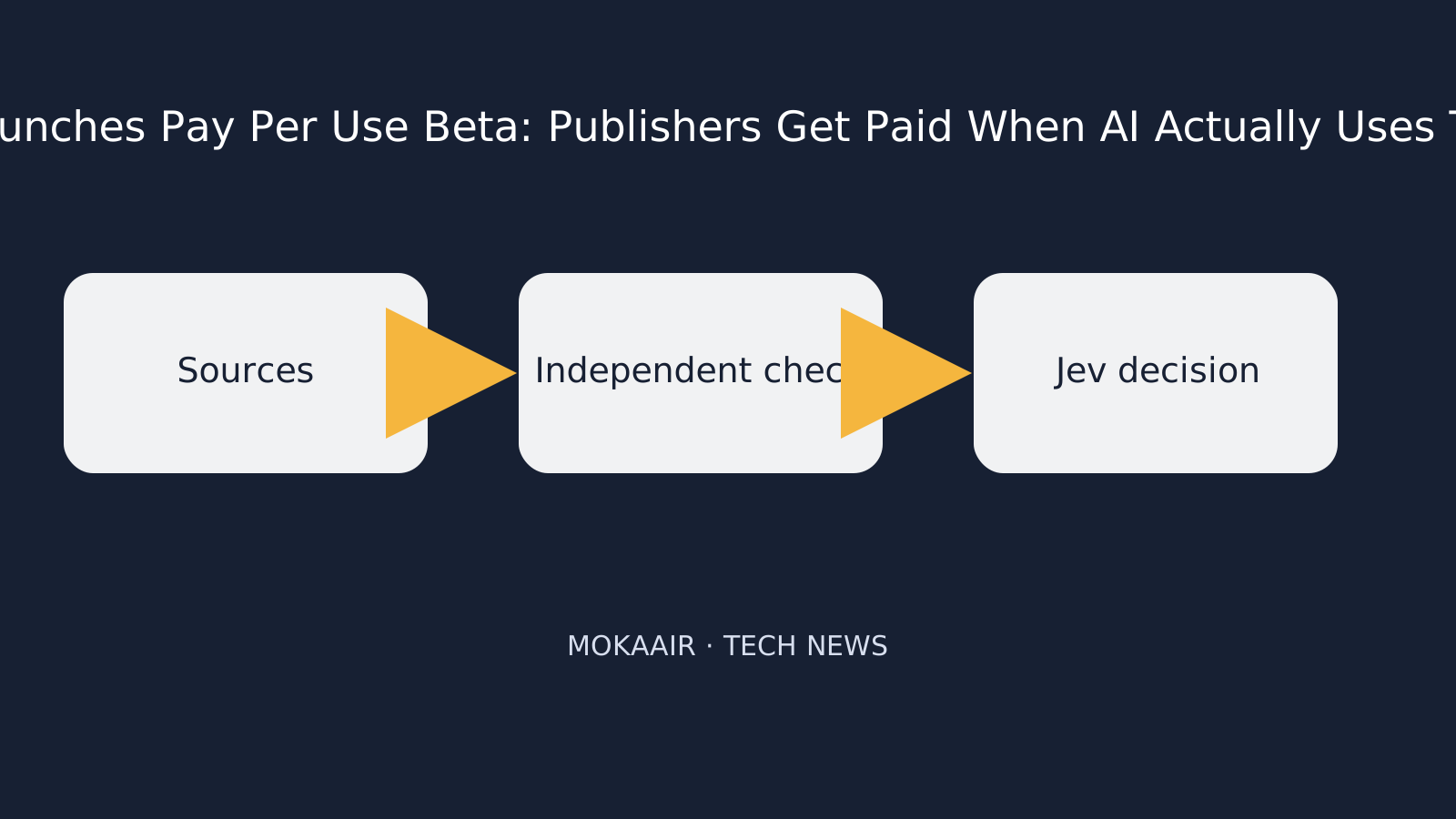
Sources are collected, independently checked, then reviewed by Jev.
How Pay Per Use works
According to Cloudflare, the process has four steps:
- Define paid uses: each AI company identifies its crawlers (automated programs that fetch web pages), defines the uses it is willing to pay for, sets prices and links a payment account.
- Publishers choose whether to participate: on the Monetize → Pay Per Use page of the Cloudflare dashboard, they review AI companies, paid uses and bids, decide whether to accept, and can later stop participating if an arrangement no longer works for them.
- Buyers report each use: usage is self-reported by buyers, the program terms require complete reporting, and Cloudflare checks that each report matches an enrolled publisher.
- Cloudflare settles: it aggregates reported usage, bills buyers and pays out monthly to the payment account linked by each publisher.
Cloudflare gave two examples: a search service could pay when it returns an excerpt of an enrolled page to a customer, and a shopping agent (AI software that carries out tasks such as shopping on a person's behalf) could pay when an enrolled review influences a recommendation, even if the shopper never reads that review. Cloudflare also said each program's terms govern how AI companies may use the content, including any restrictions on AI training.
How it differs from Pay Per Crawl
Cloudflare says AI products fetch far more content than they actually use. Charging per crawl would force buyers to pay before knowing what they need, which many buyers would not accept. Pay Per Use therefore charges for actual use instead.
| Item | Pay Per Crawl | Pay Per Use |
|---|---|---|
| Launch (per Cloudflare) | 2025 | Entered beta on September 30, 2026 |
| What is charged | Access (crawling) | Actual use after crawling |
| Who proposes the price | Not described in Cloudflare's post | AI companies define uses and bid; publishers decide whether to accept |
| Source of usage data | Not described in Cloudflare's post | Self-reported by buyers; Cloudflare checks it matches enrolled publishers |
On the same day, Cloudflare also said Monetization Gateway has entered beta. It lets sellers of APIs (interfaces that let software request data or services from other software), tools and data charge agents per request using the open x402 protocol, a publicly available standard for charging per request. Cloudflare's reasoning is that for such services, each request is itself a use.
What it means for everyday readers and website operators
For everyday readers, mechanisms like this reflect how AI search and summaries are changing the economics of online content: when you read a summary through an AI assistant instead of clicking through to the original site, the original author may miss out on advertising or subscription revenue. Cloudflare's scheme tries to have AI companies pay directly when they use content. If it catches on, it might help sustain the production of news, research and other content, but it is still in beta and its effectiveness is unknown.
For website operators, Cloudflare says participating requires no changes to the origin server (the server that actually hosts a website) and no separate integration with each AI company, and publishers can stop participating if an arrangement no longer works for them. Cloudflare also says it will work with AI companies to report more context for each use, such as the keywords that triggered a citation, the request topic or the product being supported, without exchanging personal data. It also hopes to let publishers make counteroffers and set different prices by use.
Cloudflare's position is that publishers should not be forced to choose only between blocking all AI agents and giving away their work for free. Whether AI companies and publishers widely adopt the scheme remains to be seen from the results of the beta.
Frequently asked questions
What is Pay Per Use?
According to Cloudflare, it is a mechanism that lets AI companies pay publishers when they actually use website content, and it entered beta on September 30, 2026. AI companies define uses and bid, publishers decide whether to accept, and Cloudflare handles reporting, billing and payouts.
How is it different from Pay Per Crawl?
Cloudflare says Pay Per Crawl, launched in 2025, charges for access, while Pay Per Use charges for actual use after crawling. Publishers can choose the model that suits them.
How is usage calculated, and is it reliable?
Cloudflare says usage is self-reported by buyers, the program terms require complete reporting, and Cloudflare checks that each report matches an enrolled publisher. Because it is self-reported, its actual accuracy cannot currently be confirmed by any independent source.
Can publishers leave after joining?
Cloudflare says publishers can stop participating when the arrangement no longer suits them.
Does this affect whether AI can train on my content?
Cloudflare says each program's terms define how AI companies may use the content, including any restrictions on training. The specific restrictions depend on the individual program.
How often are payments made?
According to Cloudflare, payments are made monthly to the payment account linked by the publisher.
Browse the latest news in this topic
Lifestyle
Cloudflare open-sources Streamline: a demo of using its cloud services to add graphics to live streams and burn subtitles into videos
On October 2, 2026, Cloudflare launched and open-sourced Streamline, a developer playground showing how developers can combine Stream, Workers, Containers and Durable Objects to build their own video processing pipelines, such as adding graphics to live streams in real time or adding subtitles to videos. This article explains what it is, how it works, its limitations, and what it means for viewers and developers.
Lifestyle
Google unveils Gemini 4 Argon: cyber defenders get it first, everyone else still has to wait
On September 30, 2026, Google announced Gemini 4 Argon, which it calls its new frontier (most advanced) AI model. For now it is available only to trusted cyber defenders through the Fairwind Program. Here is what Google says the model can do, what it will cost developers, how Google says it is managing the risks, and what it means for everyday users. All figures come from Google itself.
Lifestyle
NVIDIA: CoreWeave Begins Offering Vera Rubin NVL72, With Cognition as First Production Customer
According to the NVIDIA blog, AI cloud provider CoreWeave now offers NVIDIA's next-generation Vera Rubin NVL72 systems, plans to offer the Vera CPU and launched CoreWeave Forge. This matters mainly to companies building AI agents, and could eventually mean faster AI tools for everyday users.
Lifestyle
Google Cloud makes Spanner Omni generally available: its Spanner database can now run in companies' own data centers and on other clouds
Google Cloud says Spanner Omni, a version of its Spanner database that businesses run themselves, is now ready for real-world use in their own data centers, on other clouds or on a laptop. This matters to organizations that want Spanner outside Google Cloud, but they take on the running of it. Here are the features, licences and trade-offs Google Cloud describes.
Latest travel guides

GuideTokyo
Where to Stay in Tokyo: Comparing Shinjuku, Ueno, Tokyo Station, Shibuya, Asakusa, Ikebukuro, and Ginza, Plus Airport Access, Accommodation Tax, and Luggage Delivery
Where should you stay in Tokyo? Compare Shinjuku, Ueno, Tokyo Station, Shibuya, Asakusa, Ikebukuro, and Ginza by the same criteria: access from Narita and Haneda, transit routes, nearby attractions, neighborhood character, and who each area suits. Includes a comparison table, a Yamanote Line diagram, Tokyo’s accommodation tax as verified in 2026/9 (changing to 3% in 2027/4), and Airport TA-Q-BIN luggage shipping rules.
- Budget
- Hotels

GuideTokyo
How to Choose Tokyo Transit Passes: Are Suica, Welcome Suica, the Tokyo Subway Ticket, and the JR Pass Worth It?
On a first Tokyo trip, start with an IC card and pay per ride (Welcome Suica has no deposit and is valid for 28 days). If you take four or more subway rides in a day, add a 72-hour Tokyo Subway Ticket for 2,000 yen; a JR Pass is never worthwhile if you stay in Tokyo and do not go to Kansai. See what TOURIST PASMO, Suica on iPhone, and the Tokyo Metro day pass do and do not cover, with a decision chart. Prices verified in September 2026.
- Transport
- Budget

GuideTokyo
Tokyo Disneyland and DisneySea Guide: Ticket Prices, Fantasy Springs, Disney Premier Access (DPA), Standby Pass, and Which Park to Choose for Your First Visit
Tokyo Disney one-day Passport prices vary: most weekdays in 9/2026 cost ¥9,900 and weekends ¥10,900. At 14:00 daily, tickets go on sale for the same date two months later. Free Priority Pass is no longer on the official service list; only paid Disney Premier Access (¥1,000–3,500 per person per use) shortens waits. Covers hours, the 25th anniversary, Standby Pass, Entry Request, Fantasy Springs access and first-visit park choice; checked on the official site in 9/2026.
- Itineraries
- Family