Lifestyle
Cloudflare Used Frontier AI Models to Attack Its Own WAF: Most Attempts Were Blocked, and the Gaps Led to New SSRF Rules
On September 29, 2026, Cloudflare said it had advanced AI models act as attackers against its own web application firewall (WAF). According to Cloudflare, most of the 1,107 attempts were blocked. Human review left 49 findings worth investigating, and these led to SSRF rule updates that Cloudflare says benefit all its customers.
About 8 min read
What happened: Cloudflare had AI play the attacker against its own firewall
On September 29, 2026, Cloudflare published a post on its official blog written by Vikram Grover, Daniele Molteni and Kuber Nandwani. Cloudflare said customers keep asking, "Is your WAF ready for frontier AI models?", so it decided to find out. A WAF (web application firewall) is a layer of protection that sits in front of a website and filters out malicious requests. Frontier AI models are the most advanced AI models currently available.
Cloudflare says large language models are strong attackers because they can change attack payloads faster than any human hacker and adjust their tactics based on real-time responses. To examine this, Cloudflare used dynamic testing, which means probing a running website from the outside. The models could not see the source code or the WAF rules, and could see only part of the HTTP response data. Cloudflare stressed that an unblocked request was only a lead for human review, not a confirmed exploit.
Read the full description
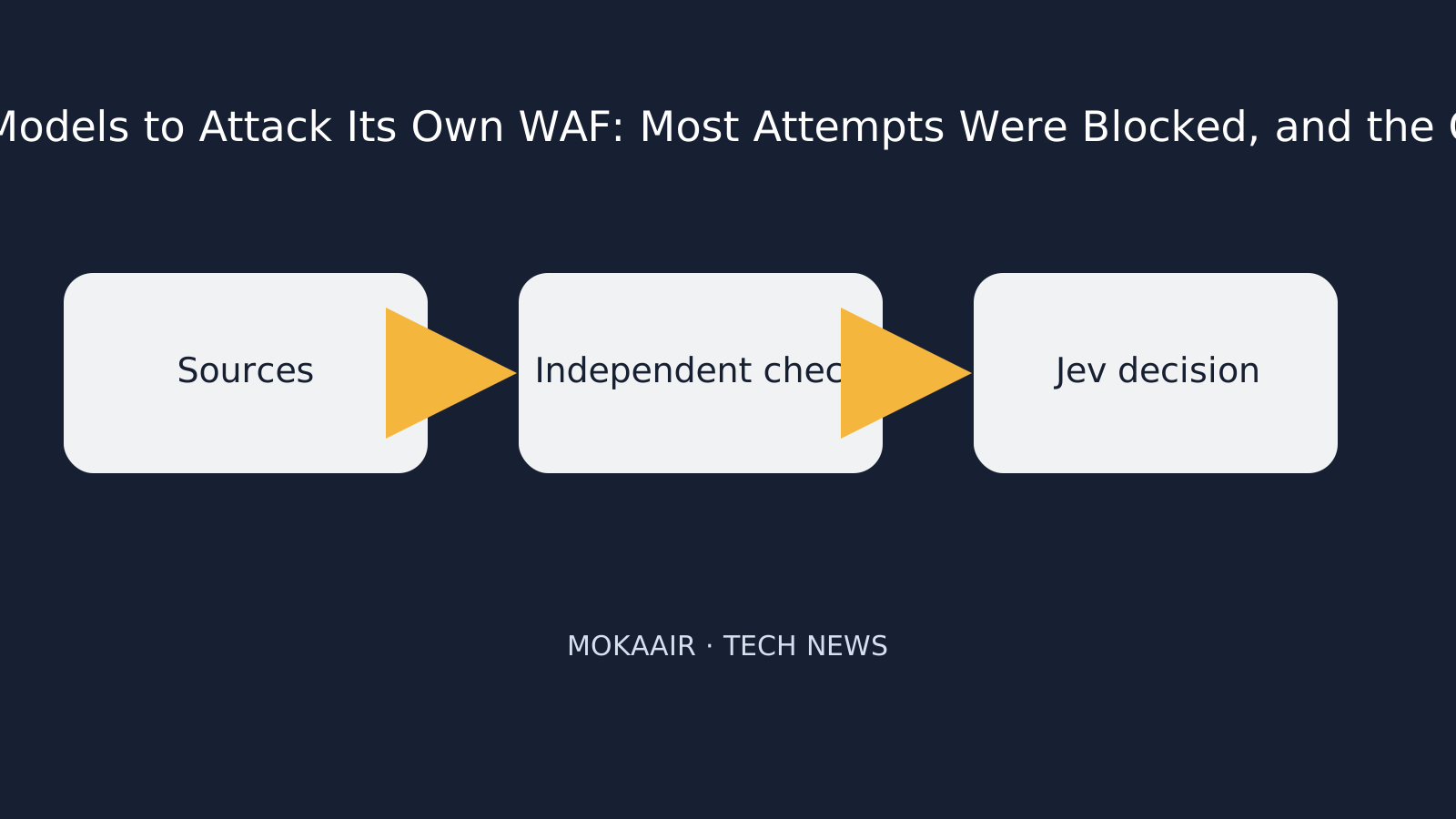
Sources are collected, independently checked, then reviewed by Jev.
How the test worked: an AI testing loop controlled by code
According to Cloudflare, the test target was an authorized customer staging environment, a test copy of a site used before changes go live. Cloudflare ran 45 scenarios. Of these, 44 covered six common attack types: cross-site scripting (XSS), SQL injection, command injection (sneaking system commands into a request), server-side request forgery (SSRF), path traversal or local file inclusion (LFI), and Log4j. The remaining scenario covered log injection and was reported separately.
Cloudflare said the test system was written in Python and called the model twice per loop: once to propose the next variation and once to review the response. The model did not send requests directly. Instead, code checked that the target host was on an allowlist, disabled redirects, logged every attempt and enforced the attempt limit. The model had no access to rule contents, rule IDs or scoring details, and it could not deploy rules or change protection settings.
Cloudflare described the WAF configuration of the test zone as follows. WAF Attack Score blocked requests scored 30 or below. The Cloudflare Managed Ruleset, a set of detection rules that Cloudflare maintains, was fully enabled. The OWASP Core Ruleset ran at Paranoia Level 3. Cloudflare noted that the results reflect the overall configuration as a whole, not the performance of any single rule.
The results: the numbers Cloudflare published
| Item | Number | Cloudflare's explanation |
|---|---|---|
| Attempts logged | 1,107 | All attempts generated by the models across 45 scenarios; not all produced usable results |
| Filtered result set | 607 | 558 blocked requests plus 49 findings |
| Blocked requests | 558 | Stopped by the WAF before reaching the application |
| WAF-related findings | 49 | Included in remediation analysis after human review; 48 were in command injection and SSRF |
| Attempt limit per scenario | 25 | Some scenarios began repeating earlier ideas as they neared the limit |
Cloudflare said the overall results were strong, with near-complete coverage of XSS, LFI, SQL injection and Log4j. Some attempts were not counted. In those cases the model did not produce a usable request, the request did not reach the target, or the generated content was harmless.
Cloudflare also described one SSRF scenario. Cloud metadata services can hand out temporary credentials, and an SSRF flaw can let an attacker make an application fetch that data for them. The model wrote the same cloud metadata address in several different forms, and the WAF blocked all of them except one. That single unblocked attempt produced only a redirect. Cloudflare noted that there is no evidence the application actually fetched metadata, so this was only a lead worth further investigation.
From findings to protection: human review and new rules
Cloudflare said every unblocked request had to pass a five-question review before it was counted as a finding:
- Did the test tool actually send a valid request?
- Was the request clearly not blocked?
- Is the mutated request still malicious?
- Is this behavior within the scope of what a WAF can address?
- Can engineers safely reproduce it?
According to Cloudflare, the findings were grouped into four sets of candidate rules. These were tested against live traffic before they could protect customers, to check the risk of false positives, which means wrongly blocking legitimate visitors. This work led to three changes to the Managed Ruleset. The July 21 release added the "SSRF - Obfuscated Host" and "SSRF - Restricted Protocol" detections and improved the existing "SSRF - Cloud" rule.
What it means for general readers and site administrators
For general readers, the report shows AI models being used to attack systems in order to test their defenses. Cloudflare had AI try large numbers of variations, and then humans judged which ones truly needed fixing. In Cloudflare's words, the model generated the requests, but people decided what mattered; without human review, there were no findings. Cloudflare also said that two versions from the same model family produced different variations but found the same underlying issues.
For site administrators, Cloudflare's first recommendation is to keep software up to date, because a request that bypasses the WAF still needs an exploitable application vulnerability to succeed. It also advises making sure Managed Rules and WAF Attack Score are configured correctly. Cloudflare said customers do not need to reproduce this experiment. It recommends first running Managed Rules in log mode, which records matches without blocking them. Administrators can then review matched requests in Security Events and switch rules to block once legitimate traffic is confirmed to be unaffected.
Cloudflare also said it will share results from white-box testing in a future post. In that kind of test, the model knows both the application's vulnerabilities and the WAF rules protecting it.
Frequently asked questions
What is the WAF Cloudflare tested?
A WAF is a web application firewall that sits in front of a website and filters malicious requests. Cloudflare tested its own WAF, configured with WAF Attack Score, the Cloudflare Managed Ruleset and the OWASP Core Ruleset.
Did the AI models successfully break into the site?
According to Cloudflare, there is no evidence of that. Unblocked requests were treated only as leads for human review. In the SSRF scenario it described, Cloudflare explicitly said there is no evidence the application fetched metadata.
What is SSRF, and why does it matter here?
Server-side request forgery (SSRF) is a flaw that can let an attacker make an application fetch data on their behalf, for example from cloud metadata services that can hand out temporary credentials. According to Cloudflare, 48 of the 49 findings involved command injection and SSRF, and all three rule changes concern SSRF.
What changed as a result of the test?
Cloudflare said the July 21 release of its Managed Ruleset added the "SSRF - Obfuscated Host" and "SSRF - Restricted Protocol" detections and improved the existing "SSRF - Cloud" rule.
I'm a Cloudflare customer. Do I need to run a similar test myself?
Cloudflare said customers do not need to reproduce this experiment. It recommends confirming that Managed Rules and WAF Attack Score are configured correctly, watching in log mode before switching to block, and keeping software up to date. Teams already doing application security testing can run their tests against a staging hostname protected by the same Cloudflare controls as production.
Does this mean a WAF is enough to protect a website?
No. Cloudflare itself stresses that a WAF is only one layer of protection. A request that bypasses the WAF still needs an exploitable application vulnerability to succeed, so patching software remains one of the strongest defenses.
Browse the latest news in this topic
Lifestyle
Cloudflare open-sources Streamline: a demo of using its cloud services to add graphics to live streams and burn subtitles into videos
On October 2, 2026, Cloudflare launched and open-sourced Streamline, a developer playground showing how developers can combine Stream, Workers, Containers and Durable Objects to build their own video processing pipelines, such as adding graphics to live streams in real time or adding subtitles to videos. This article explains what it is, how it works, its limitations, and what it means for viewers and developers.
Lifestyle
Google unveils Gemini 4 Argon: cyber defenders get it first, everyone else still has to wait
On September 30, 2026, Google announced Gemini 4 Argon, which it calls its new frontier (most advanced) AI model. For now it is available only to trusted cyber defenders through the Fairwind Program. Here is what Google says the model can do, what it will cost developers, how Google says it is managing the risks, and what it means for everyday users. All figures come from Google itself.
Lifestyle
NVIDIA: CoreWeave Begins Offering Vera Rubin NVL72, With Cognition as First Production Customer
According to the NVIDIA blog, AI cloud provider CoreWeave now offers NVIDIA's next-generation Vera Rubin NVL72 systems, plans to offer the Vera CPU and launched CoreWeave Forge. This matters mainly to companies building AI agents, and could eventually mean faster AI tools for everyday users.
Lifestyle
Google Cloud makes Spanner Omni generally available: its Spanner database can now run in companies' own data centers and on other clouds
Google Cloud says Spanner Omni, a version of its Spanner database that businesses run themselves, is now ready for real-world use in their own data centers, on other clouds or on a laptop. This matters to organizations that want Spanner outside Google Cloud, but they take on the running of it. Here are the features, licences and trade-offs Google Cloud describes.
Latest travel guides

GuideTokyo
Where to Stay in Tokyo: Comparing Shinjuku, Ueno, Tokyo Station, Shibuya, Asakusa, Ikebukuro, and Ginza, Plus Airport Access, Accommodation Tax, and Luggage Delivery
Where should you stay in Tokyo? Compare Shinjuku, Ueno, Tokyo Station, Shibuya, Asakusa, Ikebukuro, and Ginza by the same criteria: access from Narita and Haneda, transit routes, nearby attractions, neighborhood character, and who each area suits. Includes a comparison table, a Yamanote Line diagram, Tokyo’s accommodation tax as verified in 2026/9 (changing to 3% in 2027/4), and Airport TA-Q-BIN luggage shipping rules.
- Budget
- Hotels

GuideTokyo
How to Choose Tokyo Transit Passes: Are Suica, Welcome Suica, the Tokyo Subway Ticket, and the JR Pass Worth It?
On a first Tokyo trip, start with an IC card and pay per ride (Welcome Suica has no deposit and is valid for 28 days). If you take four or more subway rides in a day, add a 72-hour Tokyo Subway Ticket for 2,000 yen; a JR Pass is never worthwhile if you stay in Tokyo and do not go to Kansai. See what TOURIST PASMO, Suica on iPhone, and the Tokyo Metro day pass do and do not cover, with a decision chart. Prices verified in September 2026.
- Transport
- Budget

GuideTokyo
Tokyo Disneyland and DisneySea Guide: Ticket Prices, Fantasy Springs, Disney Premier Access (DPA), Standby Pass, and Which Park to Choose for Your First Visit
Tokyo Disney one-day Passport prices vary: most weekdays in 9/2026 cost ¥9,900 and weekends ¥10,900. At 14:00 daily, tickets go on sale for the same date two months later. Free Priority Pass is no longer on the official service list; only paid Disney Premier Access (¥1,000–3,500 per person per use) shortens waits. Covers hours, the 25th anniversary, Standby Pass, Entry Request, Fantasy Springs access and first-visit park choice; checked on the official site in 9/2026.
- Itineraries
- Family