Guide
Kuala Lumpur Airport to Your Accommodation: KLIA Ekspres, Transit and the Final Transfer
Taking the airport express to KL Sentral does not get you to your hotel door. Confirm your terminal, train service and accommodation location, then compare the cost, transfers and luggage handling for the entire journey.
About 7 min read

The most common misunderstanding about Kuala Lumpur airport transport is treating the express train's advertised journey time as the time it takes to reach your hotel. The actual door-to-door journey also includes immigration, baggage collection, finding the station, waiting and transfers in the city. This article examines those stages separately to help you choose a route that suits you, rather than promising that the same transport option is cheapest for every traveler.
First, confirm your KLIA terminal and accommodation address
Check your airline's flight details to confirm whether you will arrive at KLIA Terminal 1 or Terminal 2, then locate the corresponding station entrance. Save your accommodation's full address, not just the hotel's Chinese name. If your hotel is in Bukit Bintang, KLCC or another area, also check how to get from KL Sentral to its door. The central station is a transfer hub; not every city hotel is an easy walk away with luggage.
Start by writing “terminal—station where you leave the train—city transport—hotel entrance” in your notes, and circle the points where you need to transfer. If you are traveling with several people, have large bags or are already exhausted on arrival, convenience on the final leg may matter more than the fare per person. If you choose a car transfer, confirm whether your luggage will fit, the meeting point and the waiting arrangements. Do not assume a vehicle suits your whole group based on its model name alone.
Read the full description
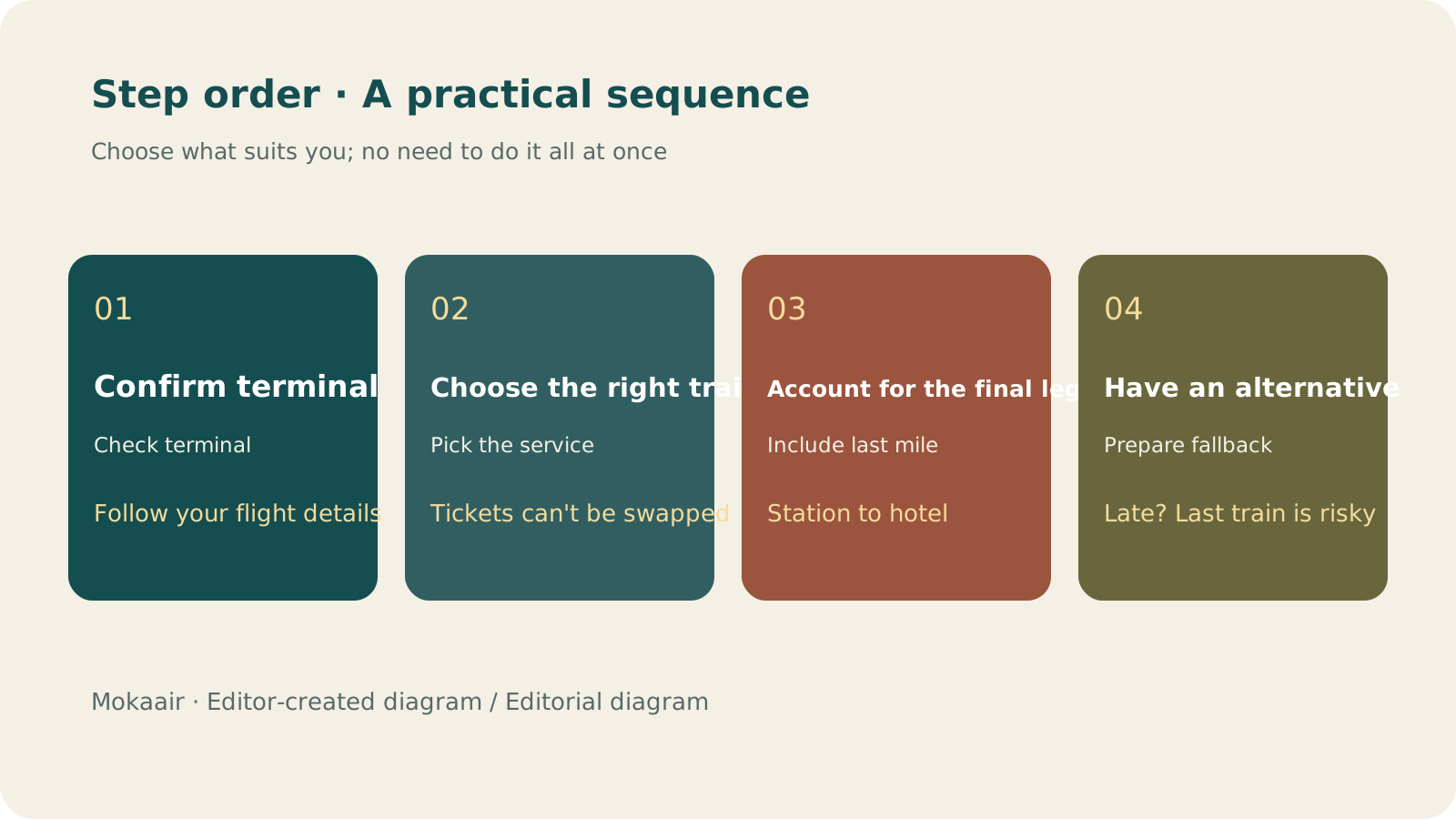
Check in order: confirm the terminal, choose the right train, account for the final leg and prepare an alternative. Compiled by the editors; not a map or measured journey times.
Ekspres and Transit sound similar, but their tickets are not interchangeable
According to the operator's official information, KLIA Ekspres takes 28 minutes from KL Sentral to Terminal One, with additional travel between Terminals One and Two. This is the train journey time only and excludes the steps before and after you reach the stations. KLIA Transit stops at intermediate stations. Its official page lists a route including Bandar Tasik Selatan, Putrajaya & Cyberjaya and Salak Tinggi, and explicitly warns that Ekspres and Transit tickets are not interchangeable.
| Option | Suitable needs | What to double-check |
|---|---|---|
| KLIA Ekspres | Direct travel between KL Sentral and the airport | Terminal, timetable and ticket validity period |
| KLIA Transit | Getting off or transferring at an intermediate station | Destination station, stops and service-specific tickets |
| Vehicle transfer | Reducing transfers that involve carrying luggage | Meeting point, capacity and traffic conditions at the time |
| Airport buses and other options | Willingness to research other combinations of timing and price | Actual route, drop-off point and service on your travel day |
Do not assume that Transit is necessarily cheaper than Ekspres for the whole journey, or buy a ticket for one service and simply follow the crowd into another entrance. Compare fares for the same journey using your actual departure station, destination station, number of passengers and purchase date, then check the product name shown on the payment page. If a promotion or package has restrictions, check whether it meets your needs. Do not add trips you did not originally need just because something is labeled a discount.
Compare the cost of the whole journey, not just the first ticket
List the airport leg's fare, the city leg's fare, any walking required for transfers and whether you will need to book a separate ride for the final leg. Groups can compare the total for everyone, while solo travelers should focus on their own total cost and convenience. Road transfer times and prices may be affected by traffic, demand and service terms at the time. Use the actual information on the booking or ride-request page, rather than treating a one-off price shared online as a fixed standard.
If you want to visit Putrajaya or another destination along the way, plan it as a separate part of your itinerary and check whether you need to exit the station, buy another ticket or store your luggage. Do not interpret “the train stops along the way” as permission to get off and resume your journey wherever you like on one ticket. The selected product's terms determine where the ticket can be used, the time limits for entering and exiting stations, and whether changes are allowed.
Arriving late or flying early? Plan a fallback first
When checking train times, use the time you can reach the platform after immigration and baggage collection, not the time your aircraft touches down. If your arrival is close to the last train, prepare another usable transport option and confirm whether your hotel allows late check-in. For the return journey, include check-in, baggage drop and security after reaching the terminal. However fast the express train is, it cannot eliminate the check-in time required by your airline.
Compare the complete journey with your hotel door as the destination
If you are staying near KL Sentral, start by checking whether you can easily walk to your hotel after arriving on the airport railway. If your accommodation is in another area, add the transfer or vehicle pickup steps. When comparing options, record the train ticket, onward transport, luggage handling and walking conditions separately. The train journey time covers only the railway leg; it cannot be treated as the time from leaving the aircraft to entering your room.
Save your departure terminal, railway destination and the hotel's full address on the same page, and have your travel companions save a copy too. Use the address to distinguish hotels with similar names or different branches, rather than relying only on the first search result. If you book a transfer, plan around the meeting point, contact details and waiting terms confirmed by the operator. When your flight changes, confirm that the operator has received the update instead of merely changing the time in your own calendar.
For an evening arrival, first check which options will still be available after you finish immigration and collect your luggage. Do not equate your scheduled landing time with the time you will reach the station or pickup point. Consult official information for railway operations and last-train conditions on your travel day. If the timing does not work, prepare ways to check other authorized transport options and save your accommodation's contact details. This fallback is intended to reduce last-minute navigation, not to guarantee that every service has vehicles available at all hours.
For the return journey, work backward from your flight time and the airline's requirements, then add the journey from your hotel to the departure point, waiting time and movement within the terminal. When buying a railway ticket, check the product name, direction and applicable date again. A ticket you used previously is not a universal template for every service. Finally, check your remaining transit card balance and organize your cash and payment methods, leaving one less issue to handle on the spot on departure day.
- Confirm whether you are using Terminal One or Terminal Two.
- Choose Ekspres or Transit based on your destination station, and check the ticket type.
- Include the route from KL Sentral to your hotel.
- Keep a workable fallback for both late arrivals and early flights.
Explore more travel preparation and transport guides
Guide
Where to Stay in Tokyo: Comparing Shinjuku, Ueno, Tokyo Station, Shibuya, Asakusa, Ikebukuro, and Ginza, Plus Airport Access, Accommodation Tax, and Luggage Delivery
Where should you stay in Tokyo? Compare Shinjuku, Ueno, Tokyo Station, Shibuya, Asakusa, Ikebukuro, and Ginza by the same criteria: access from Narita and Haneda, transit routes, nearby attractions, neighborhood character, and who each area suits. Includes a comparison table, a Yamanote Line diagram, Tokyo’s accommodation tax as verified in 2026/9 (changing to 3% in 2027/4), and Airport TA-Q-BIN luggage shipping rules.
Guide
How to Choose Tokyo Transit Passes: Are Suica, Welcome Suica, the Tokyo Subway Ticket, and the JR Pass Worth It?
On a first Tokyo trip, start with an IC card and pay per ride (Welcome Suica has no deposit and is valid for 28 days). If you take four or more subway rides in a day, add a 72-hour Tokyo Subway Ticket for 2,000 yen; a JR Pass is never worthwhile if you stay in Tokyo and do not go to Kansai. See what TOURIST PASMO, Suica on iPhone, and the Tokyo Metro day pass do and do not cover, with a decision chart. Prices verified in September 2026.
Guide
Narita and Haneda Airports to Central Tokyo: How to Choose Skyliner, N'EX, Keikyu, or the Airport Limousine Bus
From Narita to Tokyo: take Keisei Skyliner to Ueno in 36–41 minutes for ¥2,580; for Shinjuku or Tokyo Station, JR N'EX reaches Tokyo in as little as 53 minutes for ¥3,140; choose the TYO-NRT bus for ¥1,500 when budget comes first. From Haneda, Keikyu reaches Shinagawa in 11–14 minutes for ¥330. Includes fares and times for Access Express, Airport Limousine and Tokyo Monorail, plus a stay-area route guide; checked on official sites in 9/2026.
Guide
Taoyuan Airport Departure Guide: A1/A3 In-Town Check-in, Baggage, Liquids and Power Banks at Security, e-Gate Registration, and When to Leave (2026)
Departure-day guide from Taipei or New Taipei: check in online and confirm the terminal; use in-town check-in at A1 (06:00–21:30) or A3 (09:00–16:00), with a three-hour cutoff and different airlines; follow the 100 mL/one-liter liquids rule, the two-power-bank carry-on limit and lighter rules; check e-Gate rules for ROC nationals with household registration in Taiwan using an ROC passport, from age 10 and 120 cm; then calculate when to leave. Verified in September 2026 using Taiwan sources.