Guide
When Trains Stop Running in Japan: Official Updates, Keeping Tickets, and Backup Priorities
A route appearing in your navigation app does not mean trains are running. During delays or suspensions, first identify the operator and affected sections, then decide whether to wait, reroute, or cancel the day's long-distance outing.
About 7 min read
When a train is delayed during your trip, the easiest response is to keep refreshing your navigation app. But the app's suggestions, station announcements, and the railway company's service notices may update at different times. This article gives ordinary travelers a sequence to follow during disruptions. It is not a live disaster report and does not promise that other routes will be viable alternatives. Follow the day's safety instructions and staff directions first.
First identify the operator and affected section
A single station may serve JR, private railways, and subway lines. Check your ticket, platform signs, or line name to identify the operator you will actually use. JR East has its own official service information page, with categories such as Kanto, Tohoku, Shinetsu, and Shinkansen; it is not an overview of every railway in Japan. Through services running across different operators' networks may also be affected, so do not assume your entire journey is unaffected just because there is no notice for the line serving your destination.
Break each notice into four parts: affected section, direction, cause, and current status. Delays, service suspensions, trains turning back on parts of a route, and announced upcoming suspensions have different implications for your plans. The official page also warns that its information may differ from actual operations and that it does not refresh automatically. Refresh it manually when checking, then cross-check the station displays. The absence of a warning you expected does not guarantee the next train will be on time.
Backup plans are especially important for regional conventional rail services. Outlying routes served by a single line, such as the JR Senzan Line from Sendai to Yamadera, have no parallel alternative during a suspension, leaving you to wait or change your plans. For an example, see A Day Trip from Sendai to Yamadera (Risshakuji): Taking the Senzan Line and How Long It Takes to Climb 1,015 Stone Steps.
Read the full description
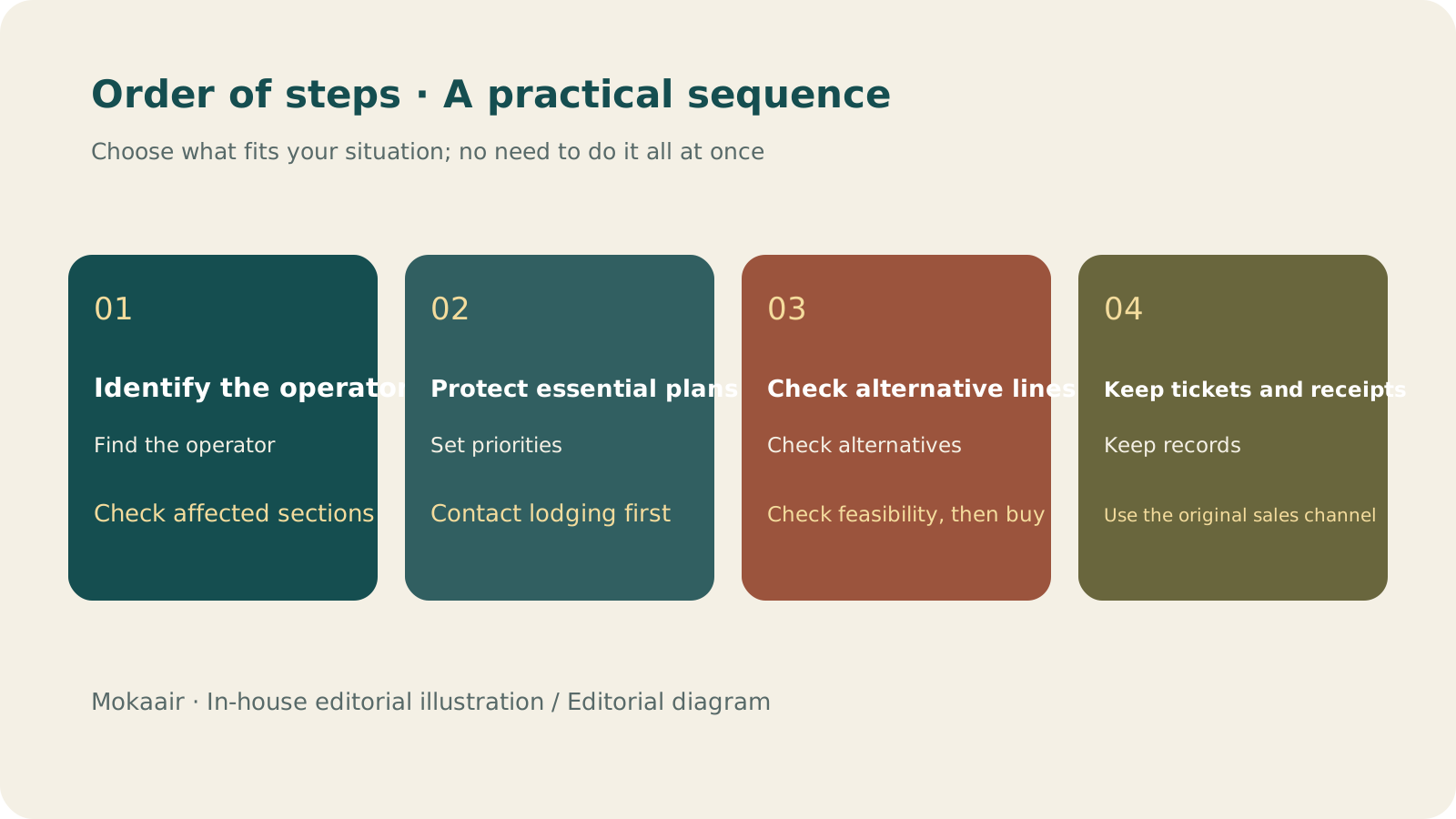
Check in order: identify the operator, protect essential plans, check alternative lines, and keep original tickets and receipts. Compiled by the editors; not a map or measured travel times.
Protect essential plans before dealing with sightseeing
Divide today's plans into what must be done, what can be rescheduled, and what can be skipped. Deal first with your return flight, confirmed accommodation, and any restaurants you need to contact; another shopping district or outlying attraction is usually easier to drop. Do not add transfer after transfer just to keep every attraction, increasing the burden of luggage, physical effort, and the risk of missing the last service. If you decide to wait nearby, choose somewhere you can receive announcements, rest, and stay clear of evacuation routes.
| Situation | A more sensible first step | Do not assume |
|---|---|---|
| Brief delays, but trains are still running | Check departures at the station and the expected impact | You will definitely make your connection at the next station |
| Service suspended on part of the route | Check which turnback stations you can reach and the alternative lines | All parallel routes are operating normally |
| Widespread suspension announced in advance | Cut back your travel early and contact your accommodation | The last service will run to the original timetable |
| No clear time for service to resume | Rearrange essential plans | Service will definitely resume after a short wait |
If transport disruption affects accommodation you have booked, first contact the hotel to explain the situation and your intended arrangements, and keep both sides' replies. You can replace a planned day trip to an outlying area with activities within walking distance of your accommodation, but do not assume that walking in bad weather is automatically a safe backup. Decide whether to go out or whether further travel is necessary based on official alerts, local conditions, and your own circumstances. Sometimes the safe backup is to stay at your accommodation and rest.
Check the costs of an alternative route before buying new tickets
After finding another route, confirm that it is actually operating today, where its entrance is, whether you need a separate ticket, and how you will reach your destination on the final leg. If you have large luggage or a companion who has difficulty using stairs, a workable transfer requires more than two lines intersecting on a map. First ask the railway company whether its alternative transport arrangements apply to your ticket type, mobile ticket, or transit card. Other travelers' experiences are no substitute for the rules.
Taxis and buses may also be affected by road conditions, queues, and weather, so check current costs and travel times. If the new plan only just gets you there in time and leaves no room for unexpected problems, consider canceling nonessential activities. For long-distance alternatives across prefectures, take particular care to check last departures and whether you can check into your accommodation. Do not buy a string of riskier new tickets just to salvage an original sightseeing ticket.
Keep original tickets and records; request refunds through the original purchase channel
Keep your original tickets, reservation numbers, payment records, and service notices until ticket arrangements are resolved. Eligibility for refunds, rescheduling, fee waivers, or travel on other services depends on the applicable rules of the carrier and purchase channel. Travel platforms, official railway websites, and station ticket counters may handle requests differently. Do not discard a paper ticket and then expect a screenshot to qualify for the same procedure. A delay certificate and refund eligibility are also separate matters.
Break changes into three parts: now, the next leg, and tonight
When service is suspended, start by dividing a note on your phone into three columns. Under "now," record your current station, the correct line, train status, and the time you checked. Under "next leg," record the service you originally planned to connect to and whether you have already bought a ticket. Under "tonight," record your accommodation and anything you must arrive in time for. This lets you tell station staff directly where you need to go and what tickets you hold, instead of showing them a map of your entire trip and expecting them to guess your priorities.
Suppose you originally planned to visit an attraction before going to your hotel. If the time for service to resume remains uncertain, first consider skipping the attraction and going straight to your accommodation. This reduces the connections your plans depend on; it does not mean the alternative route will necessarily be faster. When checking a new route, verify the operating status of each operator along the way. One railway resuming service does not mean all connecting services and onward transfers are also back to normal.
If you are comparing a bus, another railway, or staying overnight, first ask how your original ticket should be handled, then check actual availability for the alternatives. Do not immediately buy an unchangeable ticket for the next leg merely because a map shows that a route exists. Confirm fares, alternative transport arrangements, and refund eligibility against the notices for that disruption and your ticket type. Keep the original order, change notifications, and new arrangements so you can submit any later requests through the official process.
If your travel companions are separated, agree on a fixed meeting point and a way to share updates. Avoid having everyone follow different social media reports at the same time. Share confirmed facts first, such as where you currently are and which section you cannot travel on; clearly mark any unconfirmed resumption time as needing verification. Once a new plan lets everyone arrive safely and complete the essentials, there is no need to keep adding transfers just to recover the original itinerary.
- Read the operator's notices and cross-check information at the station.
- First contact the providers for your flight, accommodation, or other essential plans.
- Check whether alternative lines are actually operating and whether transfers are feasible.
- Keep original tickets and receipts, and handle requests through the original purchase channel.
When rearranging travel within Tokyo, first distinguish what each ticket coversHow to Choose Tokyo Transit Passes: Are Suica, Welcome Suica, the Tokyo Subway Ticket, and the JR Pass Worth It?On a first Tokyo trip, start with an IC card and pay per ride (Welcome Suica has no deposit and is valid for 28 days). If you take four or more subway rides in a day, add a 72-hour Tokyo Subway Ticket for 2,000 yen; a JR Pass is never worthwhile if you stay in Tokyo and do not go to Kansai. See what TOURIST PASMO, Suica on iPhone, and the Tokyo Metro day pass do and do not cover, with a decision chart. Prices verified in September 2026.Read the full article
Guide
How to Choose Tokyo Transit Passes: Are Suica, Welcome Suica, the Tokyo Subway Ticket, and the JR Pass Worth It?
On a first Tokyo trip, start with an IC card and pay per ride (Welcome Suica has no deposit and is valid for 28 days). If you take four or more subway rides in a day, add a 72-hour Tokyo Subway Ticket for 2,000 yen; a JR Pass is never worthwhile if you stay in Tokyo and do not go to Kansai. See what TOURIST PASMO, Suica on iPhone, and the Tokyo Metro day pass do and do not cover, with a decision chart. Prices verified in September 2026.
Guide
Narita and Haneda Airports to Central Tokyo: How to Choose Skyliner, N'EX, Keikyu, or the Airport Limousine Bus
From Narita to Tokyo: take Keisei Skyliner to Ueno in 36–41 minutes for ¥2,580; for Shinjuku or Tokyo Station, JR N'EX reaches Tokyo in as little as 53 minutes for ¥3,140; choose the TYO-NRT bus for ¥1,500 when budget comes first. From Haneda, Keikyu reaches Shinagawa in 11–14 minutes for ¥330. Includes fares and times for Access Express, Airport Limousine and Tokyo Monorail, plus a stay-area route guide; checked on official sites in 9/2026.
Guide
Taoyuan Airport Departure Guide: A1/A3 In-Town Check-in, Baggage, Liquids and Power Banks at Security, e-Gate Registration, and When to Leave (2026)
Departure-day guide from Taipei or New Taipei: check in online and confirm the terminal; use in-town check-in at A1 (06:00–21:30) or A3 (09:00–16:00), with a three-hour cutoff and different airlines; follow the 100 mL/one-liter liquids rule, the two-power-bank carry-on limit and lighter rules; check e-Gate rules for ROC nationals with household registration in Taiwan using an ROC passport, from age 10 and 120 cm; then calculate when to leave. Verified in September 2026 using Taiwan sources.
Guide
Maps and taxi apps in Korea: Naver Map and Kakao Map routes, k.ride versus Kakao T, payments, Seoul fares and late-night surcharges
Which apps should you install for Korea, and can you book a taxi without a Korean phone number? Learn route searches in Naver Map and Kakao Map; registration, interface languages and payments for k.ride, Kakao T, TADA and TABA; and Seoul’s KRW 4,800 starting fare and late-night surcharges. Checked in September 2026 against the App Store, Kakao Mobility, Korea Tourism Organization, Seoul government and Incheon Airport websites.