Intel
Japan Entry for Taiwan Travelers in 2026: Completing Visit Japan Web, Digital Arrival Cards, Customs Rules and JESTA Progress
Taiwan passport holders get 90 days visa-free in Japan, with no electronic authorization required. Free Visit Japan Web provides one QR code for immigration and customs. JESTA targets fiscal 2028. Covers VJW's five steps, paper arrival cards, fingerprints/facial photos, duty-free limits, meat bans, a document checklist and four-step chart. Verified in 2026/9 against Japan's Digital Agency, Immigration Services Agency, Foreign Ministry, Customs and Animal Quarantine Service websites.
About 7 min read

We may earn a commission through these links, at no extra cost to you.
Contents
- 1. Before departure: 90 days visa-free and Visit Japan Web's five steps
- 2. Arrival and immigration: one QR code, fingerprints and a facial photo
- 3. Customs: everyone must declare, duty-free allowances and prohibited items
- 4. JESTA electronic travel authorization: not yet implemented; Justice Ministry targets fiscal 2028
Taiwan passport holders do not need a visa to visit Japan, but entry procedures in 2026 differ from those two or three years ago: Visit Japan Web now combines immigration and customs declarations into one QR code, some airports have shared kiosks for both procedures, paper arrival cards remain available but fewer people fill them out, and the JESTA electronic travel authorization system now has a timetable. Verified in 2026/9 against the official websites of the Digital Agency, Immigration Services Agency, Foreign Ministry, Customs and Animal Quarantine Service, this article organizes the process into four steps: before departure, arrival, immigration and customs.
Before departure: 90 days visa-free and Visit Japan Web's five steps
The Foreign Ministry's visa-exemption list allows Taiwan passport holders whose passports bear a national ID number to stay visa-free for 90 days. Visit Japan Web (VJW) is the Digital Agency's official service and is completely free. In 2025/6, the Digital Agency announced that any website charging to generate immigration or customs QR codes is unofficial. The service for entering information on someone else's behalf ended in 2025/6; follow the official instructions for registering accompanying travelers. The process: STEP 0, create an account using an email address; STEP 1, scan or manually enter your passport details (a warning appears if less than 6 months of validity remain) and enter your basic information; STEP 2, register your planned entry for this trip, including your flight, date and contact address in Japan; STEP 3, answer the quarantine health questions, then complete “Immigration and Customs Declaration”; STEP 4, display your QR code on arrival. You can register on a computer, but at entry you must display the QR code on your own phone or tablet.
| What to prepare | Who needs it | Notes |
|---|---|---|
| Passport | Everyone | Taiwan passport bearing a national ID number: 90 days visa-free. VJW warns if less than 6 months of validity remain; check before departure. |
| Visit Japan Web QR code | Recommended for everyone | Free; one QR code covers immigration and customs declarations. Display it on your phone on arrival. |
| Paper arrival card and customs declaration form | Travelers not using VJW | Get them on the plane or at the airport. One customs form per person; family members living together may share one. |
| Return flight ticket and accommodation address in Japan | Everyone | Both VJW and the paper arrival card require a contact address in Japan. |
| Cash or other means of payment exceeding the equivalent of 100 ten-thousand yen | Anyone carrying them | Complete a declaration for carrying means of payment into or out of Japan. Gold bullion weighing over 1 kilogram, with purity of at least ninety percent, must also be declared. |
| Meat products and fresh fruit | Do not bring them | They cannot enter without an inspection certificate issued by the exporting country's government; see the customs section. |
Arrival and immigration: one QR code, fingerprints and a facial photo
The Immigration Services Agency requires all foreign nationals newly entering Japan to submit a “Disembarkation Card for Foreign Nationals” (ED card). If you use VJW, this is your QR code; officials also recommend VJW for smoother screening. Travelers who have not registered can obtain and complete a paper card on the plane or before immigration; a Chinese version is available. Since 2024/1/25, immigration and customs declarations have shared one QR code; the old separate QR codes no longer work. Some airports and terminals have shared KIOSKs that read your passport chip, scan your QR code and take a photo, collecting the information for both immigration and customs declarations in one go. At the counter, hand over your passport, show your QR code or paper arrival card, and provide fingerprints and a facial photo as required by immigration law, unless legally exempt. Refusing to provide them will result in referral for a special inquiry. After screening, a landing permission sticker is placed in your passport. To use VJW's tax-free shopping QR code, scan this sticker to generate it and show it at participating stores.
Read the full description
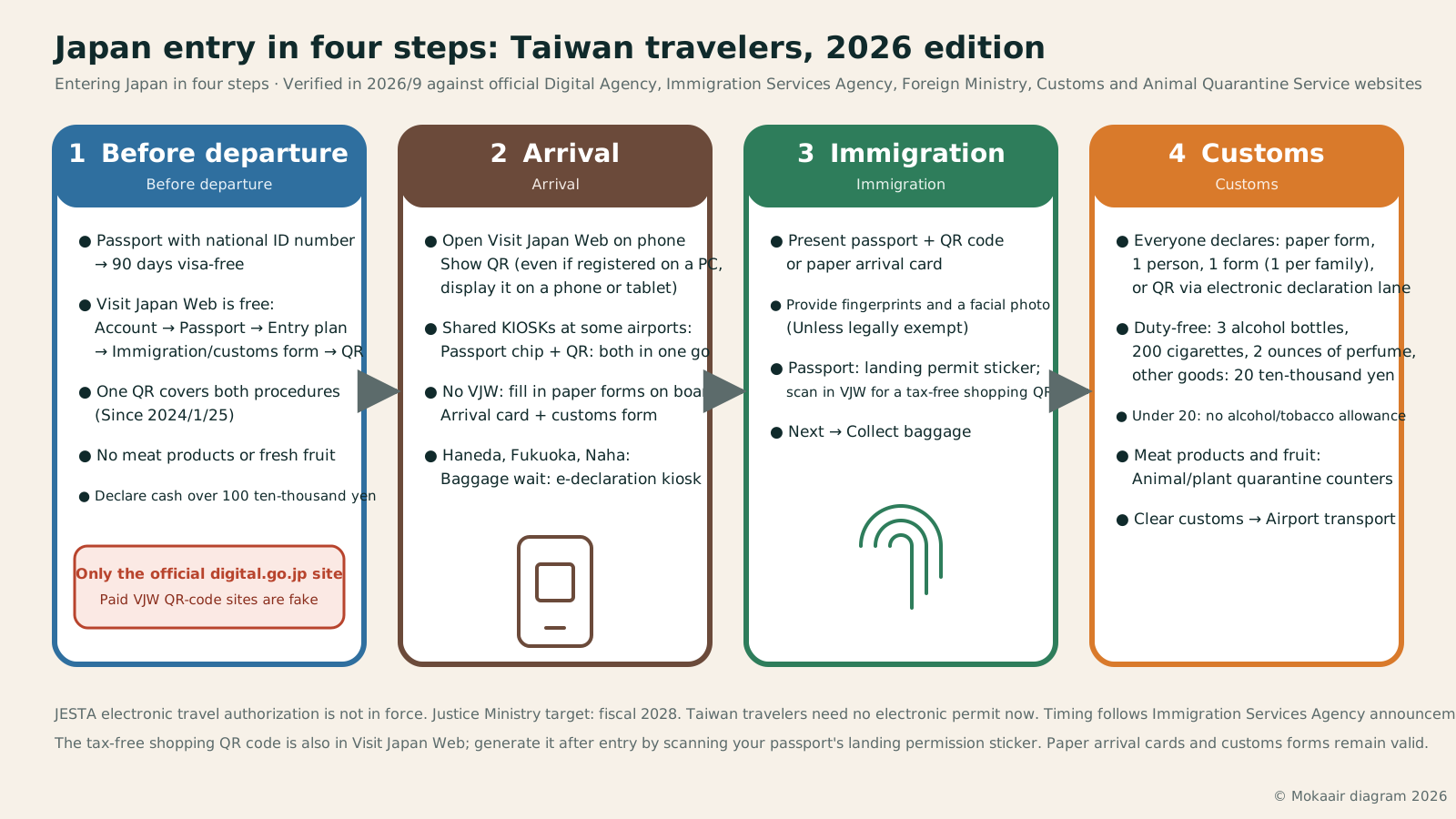
Four steps. Pre-departure: Taiwan passport with national ID number: 90 days visa-free. Visit Japan Web is free; five steps: account, passport, planned entry, immigration/customs declaration, QR code. One QR covers both from 2024/1/25. No meat products or fresh fruit. Declare cash over 100 ten-thousand yen. Use only the official digital.go.jp site. Arrival: show QR on phone. Shared KIOSKs at some airports read passport chip + QR in one go. Without VJW, fill in paper arrival and customs forms. At Haneda, Fukuoka and Naha, use electronic declaration terminals while waiting for bags. Immigration: present passport + QR or paper arrival card; provide fingerprints and a facial photo unless legally exempt. Passport gets a landing permission sticker; scan it only to use VJW's tax-free shopping QR. Customs: all must declare; one paper form per person or family, or QR via electronic declaration lanes. Duty-free: 3 alcohol bottles, 200 cigarettes, 2 ounces of perfume, other goods up to 20 ten-thousand yen; no alcohol/tobacco allowance under 20. Take meat products/fruit to animal/plant quarantine counters. Notes: JESTA is not yet in force; target: fiscal 2028. Tax-free shopping QR is also in Visit Japan Web.
Your first trip after customs: book Narita or Haneda train tickets and airport transfers to the city in advance
Customs: everyone must declare, duty-free allowances and prohibited items
Japan Customs requires everyone entering the country to make a declaration: submit one paper “Declaration of Personal Effects and Unaccompanied Articles” per person, with family members living together allowed to share one, or use your VJW QR code at an electronic declaration terminal and then proceed through the electronic declaration lane. At Haneda, Fukuoka and Naha airports, you can complete this at an electronic declaration terminal while waiting for your baggage. Duty-free allowances: 3 bottles of alcohol (760 ml each); tobacco limits depend on the types carried: 200 cigarettes if carrying only cigarettes, an amount equivalent to 200 cigarettes if carrying only heated tobacco, or 50 cigars if carrying only cigars. Other tobacco or mixed types are limited to an amount equivalent to 250 grams. The allowances also include 2 ounces of perfume and other goods with a total overseas market value of up to 20 ten-thousand yen; items whose total overseas market value per category is no more than 1 ten-thousand yen are excluded from this total. Travelers under 20 have no alcohol or tobacco allowance. Cash, checks and other means of payment exceeding the equivalent of 100 ten-thousand yen must be declared. When clearly for personal use and compliant with the rules, the following quantities are exempt from an import confirmation certificate: up to a 1-month supply, based on dosage instructions, of poisonous drugs, potent drugs and prescription drugs; up to 24 standard-size units per item of general topical medicines (excluding poisonous drugs, potent drugs, prescription drugs, buccal tablets, lozenges and suppositories) and cosmetics; and up to a 2-month supply, based on dosage instructions, of medicines other than those listed above and quasi-drugs. Quantities exceeding these exemptions require advance import confirmation and other necessary procedures, as well as compliance with other restrictions. Narcotics, cannabis, handguns, rifles, machine guns, artillery and their ammunition, handgun parts, explosives, counterfeit branded goods and obscene materials are prohibited imports. Other firearms and swords that may legally be imported require possession permits, registration documents or other proof appropriate to their type, along with import approval.
Japan's new 2026 tax-free system: pay tax first, get a refund at departure—how to claim itFrom 2026/11, Japan's tax-free shopping switches to “pay tax first, refund on departure”: what to know before buying drugstore goods or electronicsFrom 2026/11/1, Japan's tax-free shops will no longer deduct tax at checkout. Pay the tax-inclusive price, then receive a refund after customs confirmation at a self-service kiosk before checking your departure baggage. The consumables cap of 50 × ten thousand yen and sealed packaging are abolished; the 5,000 yen threshold stays. This guide covers the changes, airport refunds, and shopping on trips spanning 11/1.Read the full article
JESTA electronic travel authorization: not yet implemented; Justice Ministry targets fiscal 2028
The Ministry of Justice's “Zero Illegal Overstayers Plan” brings forward Japan's version of ESTA—the electronic travel authorization system JESTA—from its original 2030 schedule to introduction within fiscal 2028. Travelers from visa-exempt countries and regions will submit information online for screening before departure. As of 2026/9, it has not been implemented, and Taiwan travelers currently do not need to apply for any electronic authorization. Websites asking you to pay for a “Japan entry permit” are scams. The official launch date, fees and application procedures will be determined by Immigration Services Agency announcements; this article will be updated as the rollout progresses.
Tokyo city page: transport, accommodation and attractions after arrival
Osaka and Kyoto city page: transport and itineraries for arriving in and departing from Kansai
Found this guide helpful? Share it with someone who needs it
Intel
2026 Hong Kong Entry for Taiwan Travelers: Free Online Registration; 2 Entries in 2 Months, 30 Days Each; No E-cigarettes; Tobacco/Alcohol Allowances; Declare Cash over HK$12 × ten thousand
Taiwan passport holders need no Hong Kong visa: use free GovHK pre-arrival registration for Taiwan residents or a Mainland Travel Permit for Taiwan Residents. From Hong Kong Immigration, Customs, Tobacco and Alcohol Control Office and Taiwan MOFA's Bureau of Consular Affairs: three routes' eligibility, landing slips, 18+ tobacco/alcohol allowances, e-cigarette/heated tobacco import and public possession bans, and airport red-channel cash declarations over HK$12 × ten thousand. Checked 2026/9.
Intel
2026 Singapore Entry for Taiwan Travelers: Free SG Arrival Card Within 3 Days Before Arrival, No Cigarette Allowance, Vape Fines Up to SGD 10,000
Taiwan passport holders get 30 visa-free tourist days in Singapore. Submit the free SG Arrival Card within 3 days before arrival (arrival day included). Based on ICA, Singapore Customs, gov.sg, HSA and Taiwan's Bureau of Consular Affairs: SGAC timing and paid agents, Changi automated lanes, five liquor allowances, GST relief, no cigarette allowance, cash over SGD 20,000, and vaping law effective 2026/5/1. Verified 2026/9.
Intel
Entering Taiwan in 2026: the online arrival card (TWAC), visa-free stays, e-Gate and the customs rules with real fines
Checked in September 2026 against the National Immigration Agency, BOCA, Taipei Customs and the animal quarantine agency: who files the free Taiwan Arrival Card and when, which passports get 90, 30 or 14 visa-free days, who may use e-Gate, the cash you must declare, duty-free limits, and the NT$200,000 meat fine that gets visitors turned back at the border.
Sources
- Foreign Ministry: Exemption of Visa (Short-Term Stay) (Taiwan: 90 days, passport bearing a national ID number)Checked:
- Digital Agency: Visit Japan Web Traditional Chinese page (services and notices)Checked:
- Digital Agency: How to use Visit Japan Web (STEP 0 to 4, electronic declaration terminals, Haneda/Fukuoka/Naha)Checked:
- Digital Agency notice: Immigration and customs declaration QR codes unified (2024/1/25)Checked:
- Digital Agency notice: Using Visit Japan Web (free service, fake websites) (2025/6/5)Checked:
- Immigration Services Agency: Submit a “Disembarkation Card for Foreign Nationals” at immigration (ED card, VJW, shared KIOSKs)Checked:
- Immigration Services Agency: Landing procedures for foreign nationals (personal identification information: fingerprints and facial photos)Checked:
- Customs: Duty-free allowances for overseas travelersChecked:
- Customs: Submitting the “Declaration of Personal Effects and Unaccompanied Articles” on entry or return (everyone must declare, VJW electronic declaration, paper forms)Checked:
- Customs: Carrying means of payment into or out of Japan (over 100 ten-thousand yen, gold bullion over 1 kg)Checked:
- Customs: Banned/restricted imports/exports (personal-use import certificate exemptions: prescriptions etc. 1 month; other drugs 2 months; general topical drugs/cosmetics ≤24 standard-size units/item)Checked:
- Animal Quarantine Service: Bringing meat products into Japan (Traditional Chinese: inspection certificates and penalties)Checked:
- Plant Protection Station: Travelers and accompanied baggage (inspection certificates, plant quarantine counters)Checked:
- Ministry of Justice: Zero Illegal Overstayers Plan for Public Safety and Security (aims to introduce JESTA during fiscal 2028)Checked:
Compiled from the references and verification dates listed above; fares, schedules, product features, and terms can change, so please confirm the latest details on the relevant official website before travelling, booking, or purchasing.